
The short story I keep returning to
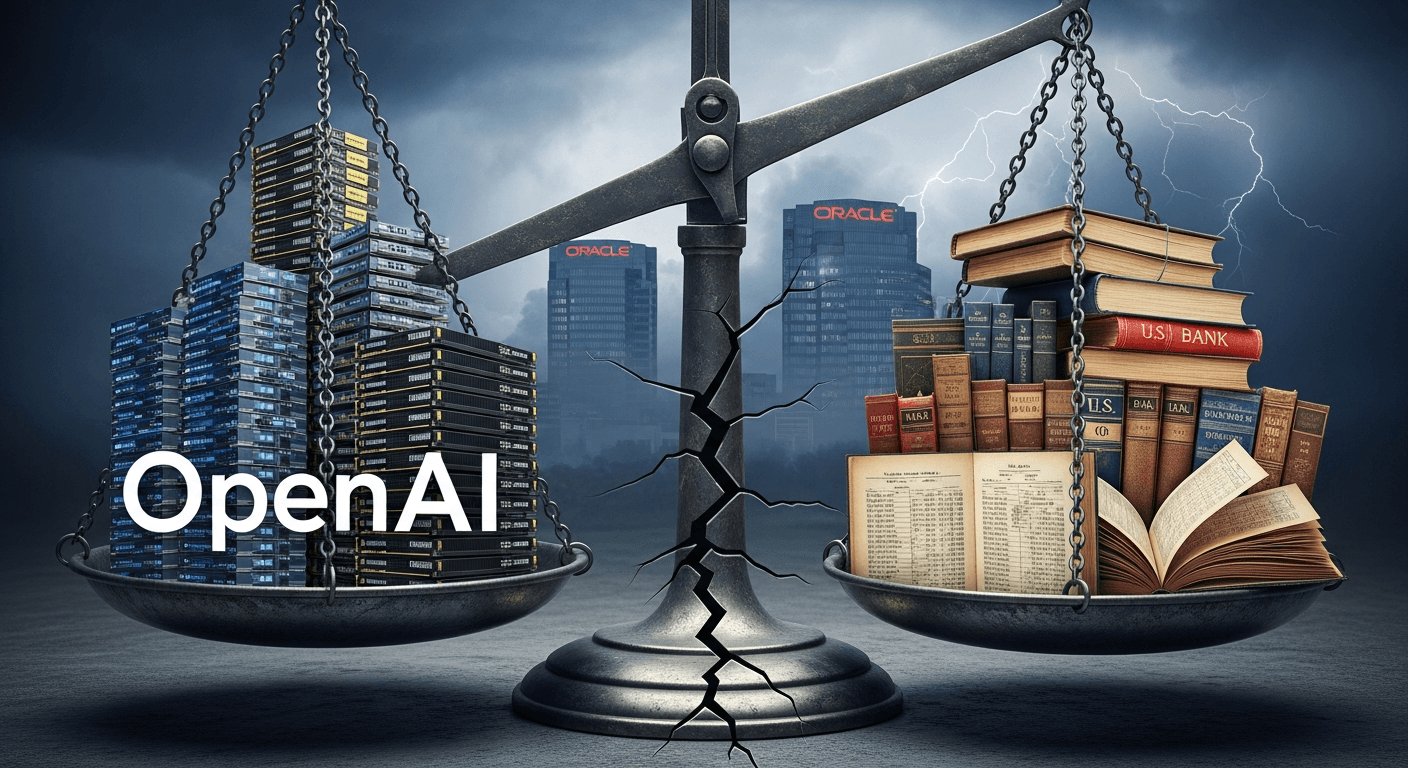
I have been watching the ripple effects of the AI gold rush for years — from chatbots on recruitment desks to backend infrastructure that makes the latest models hum. What changed for me this spring was not a single line of code but a string of deals and balance sheets that put an old lesson back in bold type: promises without matching capital can break more than one company.
Over the past months the press has reported that Oracle’s commitments to support Sam Altman sama@openai.com and OpenAI — described in some analyses as a multi‑hundred‑billion dollar infrastructure push — have forced the company to raise enormous amounts of debt, slow down or reshuffle leases, and consider layoffs in the 20,000+ range to free cash for data centres and GPUs Times of India and Economic Times.
I want to explain why that single strategic move by Larry Ellison larry.ellison@oracle.com and Oracle became — unintentionally — a stress point for banks across the United States.
What happened (in plain terms)
- Oracle promised large-scale cloud and data‑centre capacity to Sam Altman sama@openai.com's OpenAI as part of an ambitious partnership. That promise implies massive capex and recurring operational costs.
- To meet those commitments Oracle took on tens of billions in new debt in short order, and began negotiating data‑centre leases and project financings.
- Many US banks, wary of concentration risk and single‑counterparty exposure limits, struggled to underwrite or hold large tranches of loans tied to Oracle‑backed projects. Lenders tried to syndicate but found limits in place; some deals stalled or were reallocated Times of India.
- Facing financing strain and rising borrowing costs, reports suggest Oracle is looking internally to free cash (hence the layoffs estimates of 20k–30k) and to raise equity and bonds.
The chain is straightforward: big promise → big capex need → big borrowing → constrained bank balance sheets.
Why banks get hurt by a tech promise
This is not about morals; it is about mechanics.
- Concentration risk: Many banks set internal limits on exposure to a single borrower or related projects. When a titan like Oracle suddenly needs huge project loans tied to new data centres, the natural place to look for funding is the syndicated loan market — but that market has rules and limits. If too much of the exposure maps back to one strategic counterparty, banks reduce appetite.
- Collateral and tenant risk: Lenders underwriting data‑centre financings want predictable cash flows from tenants. If projects are effectively pre‑committed to a single tenant with immense but uncertain demand (an emerging AI player shifting capacity needs), the underwriting becomes more conservative.
- Rate and repricing stress: As perceived risk rose, interest‑rate premiums and spreads on project deals climbed. Costlier financing makes projects harder to pencil and deters private operators and banks from participating.
- Reputation and regulatory caution: Large loans to a single big tech client attract extra board and regulator attention. Banks worried about capital ratios and concentration steer clear or demand onerous covenants.
Put simply: a strategic commitment that looks fine for a tech company can push multiple banks against their exposure policies and capital constraints.
The human cost (why layoffs matter here)
When an infrastructure bet consumes capital that a company could have used for salaries or incremental R&D, the company faces hard choices. Reports say Oracle sees layoffs as a way to free $8–10B in cash to meet near‑term needs. That is a real‑world consequence of a capital mismatch — and it shows how corporate strategy reverberates beyond boardrooms into thousands of lives.
I have written about automation, chatbots and the human effects of technology repeatedly (Parekh’s Law of Chatbots) — this moment is different not because the machines win but because finance and promises direct the human toll.
What this means for corporates, banks and regulators
For corporates:
- Match long‑term promises with credible long‑term funding plans. If you bind your future to another firm’s growth, ensure your balance sheet can flex without resorting to mass layoffs.
For banks:
- Re‑examine syndication tools and risk transfer vehicles for capital‑intensive AI infrastructure. Securitisation, project bonds, or partial credit guarantees may help spread risk beyond one set of lenders.
- Tighten structural protections in deals (step‑in rights, tenant diversification clauses) so that single‑tenant concentration is mitigated.
For regulators and policymakers:
- Monitor systemic exposures that arise from the concentrated financing of emergent industrial clusters (AI data centres are one). When multiple banks face correlated exposures, the macroprudential picture changes.
Where the story could go from here
I see three broad scenarios:
- Oracle raises sufficient capital and diversifies tenant exposures; banks step back in as risk is redistributed — a soft landing.
- Banks continue to retrench, forcing Oracle to slow projects and recalibrate promises to Sam Altman sama@openai.com; the AI infrastructure pace stalls regionally.
- The financing stress cascades into asset sales, further restructuring, or government‑backed facilitation for critical infrastructure. Each path has different social and economic trade‑offs.
A personal note — pattern recognition
I have long believed that technology transitions are as much financial stories as they are technological ones. My past notes on how chatbots and automation reshape work and capital planning anticipated that the winners will not be decided purely by engineering superiority but by how bets are financed and who bears the risk (Parekh’s Law of Chatbots).
Watching Larry Ellison larry.ellison@oracle.com make an all‑in play for AI infrastructure — and seeing banks push back — is a real‑time case study in that thesis.
What I’d tell a bank CIO tomorrow
- Stress‑test exposures not just to borrowers but to entire ecosystems (tech + tenant commitments + downstream demand shifts).
- Build flexible exit paths into large project financings: tranche sales, insurance wraps, or contingent equity commitments.
- Partner with alternative capital providers (sovereign wealth, infrastructure funds) who can take longer horizons than commercial banks.
If we buy the idea that AI is infrastructure as important as power or telecom, we should treat its financing with similar tools — and similar caution.
Connect with the people I named above (first mention details):
- Sam Altman sama@openai.com
- Larry Ellison larry.ellison@oracle.com
- Hemen Parekh hcp@recruitguru.com
Regards,
Hemen Parekh
Any questions / doubts / clarifications regarding this blog? Just ask (by typing or talking) my Virtual Avatar on the website embedded below. Then "Share" that to your friend on WhatsApp.
Get correct answer to any question asked by Shri Amitabh Bachchan on Kaun Banega Crorepati, faster than any contestant
Hello Candidates :
- For UPSC – IAS – IPS – IFS etc., exams, you must prepare to answer, essay type questions which test your General Knowledge / Sensitivity of current events
- If you have read this blog carefully , you should be able to answer the following question:
- Need help ? No problem . Following are two AI AGENTS where we have PRE-LOADED this question in their respective Question Boxes . All that you have to do is just click SUBMIT
- www.HemenParekh.ai { a SLM , powered by my own Digital Content of more than 50,000 + documents, written by me over past 60 years of my professional career }
- www.IndiaAGI.ai { a consortium of 3 LLMs which debate and deliver a CONSENSUS answer – and each gives its own answer as well ! }
- It is up to you to decide which answer is more comprehensive / nuanced ( For sheer amazement, click both SUBMIT buttons quickly, one after another ) Then share any answer with yourself / your friends ( using WhatsApp / Email ). Nothing stops you from submitting ( just copy / paste from your resource ), all those questions from last year’s UPSC exam paper as well !
- May be there are other online resources which too provide you answers to UPSC “ General Knowledge “ questions but only I provide you in 26 languages !



No comments:
Post a Comment