
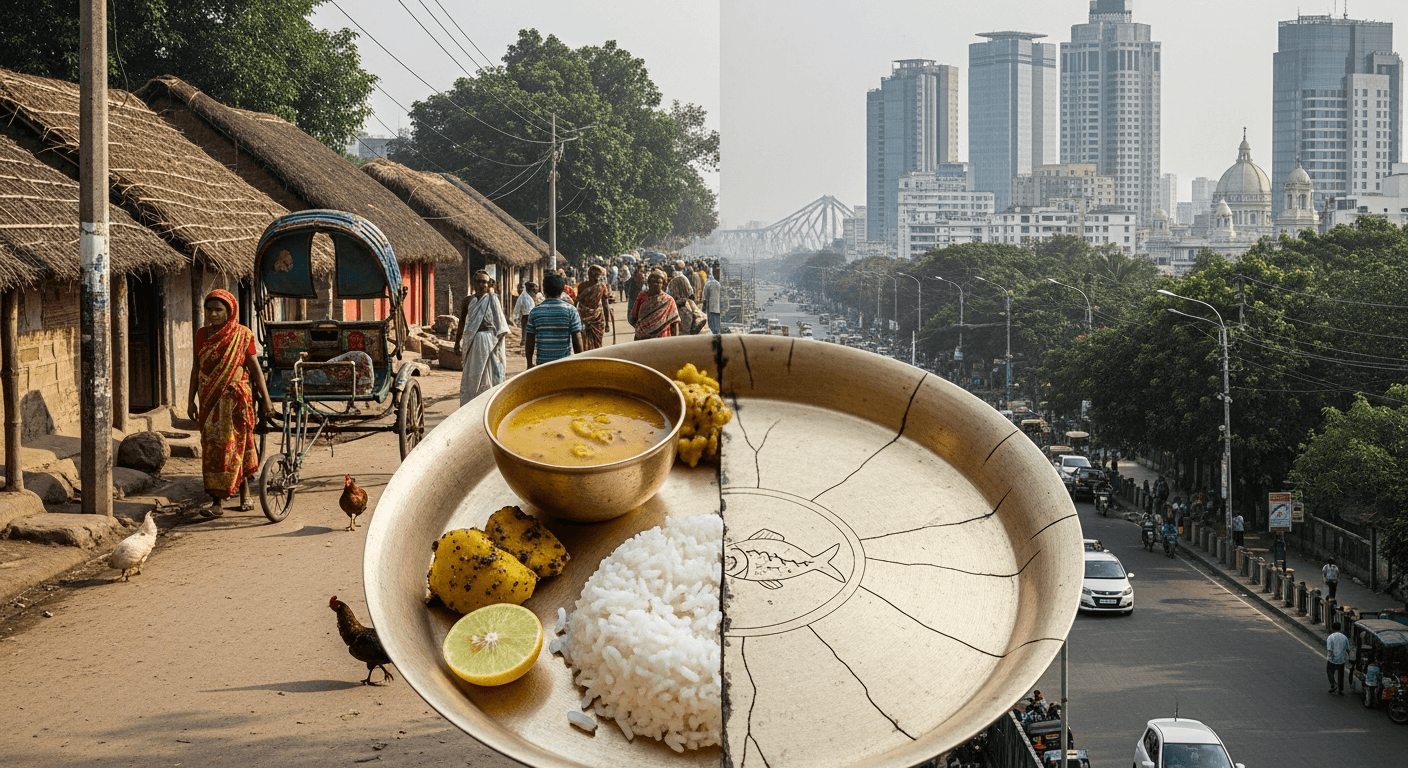
Subtitle: Why a cultural symbol and welfare politics didn't guarantee victory in West Bengal
Introduction
I’ve long watched Indian politics as a blend of ritual, policy and story-telling. In West Bengal, one of the most vivid stories is around a party whose electoral symbol — the fish — is more than an emblem: it is a piece of cultural identity. Yet in the most recent verdict, that intimate appeal did not translate into unassailable success for the incumbent. In this post I want to unpack why a campaign that put the fish on every plate (metaphorically) still tasted defeat at certain tables.
Background and context
The recent decades in West Bengal have been a study in political reinvention. A party built around regional identity, welfare outreach and a charismatic leader displaced the Left’s cadre politics and then consolidated power across urban and rural spaces. The fish symbol carries deep cultural resonance in Bengali life — it appears in festivals, food, and local idioms — so using it as a political brand made intuitive sense.
But symbols only work when they connect with voters’ lived realities. Over successive elections the contest in the state has shifted from a multi‑party field (Left + Congress + regional outfits) to a largely bipolar fight between the incumbent regional party and a national challenger that has been on the rise. Vote‑share trends across recent polls show:
- The regional party retained a strong vote share in the high‑40s in the last assembly election (approx. 46–48%). Wikipedia overview of 2021 results
- The national challenger surged from low single digits a decade ago to roughly the high‑30s/low‑40s in recent national polls — a dramatic shift that remade the arithmetic of many constituencies analysis of vote‑share trends.
(These are approximations drawn from publicly available election analyses; precise constituency figures should be checked against official returns.)
Campaign strategies: two contrasting plays
My reading of the campaigns is that both sides understood the stakes and played to different strengths.
- The incumbent relied on welfare legacies, constituency networks, and a strong local identity narrative — the fish as a symbol of belonging, nourishment and local pride. The style was: “I know your language, your plate, your festivals.”
- The challenger put organisational muscle, national narrative framing, targeted social engineering and a promise of development and law‑and‑order at the forefront. It aimed to convert demography into votes by realigning former Left and undecided voters.
Both approaches have worked in different cycles. But strategy is only one part of the equation — electoral dynamics and issues matter too.
Electoral dynamics: who swung and why
West Bengal’s electorate is complex: urban/rural divides, a significant Muslim minority (roughly a quarter to a third of the population by common estimates), a large number of Scheduled Caste/Tribe voters, and regionally specific identities (North Bengal vs. the delta and Kolkata). Key dynamics included:
- Rural vs urban: Welfare schemes and local networks tend to be strongest in rural areas. Urban voters, especially in Kolkata, respond more to governance and civic issues.
- Religion and caste: Polarisation on religious lines helped national challengers in some districts; while consolidation of minority votes helped the regional party in others.
- Swing voters: Former Left or Congress supporters — especially among SC/ST voters — were an important pool that both sides tried to mobilise.
What hurt the incumbent: key issues
Several grounded issues likely eroded the incumbent’s advantage:
- Anti‑incumbency fatigue: After a decade or more in office, perceptions of stagnation and familiarity can turn into resentment.
- Governance and law‑and‑order narratives: High‑profile incidents, whether linked to crime, protests or enforcement, allow opponents to argue that local administration has softened or become partisan.
- Local scandals and allegations: Repeated controversies — real or perceived — chip away at moral authority and give opposition narratives purchase.
- Economic pressures: Joblessness, inflation (food and fuel) and concern about small‑business distress matter more than symbolic gestures when pocketbooks are strained.
Any of these alone can be manageable; together they can make a cultural symbol feel insufficient.
Symbolism analysis: “Putting fish on the plate” — metaphor and misfire
Putting fish on the plate is a compact metaphor for a political strategy that combines identity and welfare: remind people who you are, and show you can feed them. But symbolism can backfire in three ways:
- Over‑reliance on identity: If voters feel daily grievances (governance, services, safety) aren’t addressed, symbols feel like cosmetic reassurance rather than substantive change.
- Predictability: Repetitive symbolic politics can become stale. Opponents who present a contrasting, future‑oriented narrative can attract swing voters tired of the same script.
- Local fractures: A symbol that unites in one part of the state may alienate or be neutral in another. The fish resonates strongly in many Bengali communities, but not uniformly across all caste or regional groups.
In short: identity opens doors; delivery and trust keep them open. When the latter is questioned, symbols lose power.
Data and evidence (approximations)
- Turnout: Historically high in West Bengal; recent assembly turnouts were in the 75–85% bracket depending on phases — a sign of high mobilisation 2021 election turnout summary.
- Vote‑share shifts: The regional party’s vote share has been broadly stable in the high‑40s across the last two assembly cycles; the national challenger’s vote share rose sharply between 2016 and 2019 and then stabilised in the high‑30s to low‑40s — an approximation from vote‑share studies vote‑share analysis.
- Seat changes: Small changes in vote share can produce large seat swings in first‑past‑the-post systems; that explains why the challenger’s concentrated gains in some regions translated into seat wins.
(These are approximate trends. For any precise argument, consult constituency‑level ECI data or detailed academic analyses.)
Immediate consequences and wider implications
For the state: a setback for the incumbent’s personal prestige and an invitation to introspection about governance and party organisation. For national politics: the results reaffirm that cultural symbolism and welfare reach are necessary but not sufficient; organisational depth, narrative control and appealing to swing demographics matter too.
Conclusion: lessons for political parties
- Symbols must be backed by visible delivery. Cultural identity is a durable asset but not a substitute for competence.
- Reaching new voter blocs requires concrete policy wins and credible change narratives — not only nostalgia or ritual reminders.
- Parties should treat anti‑incumbency as a real force. Regular renewal of leadership style, responsiveness and internal accountability reduces vulnerability.
I have written before about how symbols and narratives matter in politics — for example, in an earlier post on political branding and public perception I argued that logos and gestures can only carry campaigns so far Land of Koop Mandooks. The West Bengal verdict simply underlines that point: politics remains an alchemy of identity, policy and trust — and when any one element is missing, the whole mixture can sour.
Regards,
Hemen Parekh
Any questions / doubts / clarifications regarding this blog? Just ask (by typing or talking) my Virtual Avatar on the website embedded below. Then "Share" that to your friend on WhatsApp.
Get correct answer to any question asked by Shri Amitabh Bachchan on Kaun Banega Crorepati, faster than any contestant
Hello Candidates :
- For UPSC – IAS – IPS – IFS etc., exams, you must prepare to answer, essay type questions which test your General Knowledge / Sensitivity of current events
- If you have read this blog carefully , you should be able to answer the following question:
- Need help ? No problem . Following are two AI AGENTS where we have PRE-LOADED this question in their respective Question Boxes . All that you have to do is just click SUBMIT
- www.HemenParekh.ai { a SLM , powered by my own Digital Content of more than 50,000 + documents, written by me over past 60 years of my professional career }
- www.IndiaAGI.ai { a consortium of 3 LLMs which debate and deliver a CONSENSUS answer – and each gives its own answer as well ! }
- It is up to you to decide which answer is more comprehensive / nuanced ( For sheer amazement, click both SUBMIT buttons quickly, one after another ) Then share any answer with yourself / your friends ( using WhatsApp / Email ). Nothing stops you from submitting ( just copy / paste from your resource ), all those questions from last year’s UPSC exam paper as well !
- May be there are other online resources which too provide you answers to UPSC “ General Knowledge “ questions but only I provide you in 26 languages !




No comments:
Post a Comment