
Highway Outrage in Pune
Immediate summary
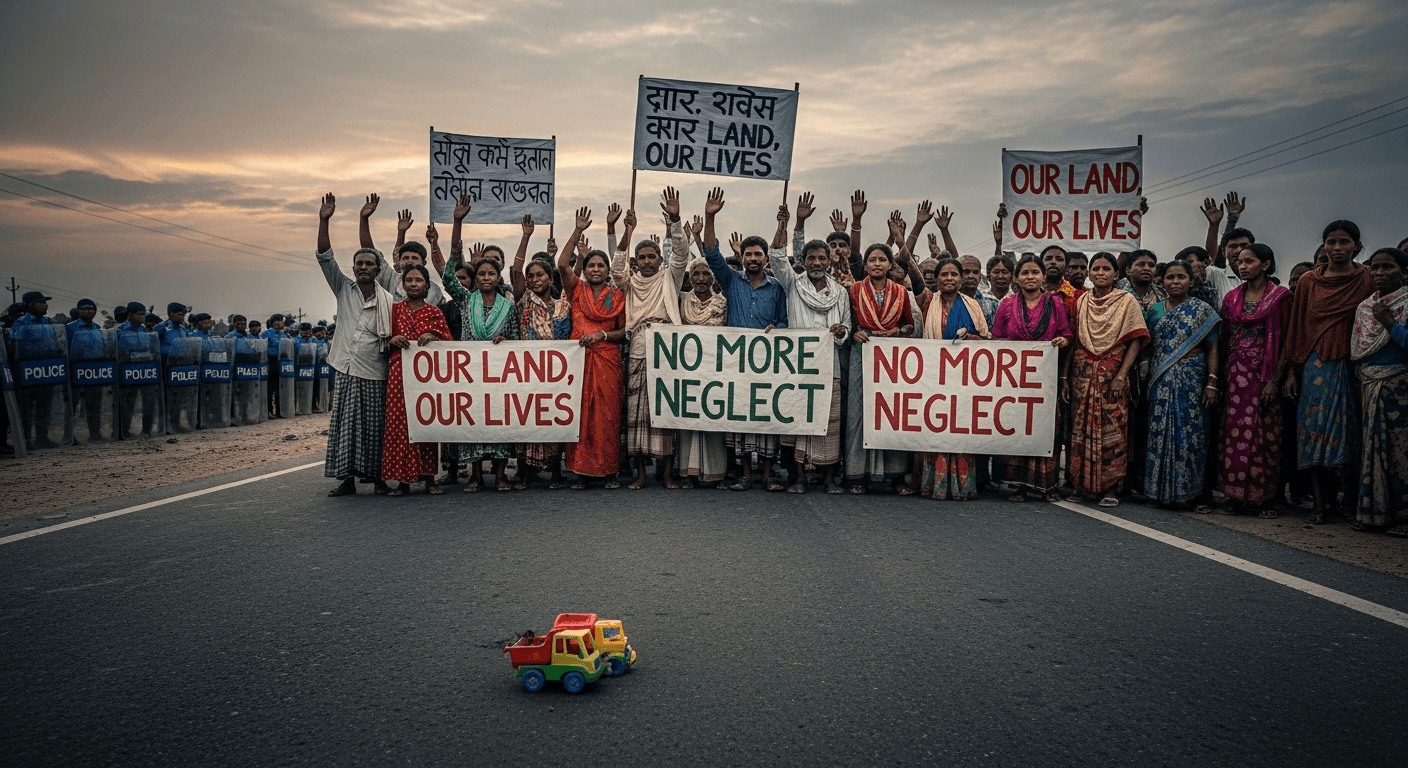
I write with a heavy heart about a recent incident in Pune that has shaken a community and interrupted a major arterial road. A three-year-old child from a village in Bhor taluka was found dead after an alleged sexual assault. The arrest of a 65-year-old man in connection with the case led to mass protests: family members and villagers blocked the Mumbai–Bengaluru (Pune) highway near the Navale/Wadgaon bridge area, placing the child’s body at the roadway and bringing traffic to a standstill for several hours. The demonstration, driven by grief and outrage, forced authorities into heavy deployment and prompted public officials to promise expedited legal action.
Timeline — crime, investigation, and recent trigger
- Original crime: According to police reports carried in local media, the child went missing while visiting relatives in a village in Bhor taluka. CCTV footage from a nearby residence played a key role in identifying and locating a suspect.
- Investigation over three years: The matter that suddenly exploded into public view was treated with urgency from the moment the body was recovered and forensic teams were involved. The case was registered under the Protection of Children from Sexual Offences (POCSO) Act and relevant sections of the Bharatiya Nyaya Sanhita; samples and post-mortem reports were sent for forensic analysis.
- Recent developments sparking the protest: Arrest of an elderly suspect and details emerging about prior complaints against him — combined with the community’s perception of risk and slow response in past cases — transformed grief into large-scale public protest on the adjacent Mumbai–Bengaluru highway, creating widespread disruption and intense media attention.
Description of the protest
- Location and scale: Hundreds of local residents gathered near the Navale/Wadgaon bridge area on the Mumbai–Bengaluru highway. The blockade reportedly lasted several hours, causing long queues and major traffic disruption in both directions.
- Demands: Protesters demanded swift and stringent action against the accused, immediate filing of a charge sheet, and a fast-track trial. Some demonstrators called for the harshest legal penalty available in law.
- Groups involved: The crowd was predominantly family members, villagers, and local civil society participants. In some reports, local political activists and community organisations were present demanding accountability from law enforcement.
- Clashes/arrests: While most reports describe the protest as intense and emotional, the police used measured force to clear the highway after hours of negotiation. There were no widespread reports of large-scale, organised violence, but tensions were high and authorities pressed for restoration of order so that emergency services and routine traffic could resume.
Legal and social context
- POCSO and criminal law: Cases involving sexual assault of minors are tried under the POCSO Act, which mandates child-sensitive procedures and prescribes stringent punishments. The state also invoked relevant sections of the Bharatiya Nyaya Sanhita for offences connected to this crime.
- Public response and precedent: The reaction in Pune fits a broader pattern: when crimes against children and women become visible, communities often respond with immediate, public demonstrations demanding swift justice. These protests reflect deep mistrust in systems perceived as slow or lenient, particularly where accused persons have prior complaints or cases on record.
- Risk of vigilante pressure: While public anger is understandable, highway blockades and attempts to take law into one’s own hands create additional harms — obstructing emergency services, risking further trauma to victims’families, and potentially interfering with a criminal investigation.
Paraphrased statements from officials and community
- A senior state official described the incident as "shocking" and assured the family of government support and a fast-track trial.
- The local police emphasized that CCTV footage and forensic evidence formed the basis for the arrest and that investigators were building a watertight case.
- Community representatives demanded speedy justice and stronger protective measures for children, and urged authorities to ensure no repeat of past lapses in handling similar cases.
What this implies for policy and policing
This tragic event exposes gaps and pressures at multiple levels:
- Investigative capacity: Timely forensic work, secure evidence chains, and trained child-protection investigators must be scaled up so that investigations are both fast and robust.
- Accountability and transparency: Public trust falls when past allegations against an accused are perceived as ignored. Police and prosecutors should communicate clearly (within legal and victim-sensitive bounds) about case steps and timelines to reduce misinformation and curb vigilante impulses.
- Victim support: Families need immediate medical, legal and psychological support. Child-friendly protocols at hospitals, police stations and courts must be enforced without exception.
- Prevention: Community education about reporting, safe spaces for children, and monitoring of known repeat offenders must be part of an integrated prevention strategy.
Recommended steps for communities and authorities
For authorities:
- Expedite forensic and legal procedures through designated fast-track mechanisms while maintaining procedural fairness.
- Assign a dedicated, trained investigation team and a special public prosecutor to preserve evidence and present a strong case in court.
- Improve public communication: regular, factual updates that avoid sensational detail but reassure communities about progress.
- Strengthen child-protection systems: enforce POCSO-mandated procedures, train first responders and ensure appropriate counseling services.
For communities and civil society:
- Channel outrage into constructive pressure: coordinated petitions, legal oversight, and monitored timelines for charge sheets and trial progress.
- Protect investigative integrity: avoid actions that could destroy evidence or compromise witness testimony.
- Support victims’ families with counseling, legal aid and economic assistance so their needs are not sidelined by the justice process.
My personal reflections and continuity with past writing
I have long written about how crimes against vulnerable groups expose broader governance gaps (No One’s Monopoly!). Today’s incident is another painful reminder that law, policy and community systems must work together — rapidly and compassionately — to protect children and to deliver justice without fueling cycles of anger and extra-judicial retaliation.
Ongoing developments and sources
This case is still unfolding. Expect continued police statements, forensic reports, a formal chargesheet and court proceedings in the coming days. My account is based on local news coverage, police releases, and civil society reporting; I will follow developments and reflect on policy implications as facts are confirmed.
Sources: local news reports, police statements, NGO reports.
Author: Hemen Parekh
Regards,
Hemen Parekh
Any questions / doubts / clarifications regarding this blog? Just ask (by typing or talking) my Virtual Avatar on the website embedded below. Then "Share" that to your friend on WhatsApp.
Get correct answer to any question asked by Shri Amitabh Bachchan on Kaun Banega Crorepati, faster than any contestant
Hello Candidates :
- For UPSC – IAS – IPS – IFS etc., exams, you must prepare to answer, essay type questions which test your General Knowledge / Sensitivity of current events
- If you have read this blog carefully , you should be able to answer the following question:
- Need help ? No problem . Following are two AI AGENTS where we have PRE-LOADED this question in their respective Question Boxes . All that you have to do is just click SUBMIT
- www.HemenParekh.ai { a SLM , powered by my own Digital Content of more than 50,000 + documents, written by me over past 60 years of my professional career }
- www.IndiaAGI.ai { a consortium of 3 LLMs which debate and deliver a CONSENSUS answer – and each gives its own answer as well ! }
- It is up to you to decide which answer is more comprehensive / nuanced ( For sheer amazement, click both SUBMIT buttons quickly, one after another ) Then share any answer with yourself / your friends ( using WhatsApp / Email ). Nothing stops you from submitting ( just copy / paste from your resource ), all those questions from last year’s UPSC exam paper as well !
- May be there are other online resources which too provide you answers to UPSC “ General Knowledge “ questions but only I provide you in 26 languages !



No comments:
Post a Comment