
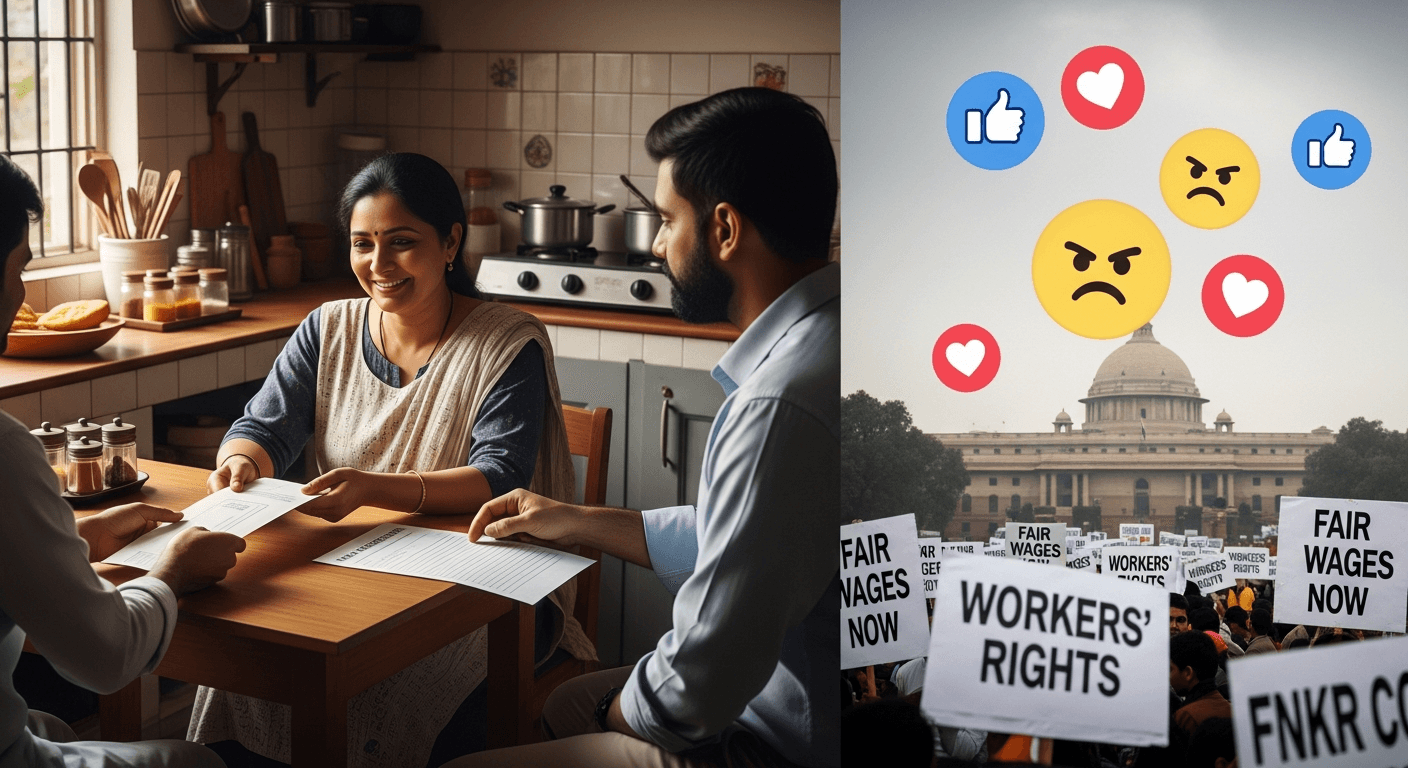
Lede: A recent public remark about a domestic worker being paid Rs 10,000 a month reopened a national conversation about wages, dignity and the legal and moral obligations of employers.
The Value of Domestic Work
I watched the debate unfold with a mix of frustration and empathy. As discussions flared on television and social media, what struck me most was how a single comment—about a specific monthly wage—became a lightning rod for deeper questions: What do we owe the people who keep our homes running? What do labour laws say, and where do they fall short? And how should households and policymakers respond so that dignity and fairness become the norm rather than the exception?
What happened (briefly)
A public figure’s offhand remark about paying a domestic worker Rs 10,000 a month triggered strong reactions online and in traditional media. Critics argued that the amount was below legally or ethically acceptable levels for full-time domestic work in many parts of India; supporters of the speaker pointed to practical affordability and context. The exchange quickly drew further commentary from journalists and public personalities, turning an individual anecdote into a larger debate about wages and respect.
Minimum wage and legal context in India
India’s framework for wages is fragmented: the Minimum Wages Act and state wage schedules mean that minimum pay for domestic work varies by state and by classification of the job. Moreover, domestic workers have historically fallen through gaps in enforcement, registration, and social security coverage. Many labour experts and advocates note that the presence of official minimums on paper does not always translate into consistent enforcement on the ground.
At the same time, there is a distinction between a legally required minimum wage and a living wage: the former is the floor established by law (and differs across jurisdictions), while the latter reflects the income needed to meet basic living expenses. In many urban areas, a sum like Rs 10,000 will often fall short of a living wage for a full-time domestic worker, especially where housing, healthcare, and education costs are high.
(For a longer treatment of structural problems and policy proposals I have written about domestic work and the need for formal protections in the past — see my earlier reflections on this subject here and here.)
Social media backlash and social dynamics
The online reaction to the remark showed familiar patterns: quick moral judgements, calls for boycotts, and heated debates about class and compassion. Social media amplified both outrage and defensive narratives. Importantly, the controversy exposed underlying social dynamics about how domestic work—disproportionately performed by women from lower-income and socially marginalised communities—is valued (or undervalued) in public discourse.
Rather than simply shaming one person, the moment offered an opportunity for a wider conversation on norms, accountability, and corrective policy.
Expert perspectives (general themes)
- Labour rights advocates emphasise stronger enforcement of state minimum wages, formal contracts, and access to social security schemes for domestic workers.
- Economists and social policy experts stress the need to distinguish short-term affordability concerns from long-term costs of systemic undervaluation, including social exclusion and economic vulnerability.
- Psychologists and social commentators point to dignity and respect in day-to-day interactions as crucial components of decent work, beyond monetary compensation.
A balanced view
It’s worth acknowledging that households differ widely in means and circumstances. A small family with tight finances faces different constraints than a high-income household. That said, fairness and legality are not conditional on sympathy alone. When a wage is significantly below statutory standards or living-cost realities, it becomes a collective problem: one household’s cost-cutting can contribute to a normalized low-pay market.
Practical advice for households employing domestic workers
- Check your state’s official minimum wage for domestic workers and comply with it. If in doubt, contact your local labour department.
- Use a simple written agreement that states hours, duties, leave entitlements, wage, and mode/frequency of payment.
- Pay on time and provide a pay slip or written acknowledgement.
- Respect weekly rest, annual leave and maternity leave norms; where possible, offer paid leave beyond statutory minima.
- Consider small benefits that improve security: a mobile phone number for emergencies, contributions to health costs, and a modest provident contribution if feasible.
- Invest in training and skill upgrades where appropriate — this benefits both employer and employee.
- Treat domestic staff with the same basic courtesies you expect in any workplace: privacy, non-discrimination and safe working conditions.
Suggestions for policymakers
- Move toward clearer, harmonised standards for domestic workers across states and strengthen enforcement capacity.
- Create easy registration and grievance mechanisms for domestic workers — simple digital portals and local helpdesks can help.
- Extend social security and pension benefits in a manner that is administratively feasible for small employers.
- Support awareness campaigns and incentives for formalising domestic employment, such as tax credits or subsidies for employers who formalise contracts and make statutory contributions.
Closing thoughts
This controversy is more than a headline: it is a reminder that how we remunerate and treat the people who support our homes is a measure of a society’s values. My own writing on domestic work has long argued for policy measures and social shifts that protect dignity and ensure fairness. A single remark can spark outrage — but it can also spark constructive reform if we use the moment to advocate for enforceable rights, practical employer practices, and public understanding.
Regards,
Hemen Parekh
Any questions / doubts / clarifications regarding this blog? Just ask (by typing or talking) my Virtual Avatar on the website embedded below. Then "Share" that to your friend on WhatsApp.
Get correct answer to any question asked by Shri Amitabh Bachchan on Kaun Banega Crorepati, faster than any contestant
Hello Candidates :
- For UPSC – IAS – IPS – IFS etc., exams, you must prepare to answer, essay type questions which test your General Knowledge / Sensitivity of current events
- If you have read this blog carefully , you should be able to answer the following question:
- Need help ? No problem . Following are two AI AGENTS where we have PRE-LOADED this question in their respective Question Boxes . All that you have to do is just click SUBMIT
- www.HemenParekh.ai { a SLM , powered by my own Digital Content of more than 50,000 + documents, written by me over past 60 years of my professional career }
- www.IndiaAGI.ai { a consortium of 3 LLMs which debate and deliver a CONSENSUS answer – and each gives its own answer as well ! }
- It is up to you to decide which answer is more comprehensive / nuanced ( For sheer amazement, click both SUBMIT buttons quickly, one after another ) Then share any answer with yourself / your friends ( using WhatsApp / Email ). Nothing stops you from submitting ( just copy / paste from your resource ), all those questions from last year’s UPSC exam paper as well !
- May be there are other online resources which too provide you answers to UPSC “ General Knowledge “ questions but only I provide you in 26 languages !



No comments:
Post a Comment