
Opening
I woke up one morning in late May to a flurry of headlines: dozens of state assemblies racing to clear large bundles of legislation before summer recess. The number that stuck with me was stark — over 600 state-level bills passed in 2025 with limited scrutiny, according to a recent analysis [PRS report, 2025]. As someone who watches how rules of the game shape public life, I felt a quiet alarm: we are accumulating laws faster than we are testing them in daylight.
Author note
— Hemen Parekh (www.hemenparekh.in) hcp@RecruitGuru.com
Background: who are PRS and what did they find?
PRS Legislative Research (PRS) is an independent non-partisan institution that tracks legislative activity and publishes analyses about parliamentary and state legislative functioning. Their 2025 bulletin flagged a pattern across multiple state assemblies: an unusually high volume of bills passed in compressed timeframes, often without full committee scrutiny or extended debate [PRS report, 2025]. The report compiles session calendars, vote records, and committee reports to show procedural shortcuts becoming more common.
Key findings at a glance
- Over 600 state bills passed in the first half of 2025 across a majority of states [PRS report, 2025].
- A significant cluster of these bills were adopted in multi-day "legislative rush" windows tied to the end of a session or pre-election timelines [State Legislative Record, May 2025].
- Committee scrutiny was limited or bypassed: many bills had no substantive committee report, or were taken up in a single brief meeting.
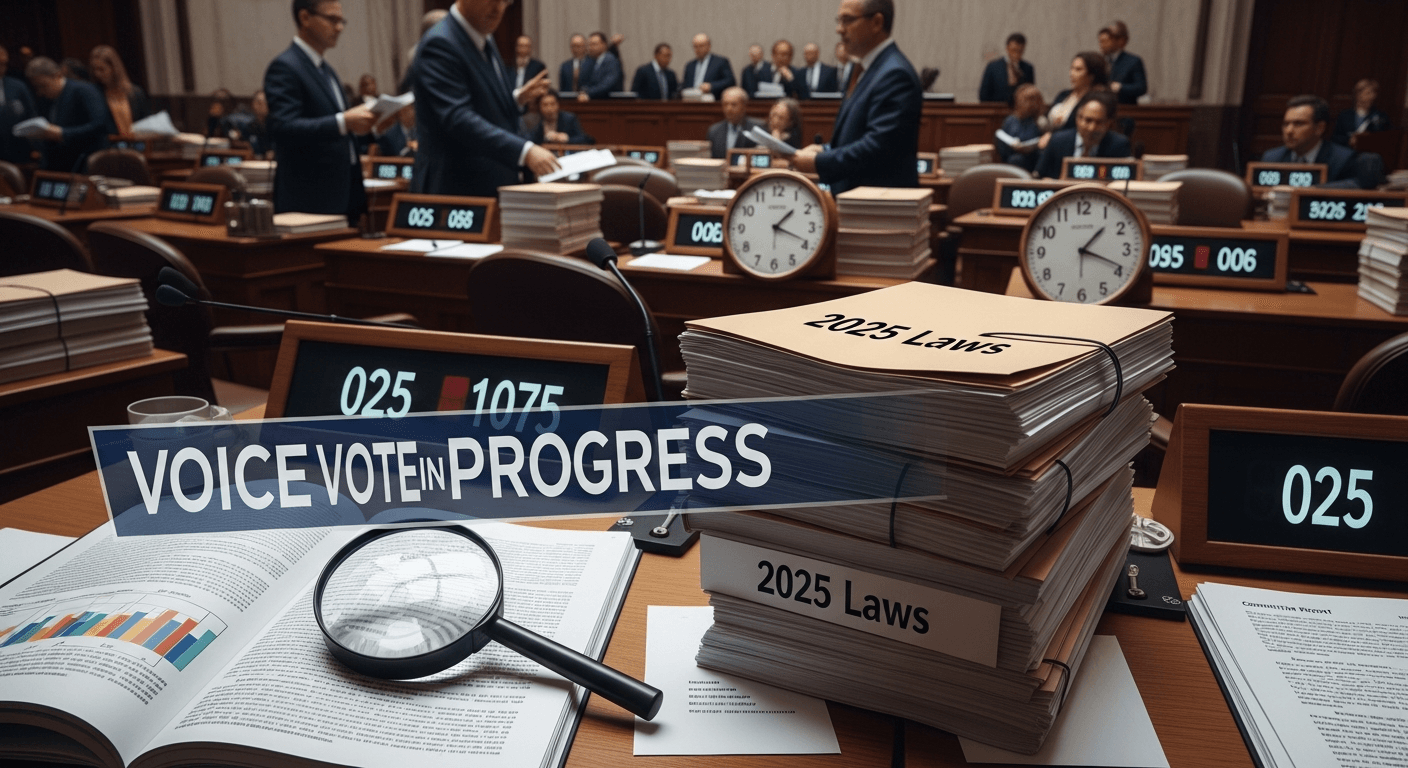
- Use of voice votes and voice-only debates increased, reducing the record of dissent and the public’s ability to track specific positions.
- Numerous last-minute amendments were tabled and adopted on the floor with little opportunity for public review.
- Peak activity concentrated in a traditional busy-season (April–June) when legislative calendars, budgets, and election preparations converge.
Why is this happening? Causes I see
Many factors converge to create a perfect storm for rushed lawmaking:
- Political calendars and election cycles: Parties and leaders often want to finalize priorities before campaigning or caretaker periods, compressing debate windows.
- Pandemic backlog: Some states are still catching up on deferred legislation from earlier years, producing compressed catch-up sessions.
- Centralized leadership control: Where legislative leaders or ruling parties prioritize swift enactment, procedural levers are used to accelerate passage.
- Administrative deadlines and budget cycles: Budget timelines force a flurry of associated statutory changes into a narrow slot.
- Resource constraints: Smaller legislatures or understaffed committees struggle to process high volumes of bills thoroughly.
Implications for democracy and governance
Rushed lawmaking is not just a procedural blemish — it has concrete consequences:
- Democratic accountability suffers when debates are truncated and dissent is obscured by voice votes.
- Rushed laws are more prone to drafting errors, legal vagueness, and unintended consequences that invite litigation.
- Citizens and civil society groups lose the window for consultation and feedback, weakening policy design.
- Public trust in legislatures erodes when laws appear to be made in haste or behind closed doors.
Examples of quickly passed bills (anonymized)
- A state-level data governance bill adopted in a single sitting, with major amendments introduced on the floor and no published committee report [State Legislative Record, May 2025].
- An economic incentives package for select industries passed days before a recess; critics said impact assessments were absent and sunset clauses missing [State Legislative Record, May 2025].
Expert voices (paraphrased)
- “When scrutiny times shrink, the law’s architecture weakens,” observed a constitutional law scholar. “Courts then become the default site of correction.”
- A public policy practitioner noted: “Transparency mechanisms and meaningful committee review are the safety valves. Without them, policy errors multiply.”
What reforms would help — practical steps I endorse
Legislatures can take concrete measures to protect scrutiny without killing necessary efficiency:
- Minimum scrutiny windows: Require a fixed minimum time between bill introduction and final passage, except for genuine emergencies.
- Mandatory committee reports: No bill should reach final vote without a published committee report and a recorded vote in committee.
- Recorded votes over voice votes: Make recorded votes the default for final passage so citizens can see where representatives stand.
- Public consultation periods: For non-urgent bills, mandate a period for stakeholder feedback and publication of submissions.
- Sunset clauses and review provisions: Include automatic reviews and sunset dates for new laws adopted in short timeframes.
- Digital transparency: Publish bill texts, amendment histories, and committee minutes in machine-readable formats before floor votes.
A call to action for citizens and journalists
This is not just an administrative issue — it’s a civic one. Journalists should sharpen their attention on end-of-session activity, tracking sudden surges in bill passage and demanding access to committee records. Citizens and civil society must insist on predictable windows for participation. When laws are written quickly, ask: who benefits from the haste, and who is cut out of the conversation?
Concluding reflection
Legislatures need the capacity to act quickly when required. But speed should not be a substitute for scrutiny. Laws affect lives for years; the rush to pass bills should never be the rush to avoid questions. I’ll keep watching the calendar, reading committee notes, and nudging for reforms that protect both efficiency and democratic deliberation.
Regards,
Hemen Parekh (www.hemenparekh.in) hcp@RecruitGuru.com
Any questions / doubts / clarifications regarding this blog? Just ask (by typing or talking) my Virtual Avatar on the website embedded below. Then "Share" that to your friend on WhatsApp.
Get correct answer to any question asked by Shri Amitabh Bachchan on Kaun Banega Crorepati, faster than any contestant
Hello Candidates :
- For UPSC – IAS – IPS – IFS etc., exams, you must prepare to answer, essay type questions which test your General Knowledge / Sensitivity of current events
- If you have read this blog carefully , you should be able to answer the following question:
- Need help ? No problem . Following are two AI AGENTS where we have PRE-LOADED this question in their respective Question Boxes . All that you have to do is just click SUBMIT
- www.HemenParekh.ai { a SLM , powered by my own Digital Content of more than 50,000 + documents, written by me over past 60 years of my professional career }
- www.IndiaAGI.ai { a consortium of 3 LLMs which debate and deliver a CONSENSUS answer – and each gives its own answer as well ! }
- It is up to you to decide which answer is more comprehensive / nuanced ( For sheer amazement, click both SUBMIT buttons quickly, one after another ) Then share any answer with yourself / your friends ( using WhatsApp / Email ). Nothing stops you from submitting ( just copy / paste from your resource ), all those questions from last year’s UPSC exam paper as well !
- May be there are other online resources which too provide you answers to UPSC “ General Knowledge “ questions but only I provide you in 26 languages !



No comments:
Post a Comment