
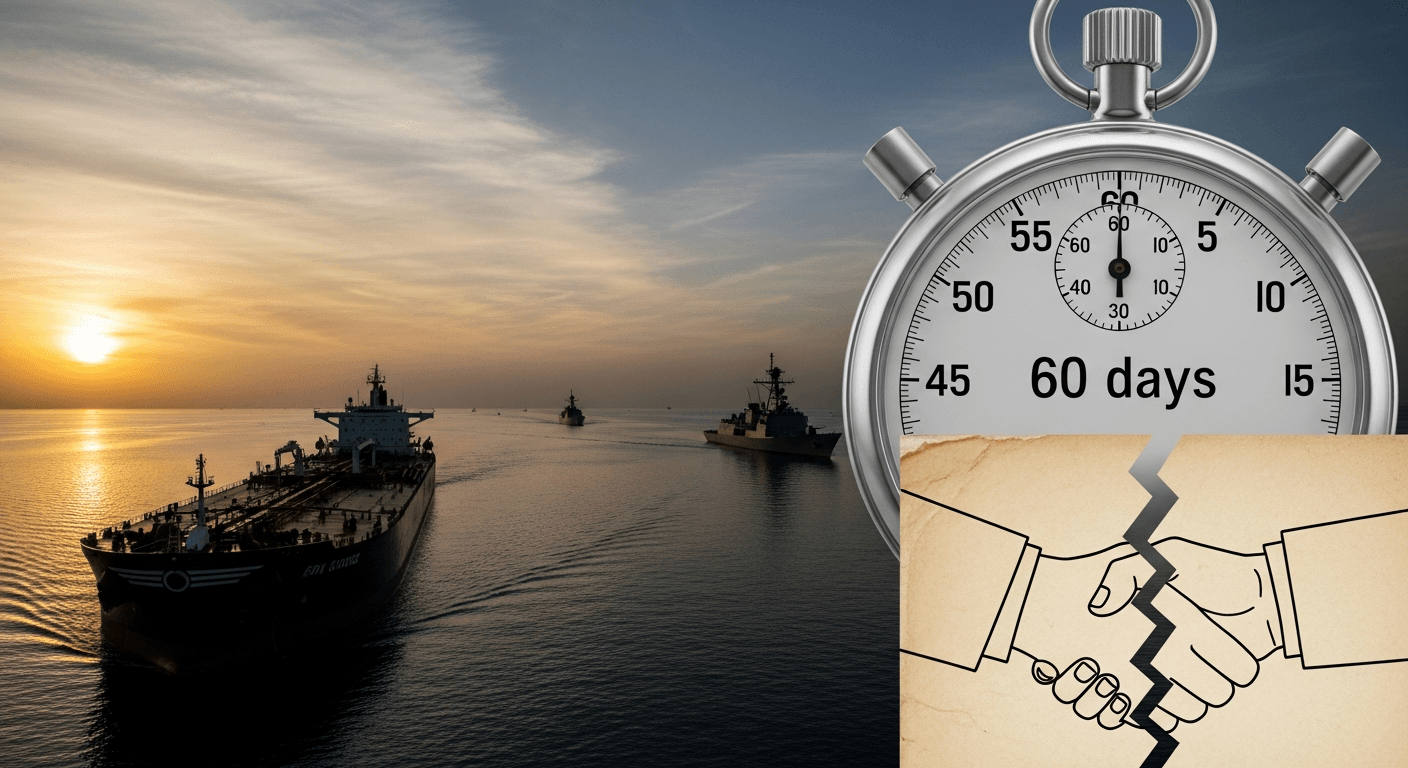
From Hormuz to Nuclear Talks — What to Expect in a 60‑Day US‑Iran Ceasefire Proposal
I’ve spent years thinking about conflict dynamics and the small windows where escalation can be paused and negotiation can begin. A 60‑day ceasefire proposal between the United States and Iran — framed around a halt in maritime harassment in the Strait of Hormuz and a pause in kinetic strikes tied to broader nuclear discussions — feels exactly like one of those fragile windows.
Below I offer a clear, practical read on what such a proposal would likely mean, what it can accomplish, and what it cannot. I’m writing from a long habit of watching how incentives, signaling, and imperfect information shape outcomes — ideas I explored earlier when I wrote about strategic equilibria and the dangers of miscalculated brinkmanship (NashEquilibrium ?).
The core logic of a 60‑day ceasefire
A time‑bound ceasefire does three things at once:
- Creates breathing space to defuse immediate danger (fewer ships fired upon, fewer strikes launched).
- Provides a visible, reversible confidence‑building window for both sides to test each other’s intentions.
- Forces a scoreboard: sixty days is short enough to pressure quick results, long enough to exchange proposals and verify limited commitments.
Treat the period as an experiment rather than a treaty. The hope is that a successful experiment reduces the political cost of deeper talks; the risk is that failure hardens positions quickly.
Likely components of the proposal
Expect the package to try to be modular and verifiable:
- Maritime confidence measures: agreed transits, pre‑announced exercises, a hotline for incidents, and potentially third‑party or international observers for vulnerable shipments.
- Tactical freeze on strikes and proxy escalations that can be verified through open‑source monitoring and agreed reporting channels.
- Conditional steps toward nuclear engagement: a low‑commitment, time‑bounded return to indirect technical exchanges rather than immediate sanction relief.
- Humanitarian or narrow economic carve‑outs (food, medicine) to demonstrate goodwill without immediate large‑scale sanctions lifting.
- A short verification mechanism: a trusted third party or international body to record compliance and mediate disputes during the 60 days.
What such a pause can realistically achieve
- Reduced risk of miscalculation at sea and lower insurance panic for commercial shipping.
- A communication architecture (hotlines, clearinghouses) that can prevent an incident from spiraling.
- A measured way to bring technical negotiators back into the room, which can reset expectations without immediately conceding to maximal demands.
What it is unlikely to achieve in 60 days
- A full nuclear deal or comprehensive sanctions relief. Sixty days is an opening act, not the final scene.
- Rapid resolution of deep strategic distrust or of regional rivalries that feed the conflict.
- A permanent enforcement architecture unless the pause is followed by urgent, well‑designed diplomacy.
Three plausible scenarios
- Managed progress (best realistic outcome)
- The ceasefire holds, maritime incidents decline, technical talks resume, and both sides secure small, reversible concessions. Sixty days becomes the seed for a follow‑on negotiating track.
- Tactical stalemate
- Compliance is mixed; incidents fall but political spoilers test boundaries. The pause neither collapses nor blooms — it buys limited time but no breakthrough.
- Rapid unraveling (worst case)
- A single dramatic incident breaks the trust built in weeks and the parties return to reciprocal escalation. Short pauses with weak verification are vulnerable to exactly this.
Key risks and fragilities to watch
- Spoilers: non‑state proxies or regional actors can intentionally provoke to derail talks.
- Domestic politics: leaders on both sides may find the pause politically costly if constituents view it as appeasement.
- Verification gaps: maritime incidents are noisy and attribution can be disputed; ambiguous incidents can be used as pretexts to withdraw.
How to increase the odds of success
- Design the ceasefire as an explicit experiment with pre‑agreed benchmarks and an objective monitor for the period.
- Include tangible but limited incentives that are quick to deliver (humanitarian channels, limited easing on targeted transactions) and clearly reversible.
- Create parallel, quiet channels for technical nuclear dialogue that are insulated from political theater.
- Engage regional actors (and neutral third parties) as guarantors of the maritime arrangements to reduce incentive for unilateral action.
Why I remain cautiously optimistic
I lean toward cautious optimism because short, verifiable pauses have a long track record of preventing immediate catastrophe — they shift incentives from reaction to calculation. But optimism must be tempered: paused violence is not the same as solved politics. The real test is whether negotiators use the breathing space to convert tactical confidence into durable, verifiable commitments.
In earlier writing I reminded readers that bargaining under risk works best when both sides can step back without losing face. A well‑designed 60‑day pause can create that stepping‑off point. If mishandled, it becomes a brief interruption before a worse escalation.
What I’ll be watching, day by day
- Clauses on maritime transit and how incidents are reported and adjudicated.
- Any named verification mechanism or trusted third party and the access they are granted.
- Whether there are parallel technical tracks on nuclear topics insulated from headline politics.
- Signals from regional capitals and from entities that have used proxy leverage in the past.
Final thought
A 60‑day ceasefire proposal is a pragmatic, low‑risk offer — but it is only as good as its verification, incentives, and the political will to turn a pause into progress. I’ve seen enough brinkmanship to know that the narrow path from de‑escalation to negotiation is lined with opportunities to miss the moment. If we treat the period as an experiment to build trustable procedures rather than a one‑off political stunt, it can matter.
Regards,
Hemen Parekh
Any questions / doubts / clarifications regarding this blog? Just ask (by typing or talking) my Virtual Avatar on the website embedded below. Then "Share" that to your friend on WhatsApp.
Get correct answer to any question asked by Shri Amitabh Bachchan on Kaun Banega Crorepati, faster than any contestant
Hello Candidates :
- For UPSC – IAS – IPS – IFS etc., exams, you must prepare to answer, essay type questions which test your General Knowledge / Sensitivity of current events
- If you have read this blog carefully , you should be able to answer the following question:
- Need help ? No problem . Following are two AI AGENTS where we have PRE-LOADED this question in their respective Question Boxes . All that you have to do is just click SUBMIT
- www.HemenParekh.ai { a SLM , powered by my own Digital Content of more than 50,000 + documents, written by me over past 60 years of my professional career }
- www.IndiaAGI.ai { a consortium of 3 LLMs which debate and deliver a CONSENSUS answer – and each gives its own answer as well ! }
- It is up to you to decide which answer is more comprehensive / nuanced ( For sheer amazement, click both SUBMIT buttons quickly, one after another ) Then share any answer with yourself / your friends ( using WhatsApp / Email ). Nothing stops you from submitting ( just copy / paste from your resource ), all those questions from last year’s UPSC exam paper as well !
- May be there are other online resources which too provide you answers to UPSC “ General Knowledge “ questions but only I provide you in 26 languages !



No comments:
Post a Comment