
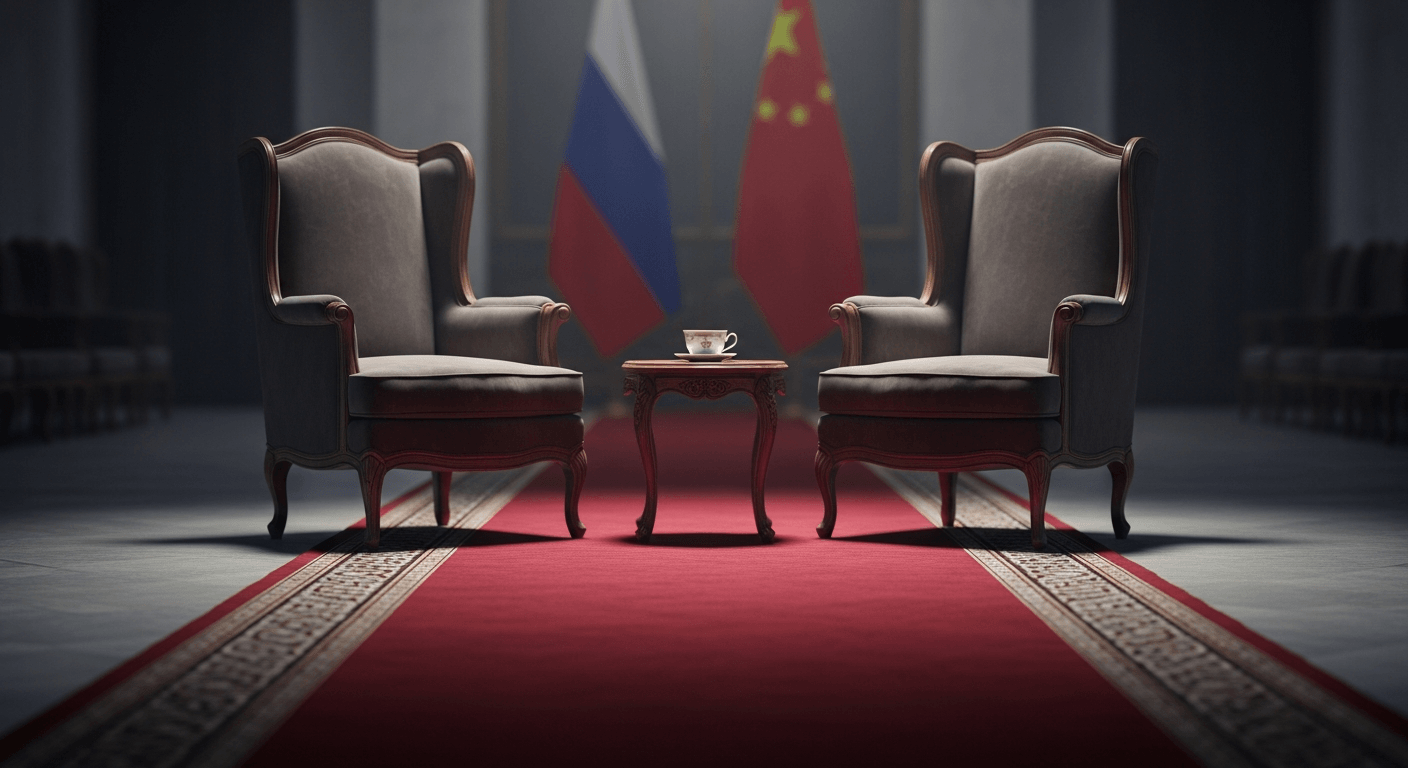
Red Carpet, Tea, Strategy
I watched the images of a red-carpet welcome in Beijing and the subsequent private tea meeting between the Russian president and the Chinese president with the same mixture of interest and skepticism I bring to all moments where ceremony and strategy cross. These state rituals are more than theater: they are calibrated signals to domestic audiences and to the world. In this piece I want to unpack the context, likely agenda, symbolism, constraints and what to watch next.
Context: a relationship of convenience and deeper alignment
Over the last decade Russia and China have drawn closer across multiple domains—diplomacy, defense cooperation, and trade—while each preserves its own strategic autonomy. The partnership is born of both shared grievances (real or perceived) with Western policy, and complementary needs: China’s demand for energy and commodities, Russia’s need for technology and market access, and both countries’ desire to hedge U.S. influence. I have written before about China’s drive to extend connectivity and influence across regions—what I called its ambition to "connect everything"—and that strategic ambition frames these high-level meetings China wants to connect EVERYTHING.
Why the red-carpet protocol matters
Ceremonial protocol is a language. A red-carpet reception and formal honors tell domestic audiences that the visit is important, and they reassure allies and rivals that the host views the guest as a major actor. For the host, lavish protocol signals status and diplomatic reach; for the guest, accepting it projects respect and influence. In short, the protocol amplifies the political weight of the visit without saying a word.
There is also an internal audience: by showing public warmth, both capitals address hardline constituencies that might otherwise distrust cooperation. But ceremony can also mask the limits of cooperation—diplomatic flash does not guarantee policy alignment.
The likely agenda: what they probably discussed
On a visit framed by ceremony and a private tea, the substantive agenda usually includes a mix of security, geopolitics and economic matters. Likely topics:
- Security and military coordination: avoiding unintended escalation in border regions, military-technical cooperation, and messaging about deterrence.
- The Ukraine front (and broader European security): deconfliction, diplomatic coordination, and economic implications of sanctions.
- Trade, energy and economics: long-term gas, oil and critical-minerals deals; infrastructure financing; and trade settlement mechanisms that sidestep dollar exposure.
- Technology and supply chains: semiconductor access, telecom infrastructure, and collaboration or divergence on dual-use technologies.
- Global institutions and strategic partnerships: aligning positions in multilateral fora and on initiatives that reshape rules of trade and finance.
A private ``tea meeting''—intimate and off-camera—suggests an emphasis on frank exchange, relationship maintenance, and testing ideas that neither side wants fully public.
The symbolism of a private tea meeting
Tea is intimate, low-key and historically resonant in East Asian diplomacy. A private tea signals a desire for candid conversation away from staged public remarks. It can be used to:
- Gauge personal chemistry between leaders.
- Float sensitive proposals that require discretion.
- Build trust on issues that would be politically costly if mishandled publicly.
Yet the intimacy also shows limits: when negotiations are advanced in private, they often require later institutional follow-through to translate into policy.
Potential outcomes and real constraints
Public deliverables from such visits are often modest—a memorandum of understanding, a new framework, or a headline trade figure—because political and structural constraints bite.
Constraints include:
- Domestic politics: both governments must balance nationalist narratives with pragmatic needs. Too-close alignment can provoke domestic unease or rival elites.
- Sanctions and financial isolation: economic measures limit what one partner can deliver and complicate long-term financing.
- Asymmetric leverage: while both benefit from cooperation, neither can fully replace market, technological or logistical ties with the West. That limits the depth of immediate commitments.
So even if announcements look grand, implementation will depend on bureaucratic follow-through, finance, and third-party reactions.
How the wider world will react
Western capitals will parse the optics and language carefully. Expect:
- The United States and the European Union to express concern about deeper strategic coordination, to reinforce deterrence messages, and to calibrate sanctions or diplomatic responses where they see escalation.
- Regional neighbors to engage in hedging: some will express unease and step up security cooperation with Western partners; others will try to maintain economic ties with both sides.
- Global markets to watch for shifts in energy deals or trade arrangements that might reroute supply chains.
The real impact depends less on ceremony and more on concrete follow-through: who signs what, who pays, and whether third parties adjust.
What to watch next
- Implementation, not optics: track trade contracts, energy supply timelines and whether proposed financial mechanisms actually move money.
- Technology pipelines: watch for concrete cooperation in semiconductors, telecoms and critical minerals that could change supply-chain resilience.
- Diplomatic ripple effects: monitor responses from NATO, the EU, Japan and regional groupings—diplomatic notes, joint statements, and new security initiatives.
- Domestic narratives: statements from parliaments, official media and influential business groups will reveal political constraints.
In short, the red carpet and tea tell us that both capitals want to show stability and mutual respect. But lasting strategic shifts require more than ceremony: they need contracts, cash, institutional frameworks and—crucially—an appetite to accept the political costs of deeper alignment. My read is that this visit is as much about reaffirmation and risk management as it is about breakthrough deals.
Regards,
Hemen Parekh
Any questions / doubts / clarifications regarding this blog? Just ask (by typing or talking) my Virtual Avatar on the website embedded below. Then "Share" that to your friend on WhatsApp.
Get correct answer to any question asked by Shri Amitabh Bachchan on Kaun Banega Crorepati, faster than any contestant
Hello Candidates :
- For UPSC – IAS – IPS – IFS etc., exams, you must prepare to answer, essay type questions which test your General Knowledge / Sensitivity of current events
- If you have read this blog carefully , you should be able to answer the following question:
- Need help ? No problem . Following are two AI AGENTS where we have PRE-LOADED this question in their respective Question Boxes . All that you have to do is just click SUBMIT
- www.HemenParekh.ai { a SLM , powered by my own Digital Content of more than 50,000 + documents, written by me over past 60 years of my professional career }
- www.IndiaAGI.ai { a consortium of 3 LLMs which debate and deliver a CONSENSUS answer – and each gives its own answer as well ! }
- It is up to you to decide which answer is more comprehensive / nuanced ( For sheer amazement, click both SUBMIT buttons quickly, one after another ) Then share any answer with yourself / your friends ( using WhatsApp / Email ). Nothing stops you from submitting ( just copy / paste from your resource ), all those questions from last year’s UPSC exam paper as well !
- May be there are other online resources which too provide you answers to UPSC “ General Knowledge “ questions but only I provide you in 26 languages !



No comments:
Post a Comment