
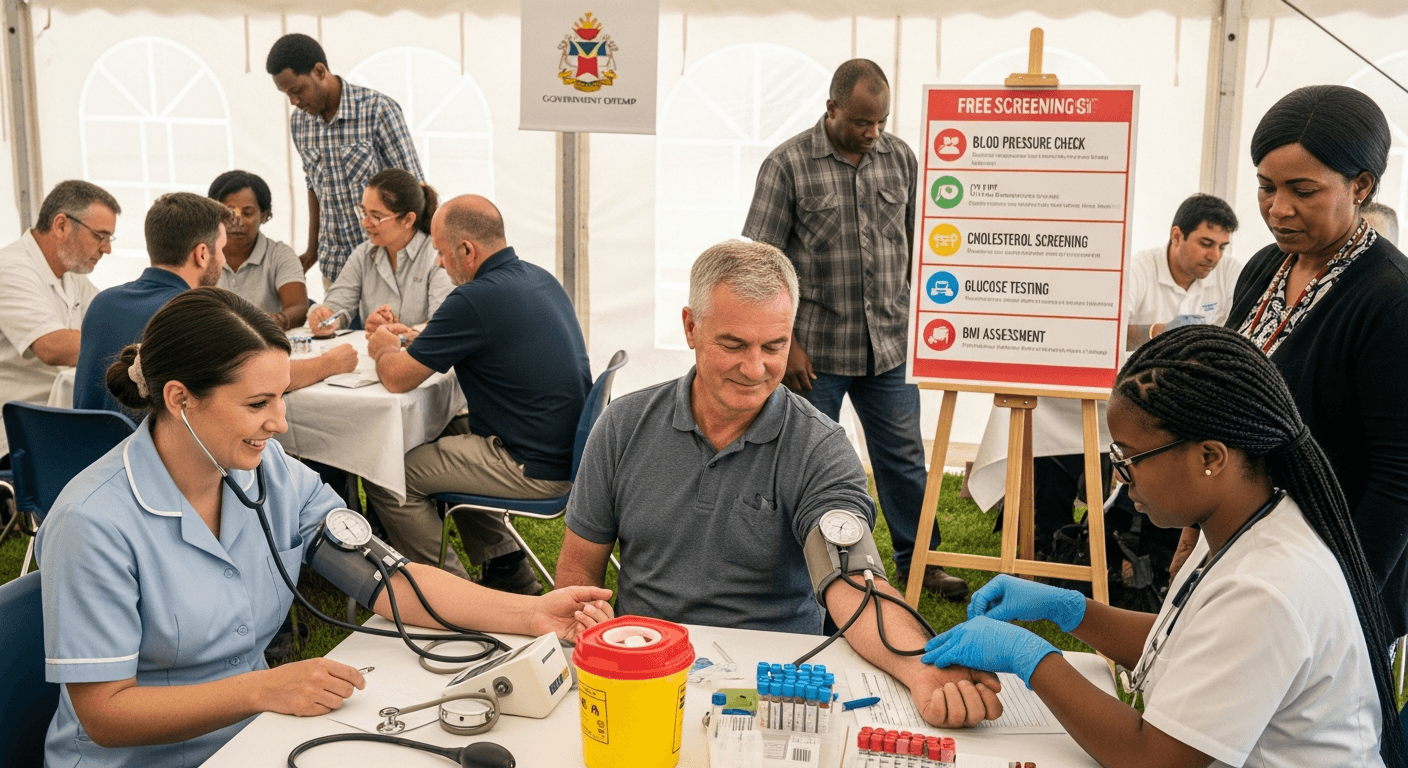
I woke up the morning I read the announcement thinking of the people I meet every day at job sites, offices and factories — those quiet, hardworking colleagues who keep cities and supply chains moving. A government program offering free health check-ups for workers aged 40 and above is straightforward on its face, but it matters. It changes the math for prevention, for productivity, and for dignity.
What the policy is (in plain terms)
The program offers no-cost health screenings targeted at employees aged 40 years and older. The screenings are being offered through a network of public health centres, partner clinics, and employer-hosted camps. The goal is to detect common chronic conditions early, offer basic treatment or referral, and connect workers to follow-up care.
Who is eligible
- All workers aged 40 and above, across formal and many informal sectors, depending on local rollout rules.
- Eligibility is typically verified through an employer ID, government-issued ID, or an enrolment form at the screening site.
- Some local programs also include immediate family members — check your local announcement.
If you’re unsure whether your workplace is participating, ask HR or your local primary health centre. I discuss the importance of accessible primary care in earlier writings on public health strategy (see my post Ayushman Bharat : Think Big).
What checks are commonly included
A sensible, cost-effective package focuses on conditions that are common after 40 and that benefit from early detection. Typical checks include:
- Basic vitals: blood pressure, heart rate, temperature
- Anthropometrics: height, weight, BMI
- Blood tests: blood sugar (fasting/random), lipid profile, basic complete blood count
- Urine test: basic screening for kidney disease and infections
- ECG (in many locations) to spot heart rhythm issues
- Lung function tests (spirometry) where occupational exposure is a concern
- Vision and hearing screening
- Basic cancer screening where applicable (cervical or breast screening referral pathways, prostate awareness)
- Brief mental health screening and counselling referral
- Vaccination status check (e.g., tetanus, influenza where relevant)
Programs vary by location — larger clinics may offer more tests, while mobile camps focus on the essentials.
Benefits — for workers and for society
For workers:
- Early detection of high blood pressure, diabetes, and high cholesterol can prevent complications and save lives.
- Reduced sick days and improved capacity to work comfortably and safely.
- Access to counselling and referral reduces anxiety and improves health literacy.
For employers and society:
- Lower long-term healthcare costs when chronic diseases are managed early.
- Higher productivity from a healthier workforce and fewer abrupt absences.
- Public health gains: detecting and managing conditions reduces the burden on hospitals and emergency services.
This is the kind of preventive nudge that changes population health trajectories if followed with continuity rather than as one-off checks.
How to participate — practical steps
- Check whether your employer has enrolled in the program. If not, ask HR to contact local health authorities.
- Locate the nearest participating health centre or scheduled camp (local government websites, municipal notices, union offices or employer memos usually list them).
- Bring an ID, any previous medical records, a list of medications, and — if possible — fasting for blood sugar testing as instructed.
- Register on arrival, undergo the screening, receive preliminary counselling, and get clear next steps (medication, referral, or lifestyle advice).
- Keep your test results and follow up within the time recommended (this is essential — a screen without follow-up is wasted opportunity).
Possible concerns and criticisms
- Privacy and data security: Workers worry about how results are used. It is reasonable to insist that results be confidential and shared only with consent.
- One-off screening vs. continuity: A single check is useful, but health gains require ongoing follow-up and access to care.
- Quality and standardisation: Mobile camps may not have the same diagnostic quality as clinics. Local oversight and standard protocols help.
- Employer misuse: There must be safeguards against discrimination based on health status. Participation should be voluntary and non-punitive.
- Accessibility for informal and migrant workers: Outreach must be intentional to reach those without formal employer channels.
All of these concerns are surmountable if the program is designed with privacy, continuity, and equity at its core.
A short call-to-action (from me to you)
If you’re a worker aged 40 or above: take the check-up. It’s not just paperwork — it’s a chance to find out whether a condition can be treated early, to get a clear plan, and to protect your ability to work and enjoy life. Encourage your peers, speak to your supervisor or union representative, and, if you run a workplace, make participation easy and respectful.
Prevention rarely looks dramatic in headlines, but it compounds into fewer hospital stories and more ordinary, uninterrupted lives. I’ve written before about the value of making primary care and preventive checks accessible to large populations — this program is a practical step in that direction Ayushman Bharat : Think Big.
If you want a simple checklist to bring to your appointment or a suggested set of questions to ask the clinician, I can share one — ask my Virtual Avatar on the site below and share it with a coworker.
Regards,
Hemen Parekh — hcp@recruitguru.com
Any questions / doubts / clarifications regarding this blog? Just ask (by typing or talking) my Virtual Avatar on the website embedded below. Then "Share" that to your friend on WhatsApp.
Get correct answer to any question asked by Shri Amitabh Bachchan on Kaun Banega Crorepati, faster than any contestant
Hello Candidates :
- For UPSC – IAS – IPS – IFS etc., exams, you must prepare to answer, essay type questions which test your General Knowledge / Sensitivity of current events
- If you have read this blog carefully , you should be able to answer the following question:
- Need help ? No problem . Following are two AI AGENTS where we have PRE-LOADED this question in their respective Question Boxes . All that you have to do is just click SUBMIT
- www.HemenParekh.ai { a SLM , powered by my own Digital Content of more than 50,000 + documents, written by me over past 60 years of my professional career }
- www.IndiaAGI.ai { a consortium of 3 LLMs which debate and deliver a CONSENSUS answer – and each gives its own answer as well ! }
- It is up to you to decide which answer is more comprehensive / nuanced ( For sheer amazement, click both SUBMIT buttons quickly, one after another ) Then share any answer with yourself / your friends ( using WhatsApp / Email ). Nothing stops you from submitting ( just copy / paste from your resource ), all those questions from last year’s UPSC exam paper as well !
- May be there are other online resources which too provide you answers to UPSC “ General Knowledge “ questions but only I provide you in 26 languages !





No comments:
Post a Comment