
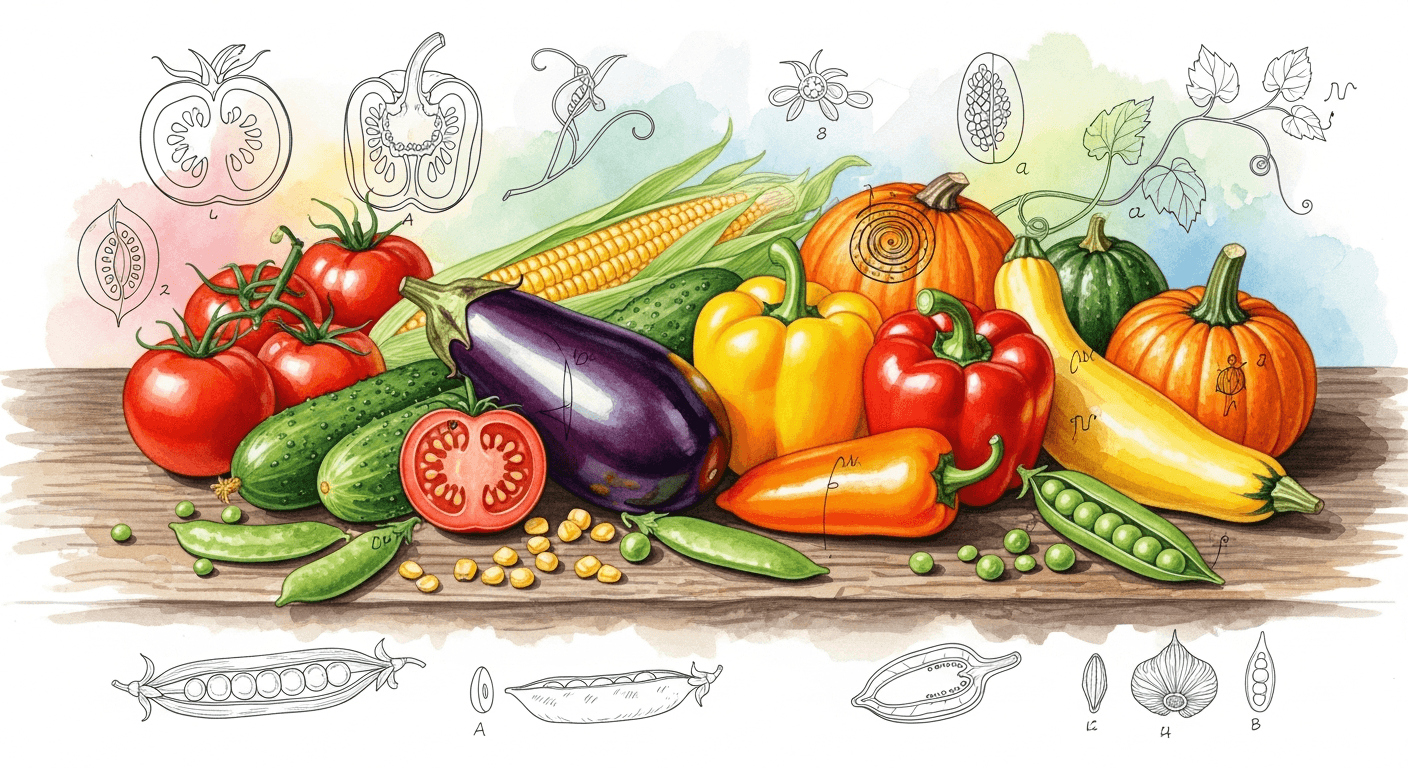
Have you ever bit into a juicy tomato mid-salad and felt like the universe was quietly laughing at you? Welcome to botanical betrayal: many things we call “vegetables” are, by plant-science rules, fruits. I’m guilty too — I grew up seasoning these “veggies” and never once asked whether they’d earned their botanical stripes. Let’s fix that, with a little science, some history, a few myths busted, and a recipe you can try tonight.
Botanical vs culinary: two languages, one kitchen
Botanically, a fruit is the mature ovary of a flowering plant, usually containing seeds. Culinary language is simpler and messier: we group produce by taste and use — sweet vs savory, raw vs cooked. So while a strawberry is obviously a fruit in both senses, a tomato is a fruit botanically (it contains seeds and develops from the flower) but a vegetable when it sits on your sandwich.
Why does this matter? Mostly for trivia-night bragging rights — though it also explains odd classifications like corn kernels being grains (they’re single-seeded fruits called caryopses) or peas living inside pods that are fruit structures (legumes).
Common “vegetables” that are actually fruits
- Tomatoes — Botanically berries. They develop from the flower and hold seeds. Culinary: salad superstar and pizza lawbreakers.
- Cucumbers — A type of pepo (the same fruit family as squash); seed-filled and fruit-by-botany.
- Bell peppers (and hot peppers) — Also berries in botanical terms; their seeds are the giveaway.
- Squash and zucchini — Pepos: large, seeded fruits grown and eaten like vegetables.
- Eggplant (aubergine) — A berry too, yes, despite its savory fate in moussaka.
- Peas — The pod is a fruit (a legume); the peas are seeds inside that fruit.
- Corn kernels — Each kernel is a caryopsis, a dry fruit where seed coat and fruit wall are fused (so yes: fruit).
- Okra — Its pods are fruits (capsules) that hold the seeds.
If you like neat labels, botany will frustrate you. But if you like trivia, it will delight you.
Why nobody told you (or you forgot)
A few reasons this fruity secret remains under wraps:
- Education divides subjects. Science taught plant anatomy; home-ec and cooking teach how to use food. The overlap — nomenclature — is often skipped.
- Culinary habits win. People classify food by flavor and preparation (tomato = salad/ sauce), not by ovaries and seeds.
- Labeling and marketing reinforce the culinary view. Grocery stores, recipe books, and restaurants all treat these items as vegetables.
- History and law. For instance, a famous U.S. customs ruling in 1893 treated tomatoes as vegetables for tariff reasons — practical, not botanical — and such rulings shape popular perception.
Fun botanical facts (to impress friends)
Tomatoes are botanically berries — but not all berries are small and sweet (bananas are berries too!).
Cucurbits (cucumbers, squash) are pepos, a special kind of berry with a tough rind.
The corn kernel’s fancy botanical name is “caryopsis” — a grain that’s also a fruit.
Legume pods (peas, beans) are fruits whose job is to house and eventually eject seeds.
Myth-busting quickies
- Myth: “If it’s not sweet, it’s not a fruit.” Bust: Flavor has nothing to do with botanical fruithood.
- Myth: “Fruits are always eaten raw.” Bust: Many botanical fruits (eggplant, squash) are more commonly cooked.
- Myth: “Vegetable equals leaf/green.” Bust: “Vegetable” is a cooking category, not a botanical one.
A friendly takeaway
Language and context shape what we call things. The kitchen sorts for taste and convenience; botany sorts for reproduction. Both are right for their own jobs. So yes — that tomato in your salad is a fruit, but it’s still a perfectly acceptable companion to your lunch.
Quick and fun recipe: Warm Corn & Tomato Salad (serves 2)
Ingredients:
- 2 ripe tomatoes, chopped
- 1 cup corn kernels (fresh or cooked)
- 1 small cucumber, diced
- 1 small red bell pepper, diced
- 2 tbsp olive oil
- 1 tbsp red wine vinegar or lemon juice
- Handful of torn basil or parsley
- Salt, pepper, and a pinch of chili flakes
Method:
- In a skillet over medium heat, warm the olive oil. Add corn kernels and a pinch of salt; sauté for 3–4 minutes until slightly charred.
- Toss the warm corn into a bowl with tomatoes, cucumber, and bell pepper.
- Add vinegar, herbs, salt, pepper, and chili flakes. Toss and taste.
- Serve warm or at room temperature with crusty bread or alongside grilled fish/cheese.
This salad celebrates the ambidextrous nature of these plants: botanically fruits, culinarily delicious as savory sides.
Regards,
Hemen Parekh (hcp@recruitguru.com)
Any questions / doubts / clarifications regarding this blog? Just ask (by typing or talking) my Virtual Avatar on the website embedded below. Then "Share" that to your friend on WhatsApp.
Get correct answer to any question asked by Shri Amitabh Bachchan on Kaun Banega Crorepati, faster than any contestant
Hello Candidates :
- For UPSC – IAS – IPS – IFS etc., exams, you must prepare to answer, essay type questions which test your General Knowledge / Sensitivity of current events
- If you have read this blog carefully , you should be able to answer the following question:
- Need help ? No problem . Following are two AI AGENTS where we have PRE-LOADED this question in their respective Question Boxes . All that you have to do is just click SUBMIT
- www.HemenParekh.ai { a SLM , powered by my own Digital Content of more than 50,000 + documents, written by me over past 60 years of my professional career }
- www.IndiaAGI.ai { a consortium of 3 LLMs which debate and deliver a CONSENSUS answer – and each gives its own answer as well ! }
- It is up to you to decide which answer is more comprehensive / nuanced ( For sheer amazement, click both SUBMIT buttons quickly, one after another ) Then share any answer with yourself / your friends ( using WhatsApp / Email ). Nothing stops you from submitting ( just copy / paste from your resource ), all those questions from last year’s UPSC exam paper as well !
- May be there are other online resources which too provide you answers to UPSC “ General Knowledge “ questions but only I provide you in 26 languages !





No comments:
Post a Comment