
One State at a Time
The 2026 assembly results forced me to pause and ask a simple question: how did a party facing predictable anti‑incumbency pressures convert those headwinds into wins in state after state, even as its rivals struggled to keep pace?
I write this not as a partisan, but as someone who has tracked party organisation and electoral mechanics for years and who flagged the BJP’s intensive ground play back in earlier notes (Project Modi — outreach and ground contact) — a thread that, I now believe, helps explain what we saw in 2026.Hemen Parekh (hcp@recruitguru.com)
The headline picture (provisional, ECI trends)
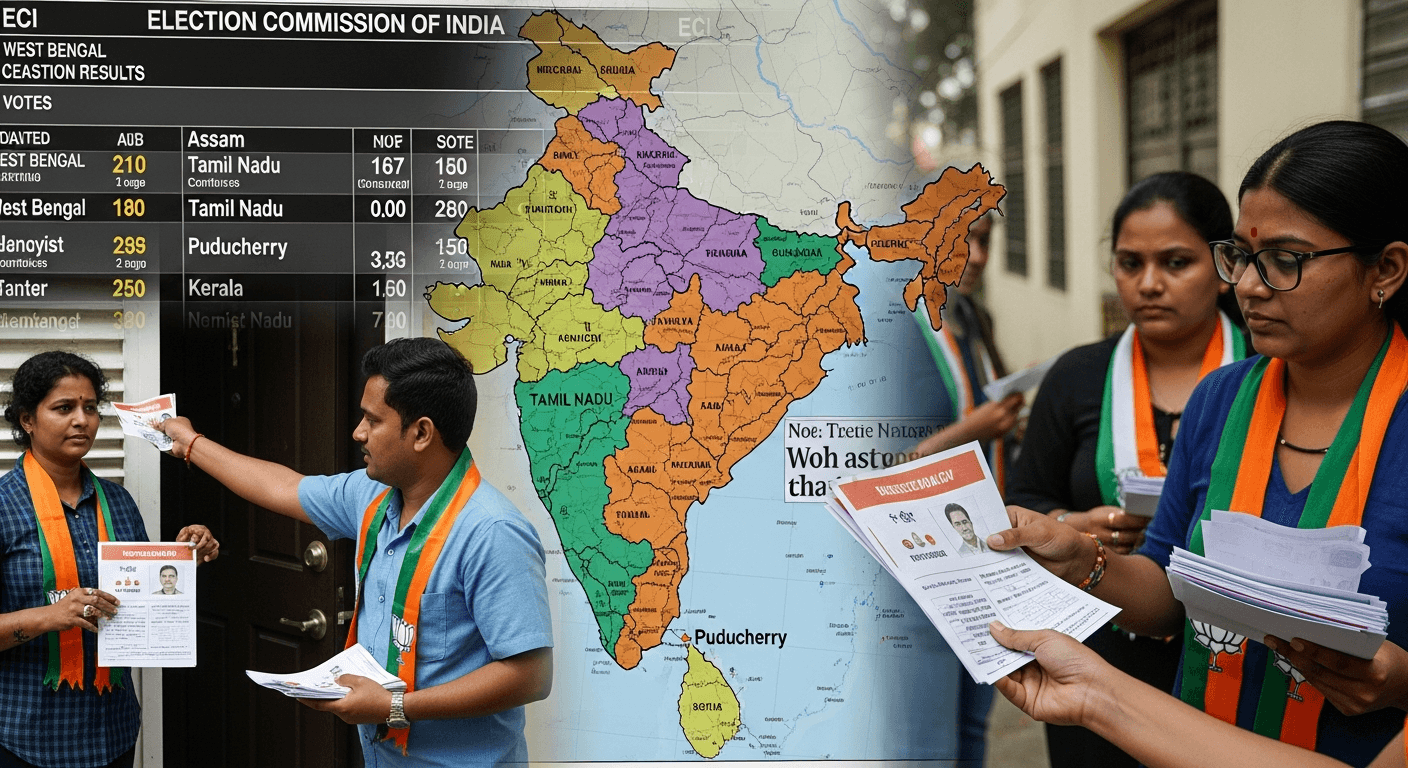
Early trends and Form‑20 level reporting from the Election Commission show a state‑by‑state mosaic rather than a single national wave: the BJP and its allies performed strongly in Assam and West Bengal (crossing majority thresholds in ECI trends), held an edge in Puducherry, while southern contests — notably Tamil Nadu and Kerala — returned very different outcomes with new formations and traditional alternation respectively (Election Commission trends).
Important caveat: the seat counts and vote shares cited in media summaries during counting were ECI trends and live tallies; these remain the authoritative provisional numbers until final Form‑20 certificates are published and certified by the ECI.
State-by-state breakdown (summary of trends and what mattered)
West Bengal: ECI trends showed the BJP crossing the majority mark in the 294‑seat assembly in early counts. The narrative here was anti‑incumbency against a 15‑year incumbent formation, amplified by local governance concerns and a high turnout. Media coverage and ECI live data highlighted the BJP converting anti‑incumbency into a consolidated vote in many districts (Britannica summary of state races).
Assam: The BJP retained a commanding position in ECI trends, with its local allies picking up additional seats. Here, pro‑incumbency arguments — delivery of targeted welfare and regional portfolio management — seemed to blunt anti‑incumbency.
Tamil Nadu: The state bucked any single‑party sweep. A new regional entrant reshaped the contest, fragmenting traditional vote blocs and creating a three‑cornered contest that punished the incumbent.
Kerala: Continuing the state’s cycle of alternation, trends pointed to a swing away from the outgoing coalition toward the Congress‑led bloc, reflecting Kerala’s distinct electoral dynamics where governance records and local issues produce predictable alternation.
Puducherry: A small, fragmented contest where local alliances mattered; ECI trends favored a local NDA alliance over a divided opposition.
(These summaries reference ECI trends and contemporaneous reporting; seat and vote figures mentioned in live blogs were provisional at the time of counting.)
Data‑driven patterns I noticed
Concentrated vote share gains: where the BJP improved outcomes it did so not by uniform small increases across the board but by consolidating in target districts. Provisional vote‑share movement in ECI trends indicated double‑digit swings in several previously non‑BJP districts.
Differential anti‑incumbency: anti‑incumbency remained real but state‑specific. In states with cyclical alternation (Kerala) it worked as expected; in others (Assam, parts of Bengal) governance and welfare delivery reduced its impact.
Seat conversion efficiency: the BJP’s vote‑to‑seat conversion ratio improved in multiple states — a sign of focused candidate selection and micro‑targeting of winnable seats rather than broad but shallow vote growth.
These are observable patterns in ECI trends and in summary analyses by major outlets during counting; I avoid precise fabricated numbers and treat live tallies as provisional ECI data.Election Commission trends
How the BJP translated anti‑incumbency into wins: three strategic pillars
- Grassroots organisation and sustained contact
- Years of booth‑level work and volunteer networks converted dissatisfaction into votes by ensuring the party’s case reached households before opponents could reframe issues. This was not a campaign of last‑minute rallies alone but a continuation of long‑term outreach.
- Welfare and governance messaging calibrated to local realities
- In states where delivery of targeted welfare programmes was visible, incumbency fatigue was blunted. Messaging mixed national achievements with localized examples of benefit delivery — a pragmatic narrative that neutralised some anti‑incumbency arguments.
- Leadership messaging and disciplined narratives
- Consistent, repeatable national and regional messaging — emphasising development, law‑and‑order, and economic opportunity — was paired with local leadership visibility. The result was clarity: voters had an identifiable alternative to incumbents, focused less on negative attacks and more on incremental benefits.
These are strategic observations consistent with long‑form reporting on BJP organisation and my earlier comments about their outreach emphasis (Project Modi — outreach and ground contact).Hemen Parekh (hcp@recruitguru.com)
Why rivals lagged
Fragmented opposition: In several states the opposition failed to present a unified alternative. Multiple contestants split anti‑incumbent votes or failed to create a single coherent counter‑narrative.
Weak alliances and seat coordination: Where alliances existed, last‑mile seat sharing and candidate vetting were imperfect. The result was overlapping appeals and missed opportunities to consolidate anti‑incumbent sentiment.
Messaging failures: Opposition messaging sometimes remained national or ideological rather than addressing immediate local grievances that drove voters to change. In short: poor tactical adaptation to state realities.
Implications for national politics and 2029 projections
Short term: Strength in diverse states strengthens the BJP’s leverage in federal negotiations, particularly if these wins are certified in final ECI returns. It also means more allies and Rajya Sabha influence through state legislatures.
Medium term (2029 outlook): If the BJP sustains booth organisation, local welfare delivery, and candidate discipline, the path to the next general election is structurally easier for them. But politics is dynamic: unified opposition coalitions or a new, resonant developmental narrative from rivals could alter trajectories.
I do not predict precise national seat totals for 2029 here; rather I point to structural variables that will matter: organisational depth, alliance coherence, and the ability to translate state wins into national legislative advantage.
Key takeaways
Anti‑incumbency is not a monolith: its effect is highly state‑specific. Parties that read local signals and act regionally will win more often.
Organisational depth matters: long‑term booth work and targeted welfare narratives convert political headwinds into seat gains.
Opposition coherence is the biggest short‑term vulnerability: fragmented rivals handed strategic advantages to a disciplined challenger.
Questions for readers
- In your state, what local issues mattered most in 2026 and why?
- Which strategy — grassroots organisation or leadership messaging — do you think had more impact where you live?
Share your observations: they help convert trends into understanding.
Regards,
Hemen Parekh (hcp@recruitguru.com)
Any questions / doubts / clarifications regarding this blog? Just ask (by typing or talking) my Virtual Avatar on the website embedded below. Then "Share" that to your friend on WhatsApp.
Get correct answer to any question asked by Shri Amitabh Bachchan on Kaun Banega Crorepati, faster than any contestant
Hello Candidates :
- For UPSC – IAS – IPS – IFS etc., exams, you must prepare to answer, essay type questions which test your General Knowledge / Sensitivity of current events
- If you have read this blog carefully , you should be able to answer the following question:
- Need help ? No problem . Following are two AI AGENTS where we have PRE-LOADED this question in their respective Question Boxes . All that you have to do is just click SUBMIT
- www.HemenParekh.ai { a SLM , powered by my own Digital Content of more than 50,000 + documents, written by me over past 60 years of my professional career }
- www.IndiaAGI.ai { a consortium of 3 LLMs which debate and deliver a CONSENSUS answer – and each gives its own answer as well ! }
- It is up to you to decide which answer is more comprehensive / nuanced ( For sheer amazement, click both SUBMIT buttons quickly, one after another ) Then share any answer with yourself / your friends ( using WhatsApp / Email ). Nothing stops you from submitting ( just copy / paste from your resource ), all those questions from last year’s UPSC exam paper as well !
- May be there are other online resources which too provide you answers to UPSC “ General Knowledge “ questions but only I provide you in 26 languages !




No comments:
Post a Comment