
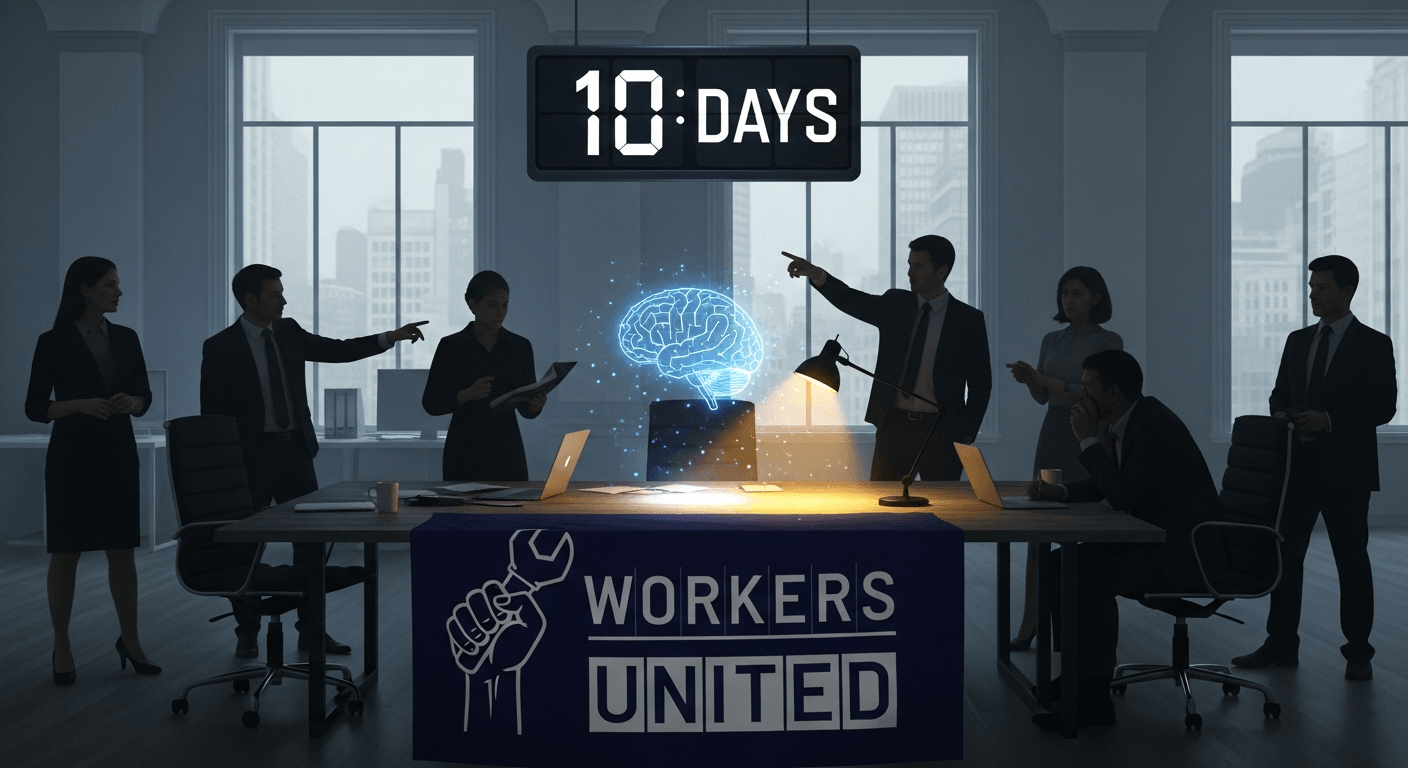
Ten Days at DeepMind
I woke up to the same headline as many of you: UK DeepMind employees have given management a ten-working-day ultimatum to voluntarily recognise two unions — the Communication Workers Union (CWU) and Unite — or face legal proceedings. This is not a narrow workplace squabble. It is a moment when workers, ethics and the future direction of frontier AI intersect in plain sight.
Why this matters to me
I have written about DeepMind before — about the hope and the responsibility that sits with organisations building powerful language and decision systems When will AI make us love each other?. What feels different now is not just the scale of technology, but the mood among the people who build it. Thousands of employees—engineers, researchers, product designers—are asking: who decides how our work is used?
The immediate trigger
The unionisation push follows concern among staff about defence and surveillance uses of company technology, including recent agreements and collaborations that touch on classified or military systems. Workers have used internal voting and a formal letter to ask for recognition; management has been given ten working days to respond before organisers move to legal routes Fortune, Morningstar/AFP and coverage in wider press Times of India.
What the demand represents
This demand is about three overlapping things:
- Worker agency: People who create systems want a seat at the table when those systems are deployed — especially where they may be used by militaries or for surveillance.
- Ethical accountability: When engineers worry that tools will enable harm, union representation becomes a mechanism for collective bargaining on values and constraints.
- Institutional precedent: A recognised union at a major frontier AI lab would be a global signal — other labs and companies will watch closely.
How the company can respond (and why it matters)
There are different paths management can take in the next ten working days, and each will shape culture and risk in different ways:
- Voluntary recognition and mediated negotiations: This would create a formal channel for worker concerns and could defuse escalation.
- Refusal and legal wrangling: That route risks public backlash, strikes, or protracted litigation that distracts from research and product goals.
- Constructive alternatives: Agreements on specific use-case restrictions, independent audits, or ethics oversight — if credible and co-designed — could be part of a solution.
My hope is that companies recognise this as a governance moment, not a threat. Giving workers a meaningful voice is a way to align internal incentives with societal expectations.
Bigger questions this episode raises
- Who gets to set guardrails for frontier AI — engineers, executives, governments, or civil society?
- Can company-level bargaining scale to influence multinational contracts and classified programmes?
- Will recognition of unions at major AI labs create durable mechanisms for ethical red lines, or simply be another channel in political contestation?
These are not technical questions. They are social and political. They require imagination, law, negotiation and — most of all — good faith.
A brief, practical checklist for those watching
- For employees: document concerns, organise transparently, and seek legal advice on recognition pathways.
- For management: open a genuine dialogue, propose mediated talks, and publish timelines for concrete gestures.
- For policy makers and civil society: watch for precedent-setting outcomes and consider how labour rights interact with AI governance.
Final reflection
I have long believed that AI's promise depends on how well we steward it together. The ten-working-day clock at DeepMind is a small, urgent test of whether large tech organisations can evolve governance from the inside out. If we get this right — by combining worker voice, independent oversight and public accountability — we reduce risk and increase public trust. If we ignore it, we should not be surprised when technology and society drift into conflict.
I will be watching how this unfolds. I hope the next ten working days become an exercise in listening and constructive change.
Regards,
Hemen Parekh
Any questions / doubts / clarifications regarding this blog? Just ask (by typing or talking) my Virtual Avatar on the website embedded below. Then "Share" that to your friend on WhatsApp.
Get correct answer to any question asked by Shri Amitabh Bachchan on Kaun Banega Crorepati, faster than any contestant
Hello Candidates :
- For UPSC – IAS – IPS – IFS etc., exams, you must prepare to answer, essay type questions which test your General Knowledge / Sensitivity of current events
- If you have read this blog carefully , you should be able to answer the following question:
- Need help ? No problem . Following are two AI AGENTS where we have PRE-LOADED this question in their respective Question Boxes . All that you have to do is just click SUBMIT
- www.HemenParekh.ai { a SLM , powered by my own Digital Content of more than 50,000 + documents, written by me over past 60 years of my professional career }
- www.IndiaAGI.ai { a consortium of 3 LLMs which debate and deliver a CONSENSUS answer – and each gives its own answer as well ! }
- It is up to you to decide which answer is more comprehensive / nuanced ( For sheer amazement, click both SUBMIT buttons quickly, one after another ) Then share any answer with yourself / your friends ( using WhatsApp / Email ). Nothing stops you from submitting ( just copy / paste from your resource ), all those questions from last year’s UPSC exam paper as well !
- May be there are other online resources which too provide you answers to UPSC “ General Knowledge “ questions but only I provide you in 26 languages !





No comments:
Post a Comment