
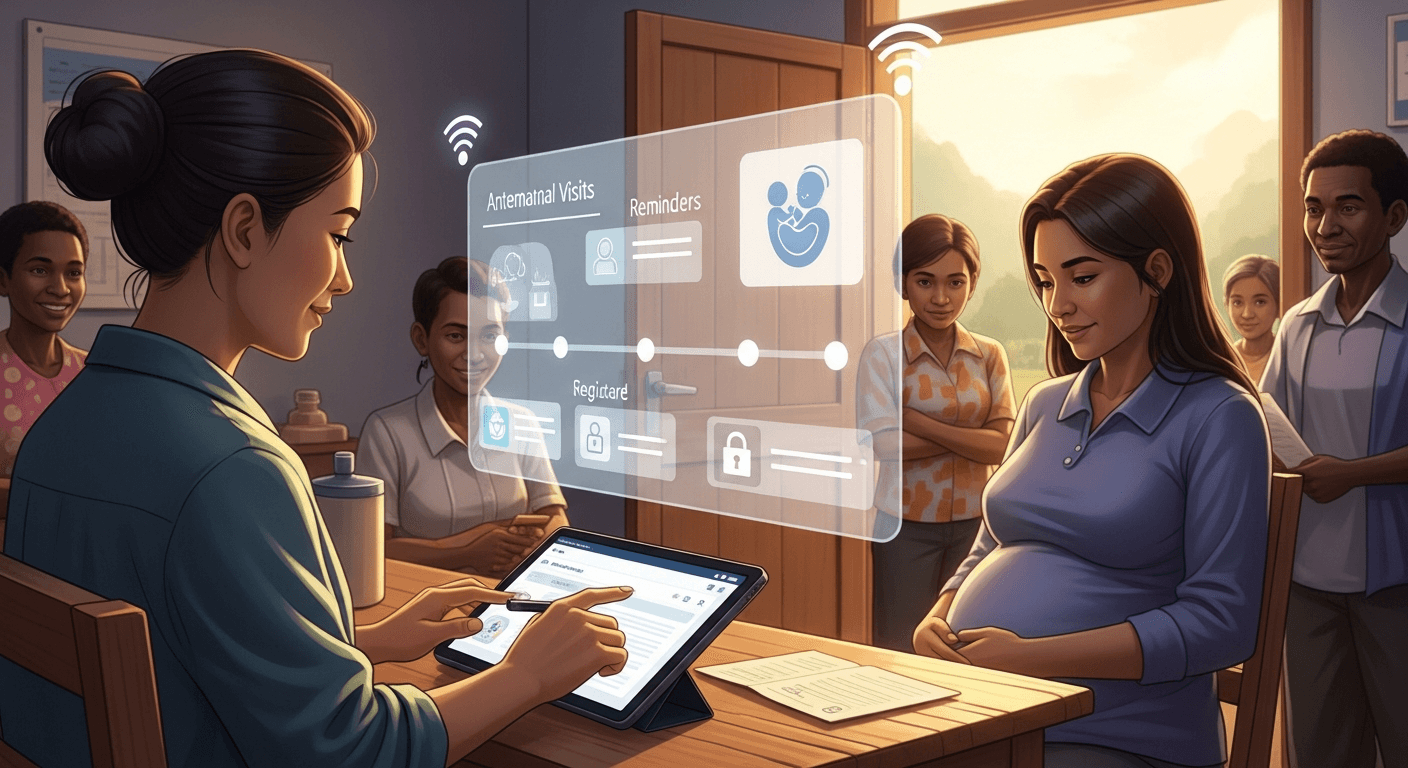
I have long believed that technology — when designed with empathy and implemented with care — can change the arc of human lives. Today I write about a new digital system to track every pregnancy so no mother or child is missed: what it must do, why we need it, and how we make it fair, private and effective.
The problem and the scale
Globally, the majority of preventable maternal and newborn deaths happen where health systems fail to find and follow pregnant women early and consistently. Most of these deaths occur in low- and middle-income countries; they are not a mystery but a failure of timely contact, basic antenatal care, skilled birth attendance and postnatal follow-up.
Behind the statistics are real people — mothers who arrive too late at a clinic, newborns whose danger signs go unnoticed, families who never received follow-up after discharge. Over the years I have argued for digital-first, human-centred interventions to reach those children and mothers who slip through the cracks (BANMALI / Poshan Tracker; Poshan Tracker context and PCTS example). This new system builds on those experiences.
How the system works — end-to-end
At its core the system is simple, modular and designed for real-world constraints.
Registration
Community-level entry points: community health workers, primary clinics, hospitals, and self-registration via a simple IVR/USSD flow or a low-data mobile web form.
Minimal essential dataset: unique identifier, estimated delivery date, contact preferences, preferred facility, and high-level risk markers (e.g., previous C-section, hypertension).
Offline-first design: registrations sync when connectivity returns; paper backup with a unique QR/ID for later digitization.
Tracking and care pathway
Pregnancy timeline: automated schedule of recommended contacts (ANC visits, tetanus, iron supplementation, facility delivery planning, postnatal visits, immunization reminders).
Integration with facility records: births, referrals, complications and newborn outcomes update the mother–child record in real time where possible.
Alerts: two-way SMS/IVR reminders for appointments; SMS to local health workers when appointments are missed; escalation workflows for high-risk pregnancies.
Reminders and engagement
Multi-channel: SMS, voice (IVR), push notifications, and community worker prompts — adapted to literacy, language and device availability.
Behavioural nudges and education: short, culturally appropriate messages about danger signs, nutrition, and newborn care.
Data privacy and governance
Consent-first: explicit, local-language consent at registration with clear options to opt-out or set sharing preferences.
Minimal necessary data: store only what is needed for continuity of care and public health analysis.
Encryption and role-based access: encrypted data at rest and in transit; audit trails and strict, limited access for providers.
Federated architecture where possible: local storage and analytics with anonymized, aggregated insights shared upwards for planning.
Benefits — mothers, children and health systems
Mothers and newborns
Timely, personalized reminders increase attendance at ANC and facility births.
Early identification of high-risk pregnancies enables targeted referral and transport planning.
Better continuity of care for postpartum complications and newborn immunizations.
Health systems
Accurate, near-real-time coverage maps: who’s registered, who’s been seen, and where gaps exist.
Smarter allocation: data-driven deployment of outreach teams, supplies and emergency referral systems.
Improved measurement: reliable denominators for program evaluation and targeted interventions.
Potential challenges and pragmatic solutions
Digital divide
Challenge: limited phone ownership, intermittent connectivity, and literacy barriers.
Solutions: offline-first apps for community health workers, IVR/USSD for basic phones, local language voice messages, and continued investment in community worker networks.
Data security and trust
Challenge: fear of misuse and breaches can prevent uptake.
Solutions: transparent consent, encryption, independent audits, public privacy policy, and community governance boards to oversee data use.
Implementation costs and sustainability
Challenge: initial investments in systems, training and devices.
Solutions: incremental pilots; open-source platforms to lower licensing costs; partnerships with telecoms for subsidized messaging; embed costs into existing maternal-child health budgets and donor-funded transitions.
Operational complexity
Challenge: integrating with many facility systems and workflows.
Solutions: modular APIs, standards-based data formats, and phased rollouts starting with the highest-impact geographies.
Real-world examples and pilots
We have tangible precedents: digital maternal messaging and tracking systems have been piloted and scaled in several settings. At the subnational level, initiatives inspired by my earlier ideas (BANMALI/Poshan Tracker) and state-level mobile apps have shown how local adaptation matters (BANMALI and Poshan Tracker reflections; Rajasthan PCTS coverage context). Other national and subnational programs have demonstrated the power of SMS/IVR reminders, community worker integration, and simple registration-to-follow-up pipelines. The common lesson: context, trust, and persistent human support are the differentiators.
Call to action — for policymakers and health organizations
We must move from pilots to national adoption with care. I propose:
- Policymakers: adopt standards for maternal–newborn digital records; fund national pilots with clear scale-up pathways; mandate privacy protections and open APIs.
- Health organizations and donors: invest in community health worker capacity, fund low-bandwidth solutions, and prioritize interoperability with immunization and civil registration systems.
- Local implementers: design with mothers and front-line workers; test multimodal communication (IVR, SMS, CHW prompts); build evaluation from day one.
When technology is thoughtfully combined with community trust and strong governance, we can ensure timely care for every pregnancy. I remain optimistic — not because technology alone will save lives, but because it can be the bridge that connects courageous health workers to the mothers who need them most.
Regards,
Hemen Parekh
Any questions / doubts / clarifications regarding this blog? Just ask (by typing or talking) my Virtual Avatar on the website embedded below. Then "Share" that to your friend on WhatsApp.
Get correct answer to any question asked by Shri Amitabh Bachchan on Kaun Banega Crorepati, faster than any contestant
Hello Candidates :
- For UPSC – IAS – IPS – IFS etc., exams, you must prepare to answer, essay type questions which test your General Knowledge / Sensitivity of current events
- If you have read this blog carefully , you should be able to answer the following question:
- Need help ? No problem . Following are two AI AGENTS where we have PRE-LOADED this question in their respective Question Boxes . All that you have to do is just click SUBMIT
- www.HemenParekh.ai { a SLM , powered by my own Digital Content of more than 50,000 + documents, written by me over past 60 years of my professional career }
- www.IndiaAGI.ai { a consortium of 3 LLMs which debate and deliver a CONSENSUS answer – and each gives its own answer as well ! }
- It is up to you to decide which answer is more comprehensive / nuanced ( For sheer amazement, click both SUBMIT buttons quickly, one after another ) Then share any answer with yourself / your friends ( using WhatsApp / Email ). Nothing stops you from submitting ( just copy / paste from your resource ), all those questions from last year’s UPSC exam paper as well !
- May be there are other online resources which too provide you answers to UPSC “ General Knowledge “ questions but only I provide you in 26 languages !



No comments:
Post a Comment