
Connect with Hemen Parekh hcp@recruitguru.com
Iran war begins to bomb the GST bonanza. What can happen?
I write in first-person because these are practical reflections I share for business leaders, risk teams and policy watchers. By “GST bonanza” I mean the recent era of Global Shipping & Trade bonanza — lower tariffs, expanding trade volumes, and the efficiencies that followed from containerised shipping, predictable port schedules and relatively open maritime lanes.
I have written before about how trade tensions and policy shifts can reshape supply chains and competitiveness Trade Wars: Powered by Cyber Wars?. The present escalation — where Iran becomes a kinetic actor affecting shipping and trade — threatens those gains in specific and measurable ways.
What is at stake
- Global markets: investor sentiment will wobble as volatility rises. Risk premia for trade-exposed sectors (autos, electronics, retail) and for banks with trade finance exposure will increase.
- Supply chains: Just‑in‑time (JIT) flows that rely on tight schedules are most vulnerable. Delays will cascade into inventory shortages and production slowdowns.
- Energy prices: any disruption near the Strait of Hormuz or key tanker routes lifts crude and refined fuel prices; markets price in a premium for transit risk.
- Shipping: container spot rates and time‑charter rates will spike as carriers re-route, add time and fuel costs, or avoid certain lanes.
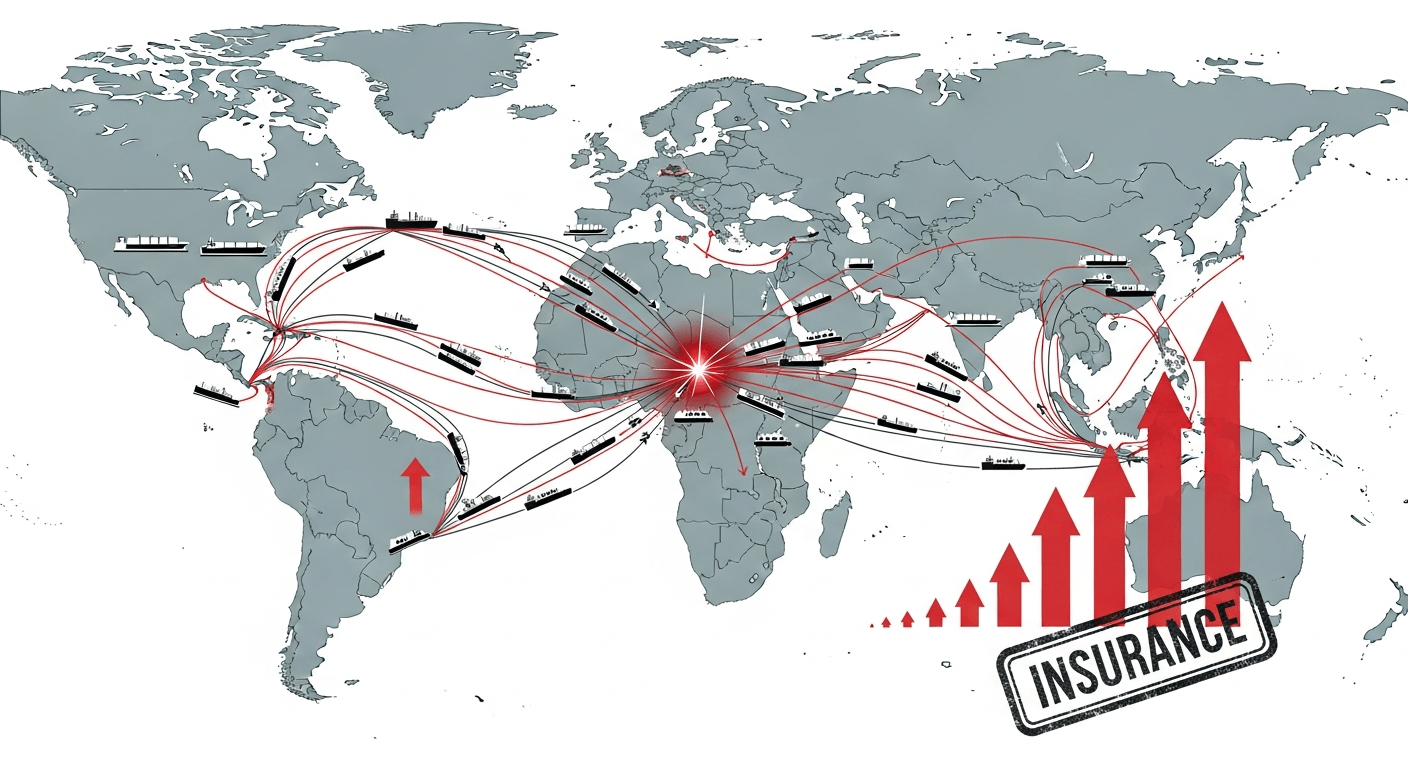
- Insurance: war and war‑related exclusions make premiums rise sharply; some insurers may withdraw cover from specific routes.
Likely scenarios
Note: these are plausible scenarios, not predictions. Outcomes are uncertain and contingent on diplomatic and military developments.
Short-term (weeks)
- Market: equity volatility up; safe‑haven flows to bonds and gold. Shipping-sensitive stocks fall.
- Shipping & routes: carriers temporarily suspend transits through highest‑risk chokepoints; some cargo is delayed or consolidated at transshipment hubs.
- Energy: crude briefly spikes; refiners face margin squeeze if fuel shortages intensify.
- Insurance: war risk premiums jump for tankers and some container trades; insurers demand higher deductibles or add exclusions.
Medium-term (3–12 months)
- Market: sustained risk premium in commodity and transport sectors; emerging markets reliant on imported energy or inputs feel pressure.
- Supply chains: firms re-route permanently where cost‑effective, nearshore where feasible, or increase safety stocks; lead times extend.
- Shipping: re‑routing around longer paths (e.g., around Africa) raises voyage costs and turnaround times, pushing up spot freight rates.
- Insurance: permanent recalibration of war‑risk pools and higher premiums for routes near conflict zones; some lines may become uninsurable without government backstops.
Geopolitical risks and likely policy responses
- Sanctions: expect intensified sanctions on actors connected to attacks. Secondary sanctions can complicate insurance and financing for vessels and ports.
- Diplomatic containment: coalition naval escorts or convoy systems may be offered for commercial shipping — but these raise costs and legal complexities.
- Insurance industry reaction: reinsurers and P&I clubs will reassess exposures; government export credit agencies may step in to cover politically sensitive trades.
- Rerouting and regulation: port authorities and flag states may issue advisories or bans; customs and sanctions compliance burdens will increase.
Practical guidance for businesses
Risk mitigation steps
- Map exposure: identify routes, suppliers, and SKUs that transit affected regions. Prioritise products with low substitution elasticity.
- Increase buffer stocks selectively: move from lean inventories to targeted safety stock for critical parts and finished goods.
- Diversify suppliers and routes: qualify second‑source suppliers outside high‑risk corridors and evaluate logistic partners with flexible routing.
Contingency planning
- Scenario playbooks: create short‑term (2–8 week) and medium‑term (3–12 month) operational playbooks covering rerouting, partial shutdowns, and force majeure invocation.
- Contracts and clauses: review Incoterms, force majeure, delivery windows, and penalty clauses. Engage legal counsel on sanctions exposure.
- Communication: prepare messaging for customers, suppliers and financial partners to explain delays and contractual adjustments.
Hedging strategies
- Commodities: use futures and options to hedge energy and key commodity price exposure; stagger hedges to avoid timing concentration.
- FX & credit: hedge receivables/payables in affected currencies; consider credit insurance for increased counterparty risk.
- Freight & insurance: negotiate freight‑rate collars where possible; buy war‑risk cover early for planned voyages and consider political risk insurance or government de‑risking facilities.
What insurers and carriers will watch
- War‑risk pooling and reinsurance capacity; a sustained conflict may force reinsurers to raise rates or restrict capacity.
- Flag‑state and port restrictions altering voyage economics; carriers will pass costs to shippers via surcharges.
Labeling uncertainty
I underscore that many outcomes are conditional. Diplomatic de‑escalation, third‑party mediation, or effective naval escorts could limit damage. Conversely, broadening of conflict or crippling sanctions could deepen market and supply‑chain effects. Treat forecasts as contingent scenarios, not certainties.
Conclusion — key takeaways
- The “GST bonanza” is vulnerable: shipping disruptions, higher energy costs and insurance repricing can quickly reverse some trade gains.
- Businesses must act now: map exposures, increase targeted buffers, diversify supply sources and routes, and update contracts and hedging plans.
- Policy responses (sanctions, naval escorts, insurance backstops) will shape the medium‑term landscape; monitor policy and insurance markets closely.
Regards,
Hemen Parekh hcp@recruitguru.com
Any questions / doubts / clarifications regarding this blog? Just ask (by typing or talking) my Virtual Avatar on the website embedded below. Then "Share" that to your friend on WhatsApp.
Get correct answer to any question asked by Shri Amitabh Bachchan on Kaun Banega Crorepati, faster than any contestant
Hello Candidates :
- For UPSC – IAS – IPS – IFS etc., exams, you must prepare to answer, essay type questions which test your General Knowledge / Sensitivity of current events
- If you have read this blog carefully , you should be able to answer the following question:
- Need help ? No problem . Following are two AI AGENTS where we have PRE-LOADED this question in their respective Question Boxes . All that you have to do is just click SUBMIT
- www.HemenParekh.ai { a SLM , powered by my own Digital Content of more than 50,000 + documents, written by me over past 60 years of my professional career }
- www.IndiaAGI.ai { a consortium of 3 LLMs which debate and deliver a CONSENSUS answer – and each gives its own answer as well ! }
- It is up to you to decide which answer is more comprehensive / nuanced ( For sheer amazement, click both SUBMIT buttons quickly, one after another ) Then share any answer with yourself / your friends ( using WhatsApp / Email ). Nothing stops you from submitting ( just copy / paste from your resource ), all those questions from last year’s UPSC exam paper as well !
- May be there are other online resources which too provide you answers to UPSC “ General Knowledge “ questions but only I provide you in 26 languages !



No comments:
Post a Comment