
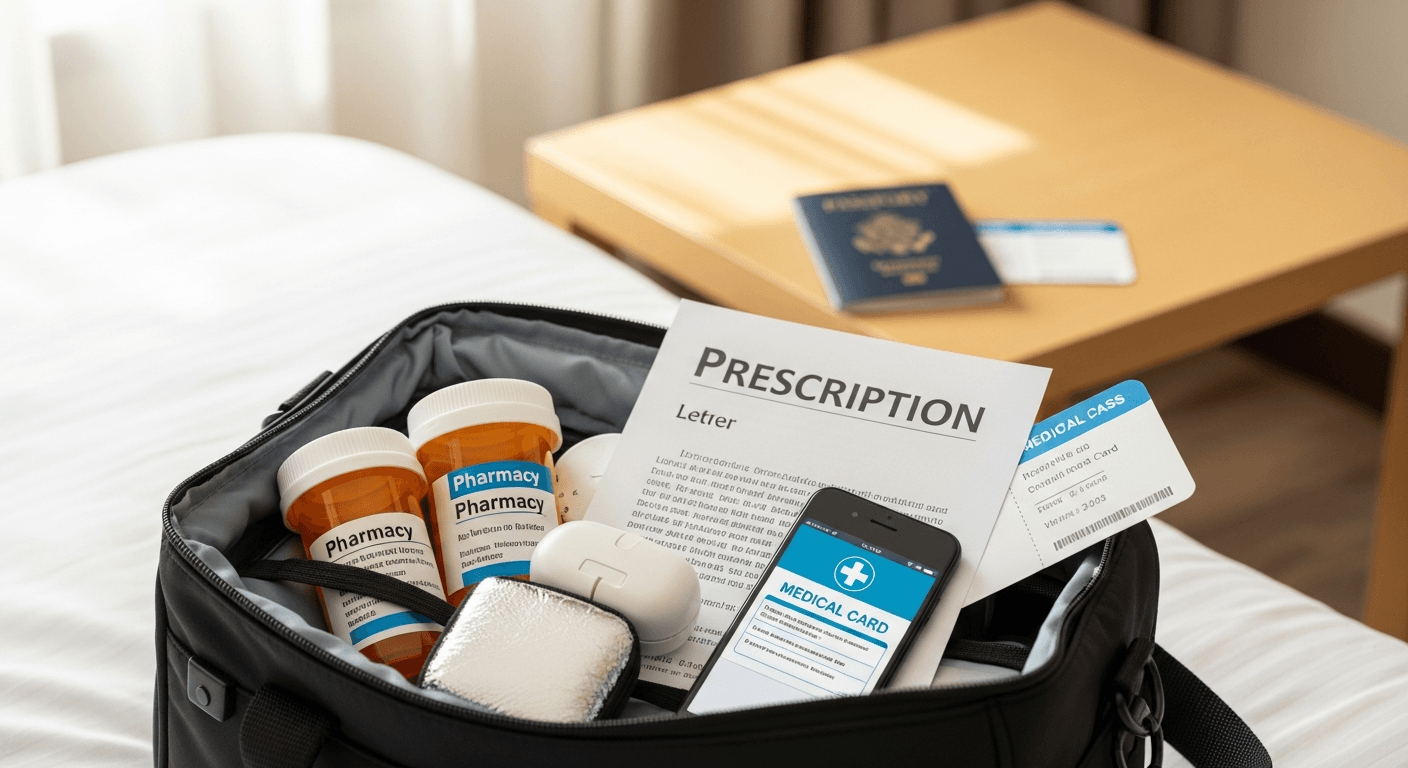
Flying With Prescription Medicines
Quick summary
Traveling with prescription drugs is common — and straightforward if you prepare. Before you pack, check documentation rules for prescriptions and controlled substances, keep medicines in original packaging, carry the right quantity, and know how to declare and handle them at the airport and across borders. Contact your airline, doctor, and the embassy of your destination if you have any doubt.
Why rules matter
Regulations exist to prevent diversion of controlled drugs, to protect public health, and to make sure you can access lifesaving treatments while abroad. Failure to follow rules can lead to confiscation, fines, or even arrest in some countries. Rules differ by country and by the class of medication — so a little prep prevents a lot of trouble.
Preparing before travel
Prescription documentation
Carry a signed original prescription or a printed copy from your prescriber that includes the drug name (generic and brand), dosage, your full name and date of birth, the prescriber's contact details, and the medical condition.
If possible, bring a short letter from your prescriber on clinic/hospital letterhead describing your diagnosis and why the medication is necessary.
Quantity considerations
Pack only what you need for the trip plus a small emergency buffer (3–7 days). Larger quantities can trigger customs questions or require permits.
For long stays, check if you can import additional supplies legally or arrange for local refills.
Carry-on vs checked baggage
Keep medicines in your carry-on bag. Security delays, lost luggage, or temperature-sensitive drugs make carry-on the safer choice.
If you must check injectables or large medical supplies, photograph/scan documentation and notify the airline in advance.
Original packaging
Keep medicines in their original pharmacy-labeled containers. Labels help security and customs officers confirm the prescription.
Translations and medical notes
For non-English destinations, have key information translated (drug names, active ingredient, dosage). A short translated medical note from your doctor can help local officials or pharmacists.
Airport and airline procedures
Declaring meds
Follow the airline and departure/arrival airport guidance. If asked on a customs declaration, answer truthfully about prescription medicines.
Security screening tips
Notify the TSA or local security officer that you carry medication and medical devices (e.g., insulin pumps). Ask for inspection in a private area if preferred.
Liquids policy: prescription liquids and medications are generally allowed beyond liquid limits but must be declared and presented for inspection.
Controlled substances
If your medication is a controlled substance (opioids, certain stimulants, benzodiazepines), check both airline policy and destination country rules; you may need a special permit or documentation.
Customs and legal considerations by region
United States (US)
Bring prescriptions and original packaging; for controlled substances, a valid prescription is expected. Analgesics and stimulants are closely regulated.
European Union (EU)
Many EU countries allow personal medication with prescription and reasonable quantities. Some drugs (narcotics, strong opioids) require an official permit.
United Kingdom (UK)
Similar to the EU in practice; check UK government guidance and bring documentation.
Australia
Australia is strict about controlled substances and some common medicines (pseudoephedrine, some painkillers). Apply for an import permit if travelling with larger quantities.
Canada
Carry prescriptions and original containers; certain controlled drugs may have limits.
Middle East and Asia (note about stricter laws)
Many countries in the Middle East and parts of Asia have very strict or zero-tolerance policies on certain medications and drug residues (including some opioids and codeine-containing products). Some over-the-counter medicines at home are controlled or banned abroad. Always check the embassy/consulate guidance first.
Before departure: contact the embassy or consulate of your destination and your airline to confirm rules relevant to your medications.
Advice for emergencies
Lost meds or delays
Carry an extra short written prescription and a digital copy of your prescription and doctor’s note in secure cloud storage.
If luggage with meds is delayed, contact the airline immediately and use your documentation to request assistance.
Refills abroad
Ask your doctor about an emergency international prescription or a larger supply before you leave. Otherwise, locate an English-speaking local doctor or use telehealth services to obtain a local prescription.
Telehealth
Many telemedicine providers can consult and prescribe while you travel; confirm their ability to prescribe certain controlled substances in the destination country.
Tips for special meds
Vaccines
Carry vaccination records and certificates (e.g., yellow fever card) when required by entry rules.
Injectables and syringes/needles
Carry sharps in their proper containers and bring a doctor’s note explaining clinical need. Many airports require syringes to be declared and screened separately.
Liquid medicines and refrigeration
Insulin and other injectables that need refrigeration: use an insulated travel case with ice packs; keep in carry-on and inform security. Bring temperature-monitoring advice from your provider.
Controlled or habit-forming medications
Some commonly prescribed anti-anxiety meds or stimulants are heavily restricted in other countries. Confirm permit requirements before travel.
Checklist (pack with you)
- Original prescription(s) and doctor’s letter
- Medication in original pharmacy-labeled containers
- Small travel pill organizer (for daily use) — keep originals with you too
- Digital copies of prescriptions and doctor contact info (cloud + local phone)
- translated medication list if needed
- Travel med card (printed and digital)
- Insulated case for refrigerated meds and thermometer if required
- Extra prescription for emergencies
- Contact info for your embassy, travel insurance, local healthcare, and your prescribing doctor
Printable travel med card (example template)
- Full name:
- Date of birth:
- Emergency contact name & phone:
- Allergies:
- Medical conditions:
- Current medications (generic name — dose — frequency):
- 1)
- 2)
- Prescribing physician:
- Name, clinic, phone, email:
- Pharmacy contact (home):
- Insurance policy number & insurer contact:
- Notes for security/customs: (e.g., "Contains syringes/insulin; prescription on letterhead")
(Keep one printed card in your wallet and a digital copy on your phone.)
Concluding takeaways
A calm, checklist-driven approach keeps medication travel simple: document, carry-on, declare when required, and confirm rules in advance with airlines and embassies. For controlled or temperature-sensitive drugs, get explicit written guidance from your doctor and from the destination’s embassy. When in doubt, call your airline and your prescriber — preparation is the best travel medicine.
I’ve written about the changing landscape of medicine delivery and regulation before; for context on how prescriptions and distribution are evolving, see my earlier piece 3 D - Digital Delivery of Drugs.
Regards,
Hemen Parekh
Any questions / doubts / clarifications regarding this blog? Just ask (by typing or talking) my Virtual Avatar on the website embedded below. Then "Share" that to your friend on WhatsApp.
Get correct answer to any question asked by Shri Amitabh Bachchan on Kaun Banega Crorepati, faster than any contestant
Hello Candidates :
- For UPSC – IAS – IPS – IFS etc., exams, you must prepare to answer, essay type questions which test your General Knowledge / Sensitivity of current events
- If you have read this blog carefully , you should be able to answer the following question:
- Need help ? No problem . Following are two AI AGENTS where we have PRE-LOADED this question in their respective Question Boxes . All that you have to do is just click SUBMIT
- www.HemenParekh.ai { a SLM , powered by my own Digital Content of more than 50,000 + documents, written by me over past 60 years of my professional career }
- www.IndiaAGI.ai { a consortium of 3 LLMs which debate and deliver a CONSENSUS answer – and each gives its own answer as well ! }
- It is up to you to decide which answer is more comprehensive / nuanced ( For sheer amazement, click both SUBMIT buttons quickly, one after another ) Then share any answer with yourself / your friends ( using WhatsApp / Email ). Nothing stops you from submitting ( just copy / paste from your resource ), all those questions from last year’s UPSC exam paper as well !
- May be there are other online resources which too provide you answers to UPSC “ General Knowledge “ questions but only I provide you in 26 languages !




No comments:
Post a Comment