
Introduction
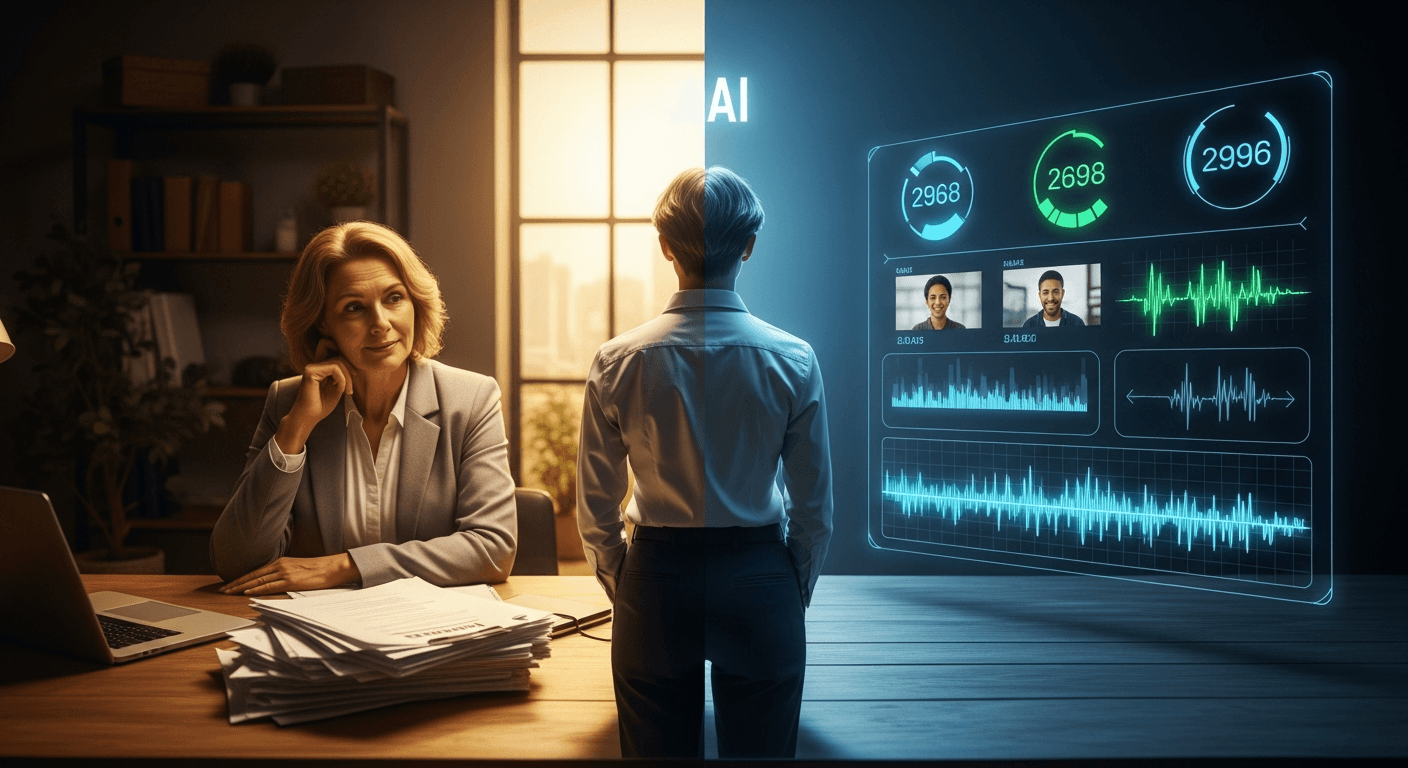
I remember the early days when recruitment meant long CV piles, coffee-fueled screening sessions and gut calls. Today, much of that human noise has been replaced by code. I write this as someone who has watched personnel analytics evolve for years — I even explored early process charts for matching candidates back in 2017 Re-process flow charts — and I can tell you: we’ve reached a moment where your next boss may literally be an algorithm.
Why this matters (fast)
AI systems already decide who gets a first interview, who is short‑listed, who receives an offer — and increasingly who is flagged for layoff. The scale and opacity of those systems mean errors and bias can affect thousands of lives quickly. That’s why I write with a little urgency: this technology is powerful, useful, and not automatically fair.
Real‑world examples
- Video interviews scored by automated systems have been used by large hiring platforms and enterprise customers to assess thousands of candidates quickly. Critics have challenged the role of facial analysis and mood detection in rating applicants.
- A major technology company quietly retired an internal recruiting model after it learned the model preferred characteristics historically overrepresented in resumes, demonstrating how training data can bake in bias.
- Game‑style assessments and behavioral microsurveys used by startups claim to measure fit and cognitive traits; employers use aggregated outputs to prioritize candidates or predict attrition.
- Warehouse and frontline operations increasingly use automated monitoring to measure productivity and trigger warnings, performance reviews, or even termination recommendations.
How these AI systems work (simple guide)
Resume screening
What it does: Parses CVs, maps keywords to job requirements, ranks candidates by a score.
How it works: Natural language processing (NLP) plus classifiers trained on historical hiring decisions.
Video interview analysis
What it does: Evaluates verbal responses, language patterns, and — in some tools — facial micro‑expressions or gaze.
How it works: Speech‑to‑text + NLP for content; computer vision models for face/body cues.
Predictive attrition (who will leave?)
What it does: Flags employees with high estimated probability of resigning or being disengaged.
How it works: Uses HRIS, engagement surveys, performance reviews, and behavioral signals to predict turnover risk.
Performance monitoring
What it does: Tracks output, idle times, keystrokes, or sensor data and surfaces productivity scores.
How it works: Telemetry + analytics dashboards; in some settings, automated alerts feed manager decisions.
Ethical concerns — the hard questions
- Bias: Models learn from historical hiring and performance decisions. If past managers favored certain schools, genders, or backgrounds, AI reproduces those preferences at scale.
- Transparency: Many systems are black boxes. Candidates and even HR teams often don’t know why a score changed or why a person was filtered out.
- Accountability: When an algorithm recommends firing or rejects a candidate, who owns that decision — the vendor, the HR leader, or the AI? Clear accountability is scarce.
- Privacy: Video interviews, keystroke logs, and biometric analyses carry sensitive data. Unconsented reuse or insecure storage creates real risk.
Legal and regulatory landscape (what to watch)
Governments and regulators are waking up:
- Europe: The EU’s AI Act treats some hiring and personnel analytics systems as high‑risk and requires transparency, testing for bias, and documentation.
- U.S.: Federal agencies (civil rights and consumer protection bodies) have issued guidance about algorithmic discrimination and deceptive practices. Local laws in some cities mandate bias audits for automated employment decision tools and restrict certain biometric uses.
- Privacy laws: Jurisdictions with biometric privacy statutes can affect video‑based screening if facial features or voiceprints are processed without proper consent.
Practical advice — for jobseekers
- Prepare for automated filters: tailor your resume to keywords and plain‑language role descriptions; avoid images, headers or formats that parsing tools struggle with.
- Treat video interviews as data: speak clearly, structure answers, and be aware that neutral facial expressions or nervous ticks can be misinterpreted by naive models.
- Build evidence: keep a portfolio, links, or short project summaries you can share. Human reviewers appreciate concrete artifacts that transcend algorithmic summaries.
- Ask questions: if a company uses automated assessments, request information about what data they collect, how it’s used, and whether a human review follows the algorithmic decision.
Practical advice — for employers
- Audit your models: measure disparate impact across demographics, simulate edge cases, and validate models on current, representative data.
- Keep humans in the loop: use AI to augment, not replace, final hiring and firing decisions — especially for high‑stakes outcomes.
- Document and explain: provide candidates clear notices about automated decision‑making and offer appeal or human review paths.
- Protect data: minimize collection, limit retention, and secure sensitive biometric or behavioral signals.
Conclusion and future outlook
AI will continue to change recruiting and workforce decisions — making processes faster and, when done right, more consistent. But speed and scale don’t eliminate the need for judgment, ethics and empathy. If we pair powerful models with rigorous audits, clear accountability and respect for privacy, AI can be a tool that widens opportunity rather than narrows it.
I’ve written about the promise of personnel analytics before and continue to believe the technology can help — if we build guardrails while adoption is still accelerating Re-process flow charts.
Connect with Hemen Parekh — hcp@recruitguru.com
Regards,
Hemen Parekh
Any questions / doubts / clarifications regarding this blog? Just ask (by typing or talking) my Virtual Avatar on the website embedded below. Then "Share" that to your friend on WhatsApp.
Get correct answer to any question asked by Shri Amitabh Bachchan on Kaun Banega Crorepati, faster than any contestant
Hello Candidates :
- For UPSC – IAS – IPS – IFS etc., exams, you must prepare to answer, essay type questions which test your General Knowledge / Sensitivity of current events
- If you have read this blog carefully , you should be able to answer the following question:
- Need help ? No problem . Following are two AI AGENTS where we have PRE-LOADED this question in their respective Question Boxes . All that you have to do is just click SUBMIT
- www.HemenParekh.ai { a SLM , powered by my own Digital Content of more than 50,000 + documents, written by me over past 60 years of my professional career }
- www.IndiaAGI.ai { a consortium of 3 LLMs which debate and deliver a CONSENSUS answer – and each gives its own answer as well ! }
- It is up to you to decide which answer is more comprehensive / nuanced ( For sheer amazement, click both SUBMIT buttons quickly, one after another ) Then share any answer with yourself / your friends ( using WhatsApp / Email ). Nothing stops you from submitting ( just copy / paste from your resource ), all those questions from last year’s UPSC exam paper as well !
- May be there are other online resources which too provide you answers to UPSC “ General Knowledge “ questions but only I provide you in 26 languages !


No comments:
Post a Comment