
Historical canvas: why symbols matter
I have long believed that objects, images and rituals carry the memory of a people. In Bengal this is especially true: trees, boats, rugs of color, painted floors and goddesses are not mere decorations. They are living archives—portable histories that mark moments of rupture and renewal. In earlier reflections on cultural continuity I explored how public symbols shape civic imagination Quo Vadis. Here I want to look specifically at Bengal: the meanings embedded in its chief symbols and how they have been summoned at milestones like the Language Movement, Partition, independence and cultural renaissances.
A brief historical background
Bengal’s history is a weave of empires, trade networks, colonial modernity and anticolonial politics. The late 19th and early 20th centuries saw the Bengal Renaissance, a period of intense intellectual and artistic ferment that redefined social norms and cultural practices. The mid-20th century brought sharper political ruptures: the Quit India and independence movements, the violent Partition of 1947, and the Language Movement of 1952 in East Bengal (which later became Bangladesh). Each of these events left impressions on the landscape of symbols—adopted, contested, repurposed—and the meanings of those symbols evolved accordingly.
Key cultural symbols and their meanings
Below I describe several emblematic symbols of Bengal and the layers of meaning they carry.
The banyan tree
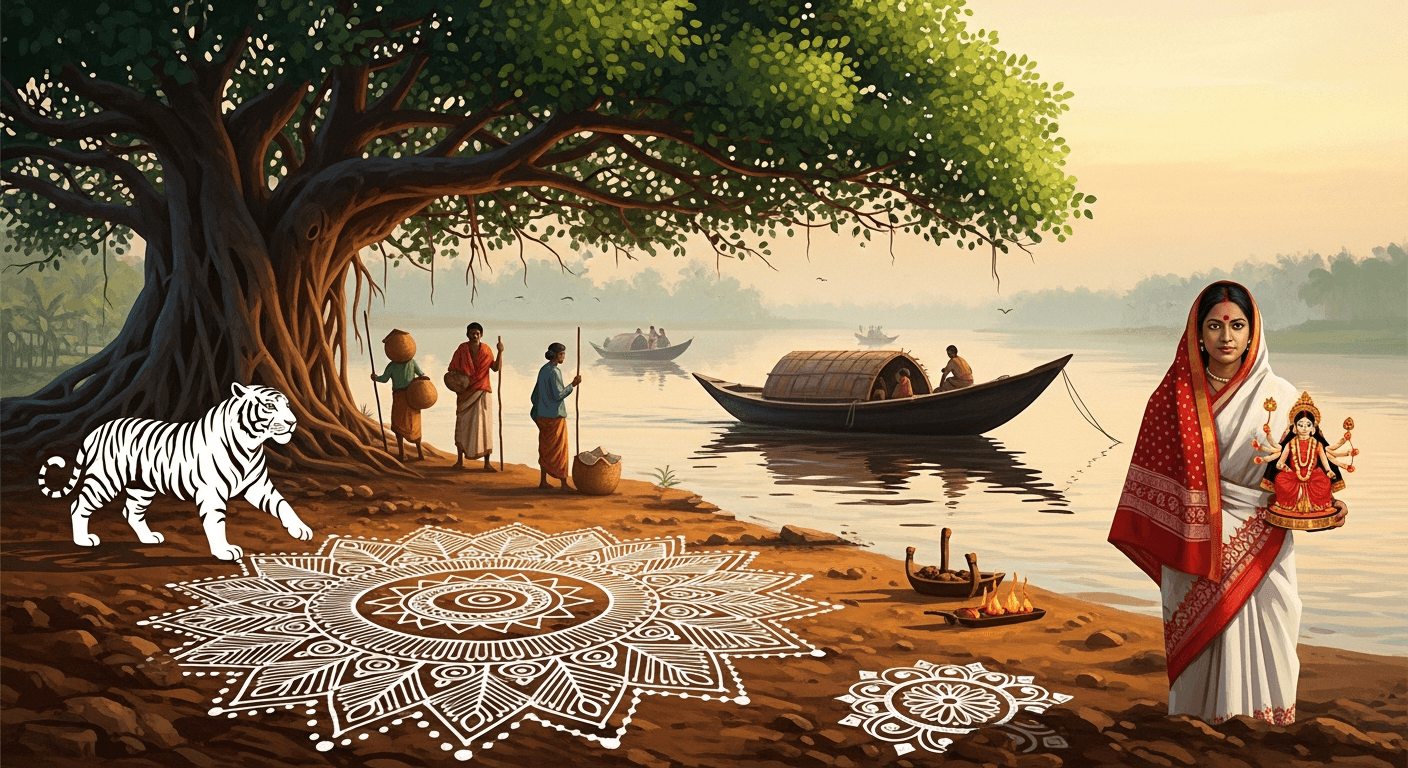
- The banyan is a common presence in Bengali villages and towns. As a living architecture that throws out aerial roots, it stands for endurance, community and public life: people gather beneath its shade for discussion, dispute and ceremony.
- At milestone moments—when communities needed a public stage, from anti-colonial meetings to village assemblies after Partition—the banyan functioned as a natural agora. It symbolizes rootedness even when people are uprooted.
The boat (nouka)
- Bengal’s riverine geography made the boat the primary vehicle of movement and imagination. It signifies journey, livelihood and adaptation.
- During Partition and migration, the boat became a metaphor for precarious passage—carrying families, memories and sometimes loss across new borders. Folk songs and visual art frequently use boats to speak about crossing, exile and homecoming.
The Royal Bengal tiger
- The tiger is a symbol of strength and the wild grandeur of Bengal’s forests. It appears in folk narratives and modern emblems alike.
- Politically, the tiger can be read two ways: as pride and defiance (an emblem of courage), and as a reminder of what is endangered—languages, communities, ecosystems—when conflict and modern pressures advance.
Alpona / Alpana (floor art)
- These intricate, often white, chalk or rice-paste designs sweep thresholds and courtyards for festivals and rites. They mark sacred time and invite auspiciousness.
- After moments of upheaval—be it Partition, war or social change—alpona became a way to reassert domestic order and cultural continuity. Drawing these patterns is an act of re-making home.
The red-and-white sari
- The red-and-white sari (often associated with festive wear and Durga Puja) carries layered meanings: red for fertility, power and auspiciousness; white for purity and simplicity.
- In modern times, journalists, artists and political movements have used this palette as shorthand for Bengali identity—especially in visual media covering festivals, protests and cultural programs.
Durga (the goddess)
- Durga’s story—of a powerful mother-goddess vanquishing chaos—resonates deeply in Bengal. Durga Puja is not only a religious festival but also a civic and artistic extravaganza that brings communities together.
- During crises, Durga becomes both maternal comfort and an icon of moral force. The festival’s public displays of artistry have also served as stages for negotiating modern identities: from anti-colonial aesthetics to contemporary political commentary.
How these symbols marked milestones
- Language Movement: Simple cultural forms—songs, poems, alpona motifs and processions—became instruments of political assertion. The demand to recognize language asserted identity through everyday cultural practice.
- Partition and migration: Boats and banyans appear in memories and art as loci of departure and new beginnings. The red-and-white sari, alpona and household rituals helped displaced families preserve continuity amid loss.
- Cultural renaissances: The Bengal Renaissance reinterpreted folk symbols for modern concerns—Durga became a subject of high art; the banyan and boat were reframed in poetry and painting as metaphors for collective life and change.
Contemporary interpretations: continuity and reinvention
These symbols are not fossilized. Today we see:
- Urban artists reimagining alpona in murals and digital formats. Traditional motifs appear in graphic design, film and fashion—linking old aesthetics to new media.
- Environmentalists invoking the banyan and the tiger as symbols in campaigns for conservation, reminding us that cultural identity is tied to ecological stewardship.
- Diasporic Bengalis using the boat and Durga imagery in festivals abroad to maintain connections to home while creating hybrid identities.
At the same time, market forces and mass media can flatten meanings. A sari pattern becomes a product line; Durga Puja themes can be commodified. The challenge is to keep symbols meaningful—rooted in lived practice rather than reduced to mere spectacle.
Why this matters now
Symbols shape how a community narrates its past and imagines its future. They are the shorthand of collective memory. For Bengal, these images have played a sustained role in moments of contestation and creativity alike. Recognizing how symbols have been used—appropriated, defended or reinvented—helps us understand social resilience and the ways culture negotiates change.
Conclusion: continuity within change
If there is one lesson I carry from studying Bengal, it is this: symbols endure because communities keep animating them. Whether it is a child tracing an alpona with rice paste, villagers convening under a banyan, singers invoking boats in elegy, or the public pageantry of Durga Puja, these acts connect us across generations. Milestones—whether traumatic or celebratory—leave marks on these symbols, but they also receive sustenance from them. The past and present hold hands in such images; change is not a break but often a new inflection of continuity.
I have touched on cultural continuity before in my reflections Quo Vadis. Revisiting Bengal’s symbols reminds me how new contexts coax fresh meanings from familiar forms. That is the living power of culture: it survives because we continually live and re-tell it.
Regards,
Hemen Parekh
Any questions / doubts / clarifications regarding this blog? Just ask (by typing or talking) my Virtual Avatar on the website embedded below. Then "Share" that to your friend on WhatsApp.
Get correct answer to any question asked by Shri Amitabh Bachchan on Kaun Banega Crorepati, faster than any contestant
Hello Candidates :
- For UPSC – IAS – IPS – IFS etc., exams, you must prepare to answer, essay type questions which test your General Knowledge / Sensitivity of current events
- If you have read this blog carefully , you should be able to answer the following question:
- Need help ? No problem . Following are two AI AGENTS where we have PRE-LOADED this question in their respective Question Boxes . All that you have to do is just click SUBMIT
- www.HemenParekh.ai { a SLM , powered by my own Digital Content of more than 50,000 + documents, written by me over past 60 years of my professional career }
- www.IndiaAGI.ai { a consortium of 3 LLMs which debate and deliver a CONSENSUS answer – and each gives its own answer as well ! }
- It is up to you to decide which answer is more comprehensive / nuanced ( For sheer amazement, click both SUBMIT buttons quickly, one after another ) Then share any answer with yourself / your friends ( using WhatsApp / Email ). Nothing stops you from submitting ( just copy / paste from your resource ), all those questions from last year’s UPSC exam paper as well !
- May be there are other online resources which too provide you answers to UPSC “ General Knowledge “ questions but only I provide you in 26 languages !

No comments:
Post a Comment