
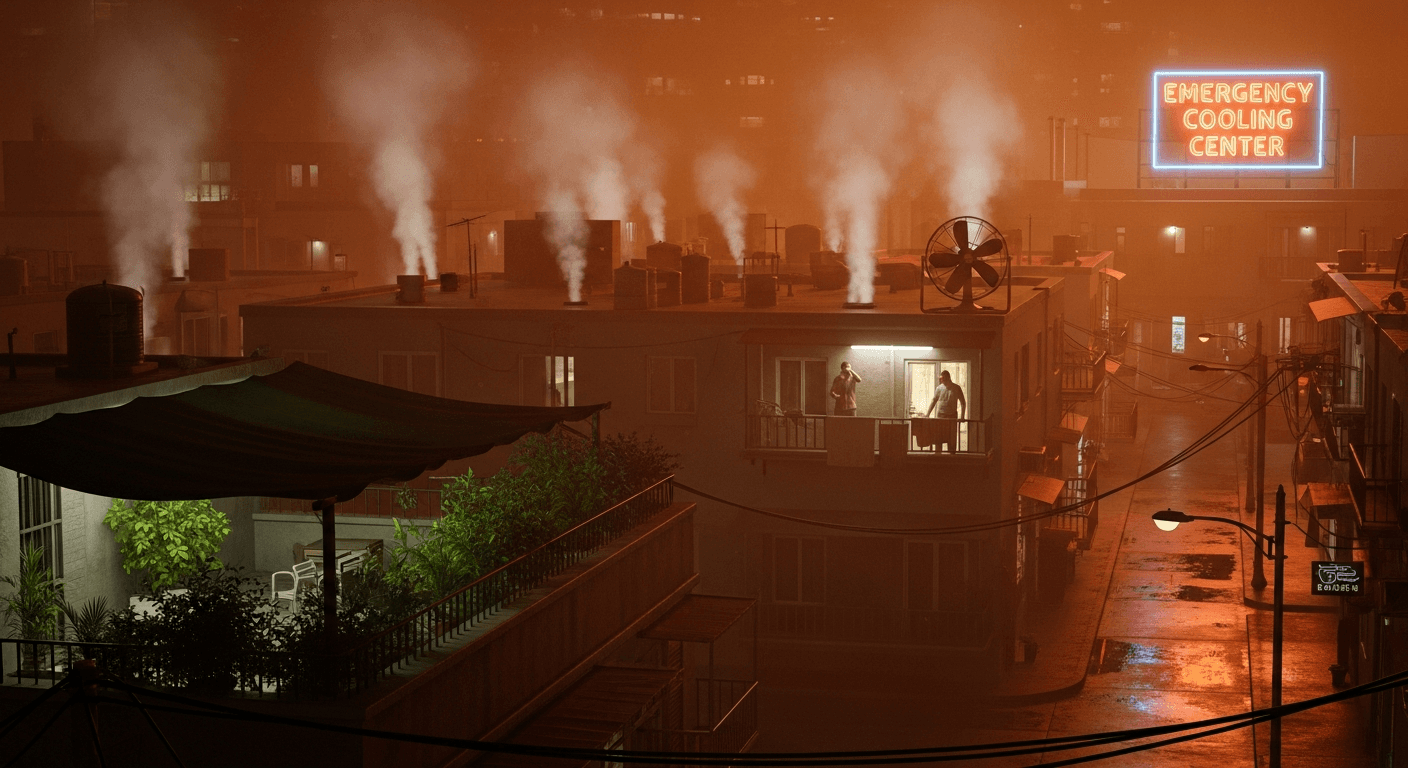
A sleepless, humid night
Last summer I woke at 2 a.m., drenched, windows ajar, but the air that came in felt like a warm blanket. The fan whirred uselessly. My neighborhood hummed with the same restless sounds: people walking streets at night to catch a breath of cooler air, buses running with windows open, and the soft neon of small shops staying lit because no one could sleep at home. That night stayed with me — not because it was unusually hot by daytime standards, but because the night never cooled.
That is the new normal in many places: warmer nights that steal rest, raise health risks, and change how cities, farms, and ecosystems function.
Why nights are heating up
Several processes are combining to make nights warmer, and they act together:
Global warming: Greenhouse gases trap more heat in the atmosphere. Nights — when solar heating is absent — are especially sensitive to this trapped heat. Climate assessments, including the IPCC, note that minimum (nighttime) temperatures have increased more rapidly than daytime maxima in many regions over recent decades.
Urban heat islands: Cities store heat in concrete, asphalt, and buildings during the day and slowly release it at night. This slows nighttime cooling and can keep urban areas several degrees warmer than surrounding rural land. In dense neighborhoods, that difference can make sleep difficult and increase health risks.
Humidity and reduced overnight ventilation: Higher humidity makes the body’s cooling (sweating and evaporation) less effective. When nights are also still — lacking cooling breezes — the body cannot recover from daytime heat. Moist nights feel much hotter than dry ones.
Together, these effects mean nights are not providing the physiological relief they used to.
What this means — immediate and longer term
Warm nights aren’t just an annoyance. They have real, measurable consequences:
Health risks: Sleep loss and sustained overnight heat raise the risk of heat exhaustion, heat stroke, and worsen chronic conditions like heart and respiratory disease. Vulnerable groups — older adults, infants, people with pre-existing illnesses, and outdoor workers — are especially at risk.
Lost overnight recovery: Sleep is when the body cools, repairs, and consolidates memory. Repeated hot nights erode this recovery, increasing fatigue, reducing cognitive performance, and making people less resilient to subsequent heat.
Energy demand: More people rely on air conditioning at night, pushing electricity use into later hours and creating bigger evening peaks. That strains grids and can increase emissions if the electricity is fossil-fuel based.
Agriculture and ecosystems: Many crops and insects rely on cool nights. Warm nights can change flowering time, reduce yields for some crops (like rice or wheat), and disrupt pest–predator relationships.
Inequality: Poorer neighborhoods often have fewer trees, denser housing, and less access to cooling — making nighttime heat a matter of environmental justice.
Evidence and trends
A consistent finding in climate science is that nighttime and winter warming have been larger than daytime and summer warming in many regions. Major climate assessments (for example, the IPCC’s recent reports) document these trends and their links to greenhouse gas increases. National agencies such as NOAA and public health organizations including the WHO have highlighted the health impacts of rising nighttime temperatures. Peer-reviewed studies in high-quality journals (e.g., Nature family journals and Science) show that minimum temperatures have risen significantly in many populated regions and that the frequency of warm nights is increasing.
To make this concrete: many regions now experience several more "tropical nights" (nights when temperatures don’t fall below about 20–25°C / 68–77°F) per year than they did decades ago. Those persistent warm nights multiply health and infrastructure stresses.
Adaptation and mitigation — practical paths forward
We need both immediate adaptation to protect people today and long-term mitigation to stop temperatures from getting worse.
Adaptation examples:
Cool roofs and reflective pavements: Lighter-colored surfaces reflect sunlight and release heat faster, helping night cooling.
Urban greening: Trees, parks, and green roofs provide shade during the day and help cool the air at night through evaporation.
Building design and passive cooling: Improved insulation, night-time ventilation strategies (where safe), and building layouts that promote cross-breezes reduce the need for energy-intensive air conditioning.
Heat-health early-warning systems: Forecasting hot nights, with targeted alerts and plans for cooling centers, can protect vulnerable people before conditions worsen.
Energy system changes: Time-of-use pricing, demand-response programs, and expanding renewable electricity reduce grid strain from nighttime AC use and lower emissions.
Mitigation (long-term):
Rapidly cutting greenhouse gas emissions remains essential. Without deep cuts, every season will bring more frequent and intense warm nights.
Integrated urban planning: Locating housing, transit, and green space thoughtfully reduces heat exposure and energy demand simultaneously.
What individuals and communities can do
Personal measures: Use fans effectively, adopt light bedding, hydrate, and check on neighbors who may be at risk. If you have air conditioning, try to use it in the most efficient ways (set reasonable thermostat levels, close curtains during the day).
Community actions: Push for tree planting, community cooling centers, and shading at bus stops. Support local policies for cool roofs and green infrastructure.
Advocate: Ask local leaders to include nighttime heat in emergency plans and to prioritize upgrades to the power grid and public spaces that reduce heat.
A short conclusion and call to action
Warmer nights are more than a comfort issue. They erode sleep, increase health risks, raise energy demand, and deepen inequalities. The good news is that many effective, practical actions exist — from planting trees to changing building designs to cutting emissions. We should treat warm nights as a public-health and planning problem, not only a climate statistic.
If you care about your community’s health and resilience, start small: plant a tree, check on an elderly neighbor after a hot day, support local cooling policies, and use your voice to push for emissions reductions. Night is meant for rest. Let’s work to make it that way again.
Regards,
Hemen Parekh
Any questions / doubts / clarifications regarding this blog? Just ask (by typing or talking) my Virtual Avatar on the website embedded below. Then "Share" that to your friend on WhatsApp.
Get correct answer to any question asked by Shri Amitabh Bachchan on Kaun Banega Crorepati, faster than any contestant
Hello Candidates :
- For UPSC – IAS – IPS – IFS etc., exams, you must prepare to answer, essay type questions which test your General Knowledge / Sensitivity of current events
- If you have read this blog carefully , you should be able to answer the following question:
- Need help ? No problem . Following are two AI AGENTS where we have PRE-LOADED this question in their respective Question Boxes . All that you have to do is just click SUBMIT
- www.HemenParekh.ai { a SLM , powered by my own Digital Content of more than 50,000 + documents, written by me over past 60 years of my professional career }
- www.IndiaAGI.ai { a consortium of 3 LLMs which debate and deliver a CONSENSUS answer – and each gives its own answer as well ! }
- It is up to you to decide which answer is more comprehensive / nuanced ( For sheer amazement, click both SUBMIT buttons quickly, one after another ) Then share any answer with yourself / your friends ( using WhatsApp / Email ). Nothing stops you from submitting ( just copy / paste from your resource ), all those questions from last year’s UPSC exam paper as well !
- May be there are other online resources which too provide you answers to UPSC “ General Knowledge “ questions but only I provide you in 26 languages !



No comments:
Post a Comment