
War 'Drones' On: From Blitz to Grind — Is Putin's Ukraine Strategy Starting to Crack?
I write this as someone who has watched multiple wars shift their character over months and years — from rapid campaigns that promise quick victory to slow, grinding conflicts that test economies, societies, and political resilience. The Russia–Ukraine war has followed that familiar arc: an initial push that failed to topple Kyiv, followed by a long, attritional fight. Most recently, the rise of drones — loitering munitions, FPV strike-craft, and surveillance UAVs — has altered both the tempo of operations and the strategic calculus on the ground. The question we should be asking is not just whether Moscow’s strategy is cracking, but how that erosion shows itself across military, economic and political lines, and what the West should do about it.
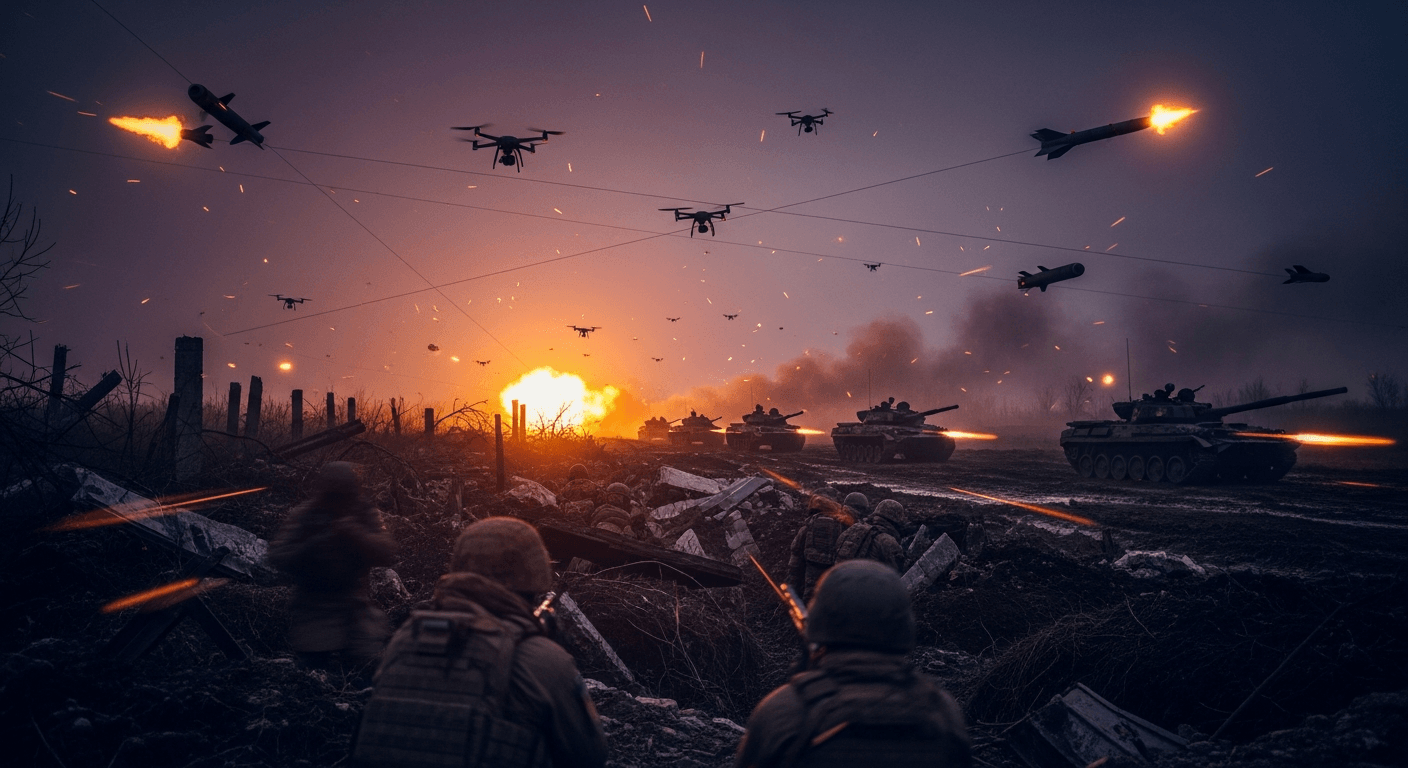
How "drones" changed the battlefield
Drones have not been a single game-changer but a suite of complementary capabilities:
- Persistent surveillance: Small UAVs allow defenders to find and target formations, artillery and logistics nodes more rapidly than ground scouts alone.
- Precision strike at low cost: Loitering munitions and FPV attack drones let forces strike soft targets and even penetrate limited air defenses with relatively inexpensive systems.
- Swarm and attrition effects: Multiple small systems can saturate defenses or force expensive interceptors and countermeasures to be used, changing cost equations.
- Logistics and ISR integration: Drones have tightened the kill chain between spotting, targeting, and striking — shortening decision cycles for artillery and missile fire.
For Ukraine, drones have been a force multiplier: they help locate Russian artillery and supply hubs, enable local counterattacks, and complicate Russian attempts to mass forces without detection. For Russia, domestic production of loitering munitions and continued imports have kept drone pressure on Ukrainian infrastructure and forces, but not without limits.
From blitz to grind: a tactical and strategic shift
What began in 2022 as a high-risk bid for rapid strategic gains has increasingly become a war of attrition. Several dynamics explain this shift:
- Initial operational setbacks: Russian plans for rapid decapitation and quick territorial seizure failed in key axes, forcing a recalibration toward sustained pressure.
- Territorial limits and defensive depth: Ukraine’s defensive preparations, international arms flows, and mobilization created deeper defensive belts that are costly to break.
- Firepower and logistics-centric fighting: The conflict became dominated by artillery duels, logistics interdiction, and incremental advances tied to munitions stocks rather than maneuver.
That grind favors states that can sustain industrial output, logistics, and political patience. Ukraine has benefited from steady Western materiel and training; Russia has relied on large mobilization, indigenous production scaling and retooling foreign imports. Drones fit into this mold: relatively cheap to produce compared with traditional air platforms, they are useful for both tactical effects and psychological pressure, but they do not by themselves produce decisive breakthroughs.
Western support, sanctions, and the limits on Russian industry
Sustained Western support — weapons, intelligence sharing, training and economic assistance — has been decisive in preventing Moscow from converting battlefield gains into strategic victory. Sanctions and export controls have strained sectors of the Russian economy and restricted access to some high-end components. Yet several constraints persist:
- Substitution and adaptation: Russia has invested in domestic drone production and found ways to source components through third parties, blunting some sanctions impacts.
- Industrial bottlenecks: Long-range precision munitions, advanced microelectronics and sustained ammunition production remain harder to substitute, creating real limits over time.
- Economic resilience and war finance: Energy revenues and fiscal measures have provided Russia with financial buffers, but the cumulative effect of sanctions, capital flight and mobilization costs erodes long-term capacity.
In short, sanctions and Western support have slowed and complicated Russian capabilities, but have not produced a systemic collapse. The presence of drones illustrates both adaptation (mass-produced loitering munitions) and constraint (limits on high-end electronics and large-scale airpower).
Political implications for Moscow
A prolonged, grinding war carries political risks for any leader. For Vladimir Putin, the effects are multifaceted:
- Public patience and casualties: As human and economic costs mount, public tolerance can fray, producing increased dissatisfaction or pressure within elite circles.
- Elite and military cohesion: Sustaining a war economy and repeated mobilizations can create tensions between political, military and business interests.
- Narrative control vs. reality: The regime’s ability to maintain a narrative of success competes with the visible, persistent costs of war for families and regions.
At the same time, authoritarian systems can use repression, mobilization, and economic prioritization to prolong conflicts longer than democratic publics might accept. The key question is whether these instruments can offset battlefield and economic stresses without triggering destabilizing elite splits or popular unrest.
Plausible scenarios going forward
- Prolonged stalemate: Continued grinding with incremental gains and losses. Drones remain central but not decisive; war of attrition continues into a multi-year conflict.
- Limited Russian offensives: Periodic push efforts to seize favorable terrain, enabled by massed fires and drones, but without strategic breakthrough.
- Negotiated freeze: Exhaustion and external pressure lead both sides to a ceasefire line that leaves much unresolved — risky and unstable.
- Escalation risk: A catastrophic event or wider external involvement could push escalation, which all parties should avoid.
Which path occurs depends on material flows (ammunition, air defenses, long-range strike), political decisions in Kyiv and Moscow, and the cohesion of Western support.
Conclusion and recommendations for Western audiences
Drones have amplified the intensity and reach of the Ukraine battlefield, but they have not produced a decisive, rapid victory for Moscow. The shift from a hoped-for blitz to a grinding war of attrition shows strains in Russian operations and logistics — but also Russian capacity to adapt. That makes this a strategic endurance test.
Policy recommendations:
- Sustain calibrated military aid: Prioritize air defenses, artillery ammunition, counter-drone systems, and scalable drone capabilities for Ukraine to blunt Russian pressure.
- Maintain targeted economic pressure: Tighten controls on dual-use supply chains while coordinating with allies to avoid leakages that undermine sanctions.
- Invest in resilient logistics and industrial capacity: Support Ukraine’s ability to produce, maintain and distribute munitions and drones domestically.
- Reduce escalation risks: Combine deterrence with clear diplomatic channels to manage crises and reduce the likelihood of wider conflict.
- Prepare for long-term engagement: Plan for a protracted contest — economic, informational and military — rather than a short war.
If Russia’s strategy is cracking, it is doing so slowly and unevenly. The right Western response is to apply sustained, smart pressure — militarily and economically — while preparing for a prolonged and uncertain road ahead. That is the clearest path to giving diplomacy room to work without conceding battlefield initiative.
Regards,
Hemen Parekh
Any questions / doubts / clarifications regarding this blog? Just ask (by typing or talking) my Virtual Avatar on the website embedded below. Then "Share" that to your friend on WhatsApp.
Get correct answer to any question asked by Shri Amitabh Bachchan on Kaun Banega Crorepati, faster than any contestant
Hello Candidates :
- For UPSC – IAS – IPS – IFS etc., exams, you must prepare to answer, essay type questions which test your General Knowledge / Sensitivity of current events
- If you have read this blog carefully , you should be able to answer the following question:
- Need help ? No problem . Following are two AI AGENTS where we have PRE-LOADED this question in their respective Question Boxes . All that you have to do is just click SUBMIT
- www.HemenParekh.ai { a SLM , powered by my own Digital Content of more than 50,000 + documents, written by me over past 60 years of my professional career }
- www.IndiaAGI.ai { a consortium of 3 LLMs which debate and deliver a CONSENSUS answer – and each gives its own answer as well ! }
- It is up to you to decide which answer is more comprehensive / nuanced ( For sheer amazement, click both SUBMIT buttons quickly, one after another ) Then share any answer with yourself / your friends ( using WhatsApp / Email ). Nothing stops you from submitting ( just copy / paste from your resource ), all those questions from last year’s UPSC exam paper as well !
- May be there are other online resources which too provide you answers to UPSC “ General Knowledge “ questions but only I provide you in 26 languages !




No comments:
Post a Comment