
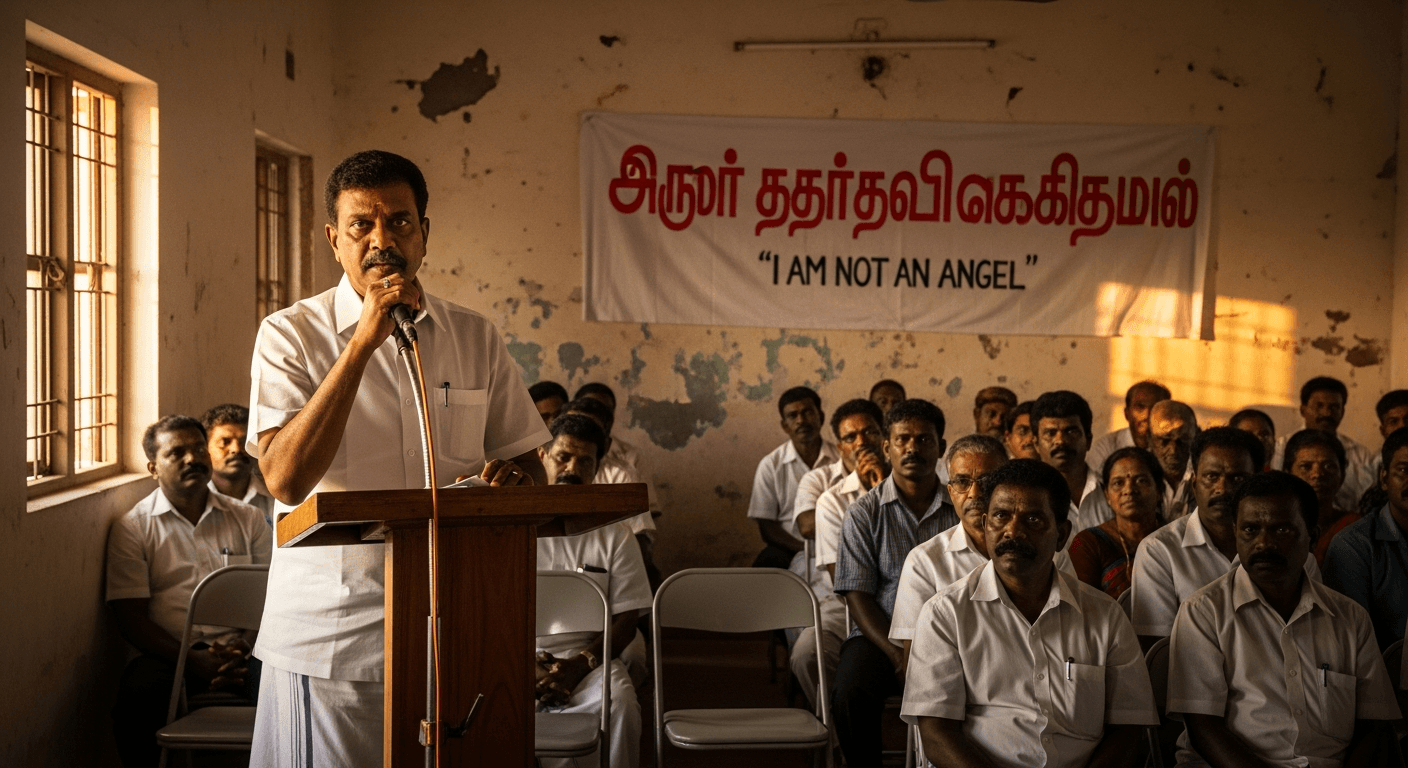
Context and first impressions
In the days after a closely watched state election, I listened carefully to the new Chief Minister’s maiden address. It was a moment many in Tamil Nadu had anticipated: a popular figure from outside the conventional political class stepping into the highest office in the state. The speech was short on rhetorical flourish and heavy on a single, memorable sentence: “I am not an angel.” That line has captured attention because it is at once candid and ambiguous — a claim of humility, a warning against unrealistic expectations, and a positioning move aimed at managing public hope.
What he likely meant by “I am not an angel”
When a newly sworn-in leader says, “I am not an angel,” I read it as a deliberate attempt to temper expectation. In plain language, it signals three things:
- An acknowledgement of limits: No administration can instantly fix entrenched problems.
- A rejection of infallibility: He is telling people to expect effort, not miracles.
- A subtle political promise: He will be accountable and practical rather than performatively pure.
Put together, the phrase works as a political reality check. It reassures voters that the leader knows governance is complex, while also preparing them for trade-offs and slow progress.
Reaction from opposition and supporters
Responses split mostly along predictable lines. Opposition voices seized on the sentence as ammunition: some framed it as an admission of weakness or an invitation to doubt competence. Critics asked whether such a frank line would translate into blurred responsibility when difficult choices appear.
Supporters, by contrast, interpreted the remark as refreshingly honest. Many welcomed the leader’s refusal to be carried away by heroic language. For a public weary of grand promises and stalled delivery, humility—even blunt humility—can be persuasive. Grassroots supporters who backed him for being “one of us” saw the line as confirmation that he won’t pretend to be a distant, unaccountable elite.
Key policy themes he highlighted
The first address was less a policy manifesto and more a roadmap of priorities. He emphasized practical governance and signalled where his early energy will focus:
- Welfare and social stability: Renewed attention to core welfare schemes and food security to reassure ordinary households.
- Jobs and livelihoods: A call to revive local economies and create practical, short-term employment opportunities.
- Infrastructure and services: Better delivery of basic services—water, power, and transport—ranked high on his list.
- Law and order and governance reform: Promises to streamline administration and reduce corruption, framed as incremental rather than sweeping.
He avoided long, sweeping promises. Instead, he spoke of concrete targets and follow-through—suggesting a managerial style that privileges delivery over drama.
Implications for Tamil Nadu politics
This speech matters for several reasons.
It resets expectations. By admitting imperfections, the leader buys political space to make hard decisions without immediately losing popular support.
It changes opposition strategy. Critics now must choose between appearing petty for attacking a candid remark or offering constructive oversight. How they respond could shape the political tone for months.
It alters governing norms. A celebrity-turned-chief-executive leaning on pragmatic governance rather than populist spectacle could nudge other parties to focus on delivery.
Yet risks remain. Tempered expectations can cool immediate criticism, but they can also be read as license for slow action. If delivery does not follow candid talk, the initial honesty may become a liability.
A brief background: an actor turned politician
The new Chief Minister’s rise followed a career outside conventional politics. For years he built a profile in the public eye as a film star, cultivating a broad personal following. That popularity translated into rapid political traction when he entered the public arena more directly.
This background matters. Celebrity entry into politics brings instant mass reach and a nontraditional political narrative—but it also raises questions about experience in administration. His first address seemed aimed at bridging that gap: acknowledging limits while promising to learn fast and to surround himself with experienced hands.
Balancing hope with realism
As someone who watches public life closely, I found the speech notable for its modest tone. It was not the kind of grandiosity that so often greets a new leader; instead it was candid and managerial. Whether voters will reward that approach depends on follow-through. The hard job for this government now is to convert tempered language into measurable improvements without retreating into the same old habits of delay and overpromising.
Concluding paragraph
The “I am not an angel” line crystallizes a central political choice: whether to sell hope as instant transformation or to promise steady, accountable progress. It is an invitation to patience but also a test of credibility. The new Chief Minister has begun by lowering the bar of myth and raising the bar of delivery. Tamil Nadu will soon judge whether this balance can be sustained.
Regards,
Hemen Parekh
Any questions / doubts / clarifications regarding this blog? Just ask (by typing or talking) my Virtual Avatar on the website embedded below. Then "Share" that to your friend on WhatsApp.
Get correct answer to any question asked by Shri Amitabh Bachchan on Kaun Banega Crorepati, faster than any contestant
Hello Candidates :
- For UPSC – IAS – IPS – IFS etc., exams, you must prepare to answer, essay type questions which test your General Knowledge / Sensitivity of current events
- If you have read this blog carefully , you should be able to answer the following question:
- Need help ? No problem . Following are two AI AGENTS where we have PRE-LOADED this question in their respective Question Boxes . All that you have to do is just click SUBMIT
- www.HemenParekh.ai { a SLM , powered by my own Digital Content of more than 50,000 + documents, written by me over past 60 years of my professional career }
- www.IndiaAGI.ai { a consortium of 3 LLMs which debate and deliver a CONSENSUS answer – and each gives its own answer as well ! }
- It is up to you to decide which answer is more comprehensive / nuanced ( For sheer amazement, click both SUBMIT buttons quickly, one after another ) Then share any answer with yourself / your friends ( using WhatsApp / Email ). Nothing stops you from submitting ( just copy / paste from your resource ), all those questions from last year’s UPSC exam paper as well !
- May be there are other online resources which too provide you answers to UPSC “ General Knowledge “ questions but only I provide you in 26 languages !




No comments:
Post a Comment