
I. The news in brief
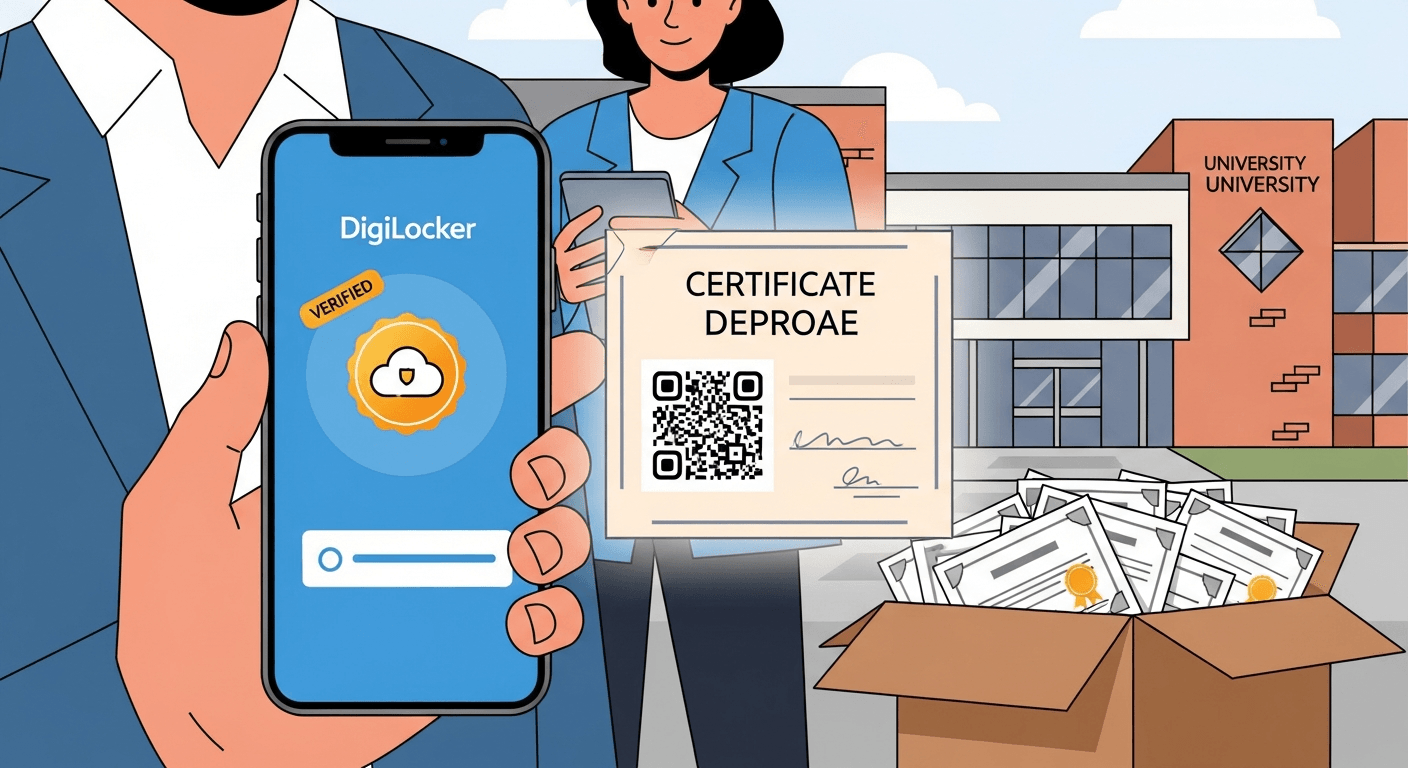
A recent directive from the Government of Maharashtra asks universities to upload degree certificates to DigiLocker soon after results are declared. As an advocate for digital identity and paperless governance, I welcome moves that reduce wait times for verification and open pathways for graduates to use their credentials immediately.
II. What is DigiLocker?
DigiLocker is a cloud-based digital document wallet promoted under India's Digital India initiative. It lets citizens receive, store and share verified copies of government-issued documents — from Aadhaar and PAN to driving licences and educational certificates — directly from issuing authorities. Documents issued or fetched through DigiLocker are considered authentic digital records under Indian law, and the platform is designed for 24x7 access on web and mobile.
I have written about DigiLocker and its potential as a single unified identity and document vault in my earlier posts, where I traced its evolution and scale DigiLocker = Single Unified Identity for Indian Citizen.
III. Why Maharashtra asked universities to upload degrees promptly
The rationale is straightforward:
- Reduce friction: Graduates often wait weeks or months for physical certificates; digital issuance removes that delay.
- Improve verification speed: Employers, professional bodies and other universities can verify credentials instantly.
- Curb fraud: Digitally-issued certificates, when delivered via a secure government channel, are harder to forge.
- Encourage uptake: Prompt upload sets an operational standard and normalises students using digital credentials.
For state higher-education departments, the step aligns administrative control (timely issuance) with public convenience (instant access).
IV. Benefits for students and institutions
Benefits for students
- Immediate utility: Apply for jobs, higher studies, licences or scholarships without waiting for couriered documents.
- Portability: Carry credentials on phone — useful for inter-state mobility and remote hiring.
- Reduced cost & stress: No repeated requests for provisional certificates or notarisation.
Benefits for institutions
- Streamlined processes: Fewer manual dispatches, fewer help‑desk queries, and less paper handling.
- Transparent audit trail: Digital issuance logs help in accountability and record-keeping.
- Faster verification partnerships: Employers and credential-check services can integrate with DigiLocker APIs for real-time checks.
V. Implementation challenges
While the benefits are clear, implementation is not automatic. Key challenges include:
- Integration effort: Universities must map legacy student records, digitise templates and integrate with DigiLocker APIs.
- Data quality: Incorrect or incomplete student metadata (names, dates, enrollment numbers) can create mismatches.
- Scale & timing: Large universities releasing thousands of degrees at once need batching and load planning to avoid failures.
- Resource gaps: Smaller colleges may lack trained staff, secure systems, or budget for integration.
These operational realities mean central guidelines are helpful, but so are implementation roadmaps and capacity support.
VI. Data privacy and security considerations
Digitally storing personal and academic records raises legitimate privacy and security questions:
- Authentication: Strong two-factor access (OTP + PIN) for students, and secure API authentication for universities.
- Consent & control: Students should retain the ability to view, share, or revoke access to their digital certificates.
- Data minimisation: Only necessary metadata should be pushed; avoid exposing sensitive fields unnecessarily.
- Secure endpoints: Universities must harden systems that prepare and transmit certificates to DigiLocker to prevent tampering.
- Retention & audit: Clear policies should govern how long records are kept and how logs are audited for misuse.
A combination of secure engineering practices, transparent consent flows, and strong legal safeguards will be essential.
VII. Practical steps — what universities and students should do
For universities
- Map and clean records: Standardise names, roll numbers and course codes before bulk upload.
- Pilot first: Start with a single batch (e.g., one college or academic department) to validate templates and workflows.
- Train staff: Provide clear SOPs for the registrar’s office and IT teams.
- Communicate: Inform graduating students about DigiLocker benefits and access steps.
For students
- Create/verify your DigiLocker account: Link with your mobile and Aadhaar (if comfortable and required) and set a secure PIN.
- Check metadata: On receiving the digital degree, verify spelling, course details and graduation date immediately.
- Share responsibly: When sharing credentials, use DigiLocker’s secure share links or QR-based verification.
VIII. Conclusion and recommendations
Maharashtra’s directive is a pragmatic step toward modernising credential issuance. To realise its promise, I recommend:
- A phased roll-out with technical support for smaller institutions.
- Mandatory metadata standards to avoid verification errors.
- Awareness campaigns so students understand how to access and use digital degrees.
- Regular security audits and clear grievance redressal mechanisms.
When done right, rapid digitisation of degrees will reduce friction for graduates, strengthen trust in academic credentials, and save time and resources for universities. I see this not only as an administrative improvement but as part of the broader evolution toward paperless, citizen-centric services.
Regards,
Hemen Parekh
Any questions / doubts / clarifications regarding this blog? Just ask (by typing or talking) my Virtual Avatar on the website embedded below. Then "Share" that to your friend on WhatsApp.
Get correct answer to any question asked by Shri Amitabh Bachchan on Kaun Banega Crorepati, faster than any contestant
Hello Candidates :
- For UPSC – IAS – IPS – IFS etc., exams, you must prepare to answer, essay type questions which test your General Knowledge / Sensitivity of current events
- If you have read this blog carefully , you should be able to answer the following question:
- Need help ? No problem . Following are two AI AGENTS where we have PRE-LOADED this question in their respective Question Boxes . All that you have to do is just click SUBMIT
- www.HemenParekh.ai { a SLM , powered by my own Digital Content of more than 50,000 + documents, written by me over past 60 years of my professional career }
- www.IndiaAGI.ai { a consortium of 3 LLMs which debate and deliver a CONSENSUS answer – and each gives its own answer as well ! }
- It is up to you to decide which answer is more comprehensive / nuanced ( For sheer amazement, click both SUBMIT buttons quickly, one after another ) Then share any answer with yourself / your friends ( using WhatsApp / Email ). Nothing stops you from submitting ( just copy / paste from your resource ), all those questions from last year’s UPSC exam paper as well !
- May be there are other online resources which too provide you answers to UPSC “ General Knowledge “ questions but only I provide you in 26 languages !


No comments:
Post a Comment