
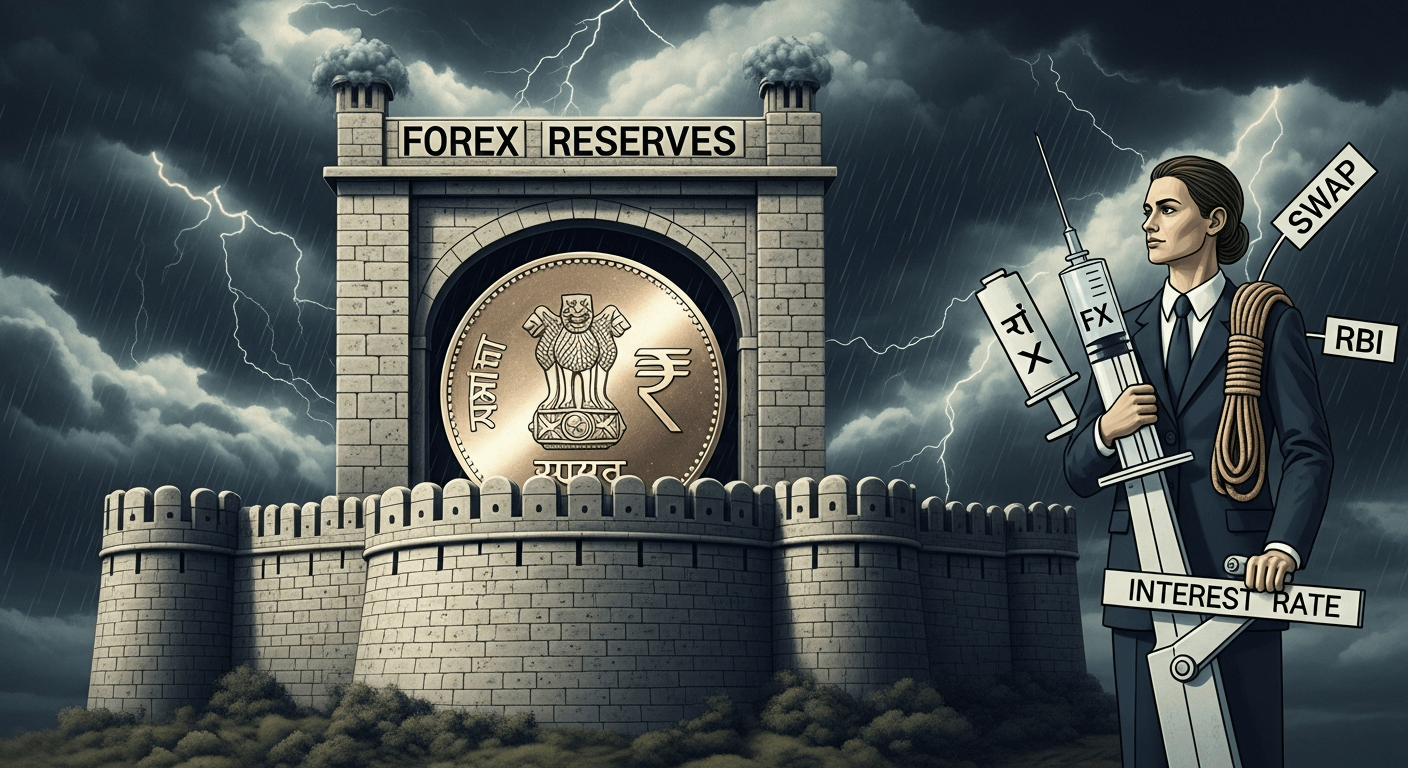
Do Reserves Really Defend Rupee?
I keep returning to one simple but consequential question: does India’s pile of foreign exchange reserves give us enough firepower to defend the rupee when markets test it? The short answer many economists give today is: yes—more confidently than a decade ago—but that confidence rests on a few measurable facts and some important caveats.
What are forex reserves and why they matter
Foreign exchange (FX) reserves are assets held by the central bank—foreign currency deposits, sovereign bonds, gold, IMF special drawing rights (SDRs), and the like. They matter because they provide:
- A liquidity buffer to meet external obligations (imports, debt servicing).
- A tool for the central bank to smooth sharp exchange-rate moves.
- Confidence for foreign investors and rating agencies.
Reserves are not a magic shield that permanently fixes an exchange rate. They are a finite, though powerful, element of the macro toolkit.
Key metrics economists watch
Instead of a single number, analysts look at a few ratios that tell us how comfortable the buffer is:
- Months of import cover: reserves divided by annual imports (then converted to months). Conventional benchmarks say 3 months is a minimum; advanced-economy cushions are often much higher.
- Reserves-to-GDP: a broad sense of how big the buffer is relative to the economy.
- Reserves-to-short-term external debt (reserves-to-STED): how many times reserves cover liabilities due within 12 months.
These metrics give a clearer picture than the headline reserves figure alone.
Where India stands (plausible context for 2024–25)
RBI reserves are commonly reported in the range of roughly $600–$650 billion in 2024–25 (exact figures vary with valuation and timing). To make sense of that:
- Months of import cover: India’s annual merchandise plus services import bill is in the several-hundred-billion-dollar range. With reserves of roughly $600–$650 billion, import cover works out to around 11–13 months—well above the usual 3-month safety threshold and comfortably higher than many peers.
- Reserves-to-GDP: with India’s nominal GDP in the low-to-mid trillions of dollars, reserves of this size imply a reserves-to-GDP ratio in the mid-teens percentage range—again a strong position for an emerging market.
- Reserves-to-STED: India’s short-term external debt (liabilities maturing within a year) sits at a fraction of total external liabilities. If STED is on the order of, say, $150–$200 billion, reserves provide 3–4x cover. That multiple is reassuring: it means short-term claims are well covered.
These ballpark numbers are why many economists say India has the ammunition needed to ride out sudden shocks.
Tools RBI can use beyond the stock of reserves
Reserves are one tool among many. The Reserve Bank of India’s (RBI) toolkit includes:
- Direct FX intervention: buying or selling dollars in the market to smooth volatility.
- Interest-rate policy: tightening or easing to influence capital flows.
- Macroprudential / capital-flow measures: temporary capital controls or limits to curb disorderly flows.
- Swap lines and coordination: bilateral currency swaps with other central banks to boost liquidity if needed.
- Sterilisation operations and foreign-currency debt management to manage reserve impacts on liquidity and inflation.
These policy options multiply the practical defensive capability beyond the headline reserves number.
What critics worry about
Skeptics point to real limits:
- Valuation and composition: reserves denominated in foreign currencies lose value when the dollar strengthens; gold and SDRs behave differently from cash.
- Liquidity mismatch: some reserves are less liquid or encumbered, and not every dollar in the pile is instantly deployable.
- Off-balance contingent liabilities: FX forwards, swap commitments, or government guarantees can reduce effective cover.
- Overreliance: large interventions to defend a fixed rate can deplete reserves and invite market speculation.
These are legitimate concerns. Reserves reduce risk; they do not eliminate it.
Why economists remain confident
Despite the caveats, the confidence I hear in policy and market circles rests on several pillars:
- Comfortable import cover and reserves-to-STED multiples reduce the immediate solvency and liquidity risks.
- A flexible exchange-rate regime means the RBI rarely needs to defend a fixed parity; it intervenes to reduce disorder, not to hold a peg.
- Strong external inflows—FDI, resilient exports and remittances—help keep the current-account position manageable.
- Policy credibility: the RBI’s experience in using its toolkit and transparent communication has built market trust.
- Additional backstops: multilateral and bilateral arrangements can be tapped if stress is systemic.
Together, these factors explain why many economists are more sanguine today than during earlier crises.
The remaining risks
Confidence is conditional. Key risks that could expose weaknesses include:
- A synchronized global shock that reverses capital flows quickly.
- A sharp rise in commodity prices (oil) that blows up the current account.
- Domestic policy missteps that erode investor confidence.
- Rapid valuation losses if the dollar moves aggressively.
Prudence demands monitoring these scenarios and keeping policy flexibility.
Parting thought
I’ve written before about the foundations of macro resilience and the importance of buffers for a growing economy (Foundation of Economy). Today’s forex buffers give India optionality: they don’t make us invincible, but they do make a very credible case that the RBI can—and will—manage disorderly moves in the rupee without sacrificing longer-term objectives.
Regards,
Hemen Parekh
Any questions / doubts / clarifications regarding this blog? Just ask (by typing or talking) my Virtual Avatar on the website embedded below. Then "Share" that to your friend on WhatsApp.
Get correct answer to any question asked by Shri Amitabh Bachchan on Kaun Banega Crorepati, faster than any contestant
Hello Candidates :
- For UPSC – IAS – IPS – IFS etc., exams, you must prepare to answer, essay type questions which test your General Knowledge / Sensitivity of current events
- If you have read this blog carefully , you should be able to answer the following question:
- Need help ? No problem . Following are two AI AGENTS where we have PRE-LOADED this question in their respective Question Boxes . All that you have to do is just click SUBMIT
- www.HemenParekh.ai { a SLM , powered by my own Digital Content of more than 50,000 + documents, written by me over past 60 years of my professional career }
- www.IndiaAGI.ai { a consortium of 3 LLMs which debate and deliver a CONSENSUS answer – and each gives its own answer as well ! }
- It is up to you to decide which answer is more comprehensive / nuanced ( For sheer amazement, click both SUBMIT buttons quickly, one after another ) Then share any answer with yourself / your friends ( using WhatsApp / Email ). Nothing stops you from submitting ( just copy / paste from your resource ), all those questions from last year’s UPSC exam paper as well !
- May be there are other online resources which too provide you answers to UPSC “ General Knowledge “ questions but only I provide you in 26 languages !



No comments:
Post a Comment