
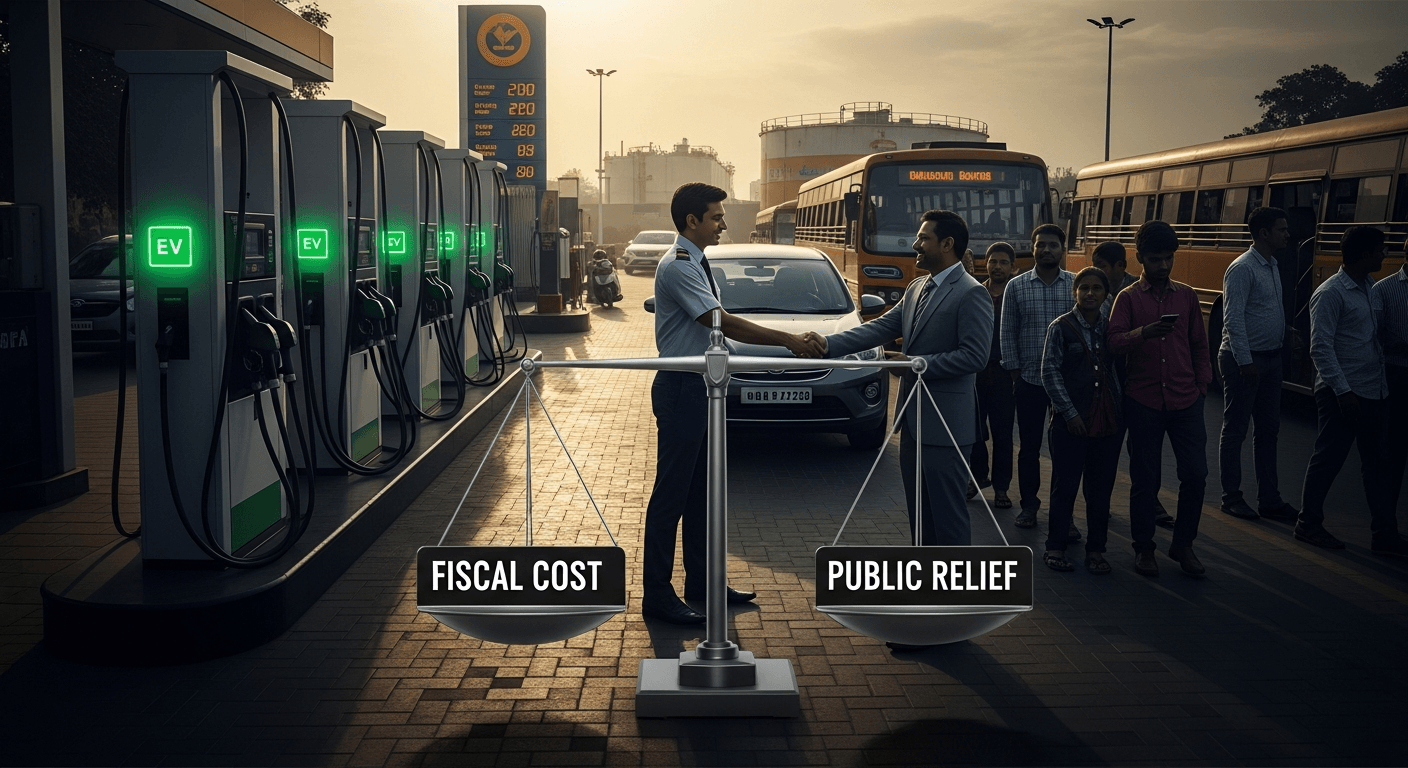
Meta description: India’s decision to keep petrol and diesel retail prices frozen for four years masks a complex mix of fiscal trade-offs, distributional impacts, and long-term structural questions. I unpack the economics, politics, social effects, and practical policy options.
I have watched India’s energy debates for years — and I have argued before that visible fuel prices are a public policy hinge: they influence inflation, inequality, industrial costs and the pace of energy transition. In an environment where petrol and diesel prices are frozen for four years, the surface calm hides deep stresses. Below I summarize the historical context, explain the economics of price controls and taxation, weigh political and social consequences, and suggest clearer policy options.
A short history and context
India’s retail fuel pricing has swung between administered support and market-linked pricing over recent decades. Historically, when the government kept pump prices low it recorded “under-recoveries” for public-sector oil companies — implicit subsidies that were financed by the budget or by upstream firms. I wrote about these dynamics more than a decade ago when under-recoveries were a major part of the conversation and their burden on the broader public became clear (PETROL PRICES : LET THESE RISE !).
Separately, the government and oil PSUs have invested heavily in retail infrastructure (for example, plans discussed in the past to expand pumps), a choice that interacts awkwardly with long-term electrification and mobility shifts (25,000 New Petrol Pumps ? Why ?). A multi-year price freeze must be judged against this longer arc: fiscal exposures, capital allocation, and the technology transition to EVs and renewables.
How fuel prices are built: taxes, margins, and global oil
Retail petrol and diesel prices in India include three broad components:
- International crude cost (import parity) and refining margins.
- Central and state taxes (central excise, road cess, and state VAT). Together these can account for a very large share of the pump price — commonly in the range of 40–60% for petrol (diesel often bears lower direct taxes but is subject to indirect taxes and cross-subsidies).
- Retail distribution margins and dealer commissions.
When retail prices are frozen while global crude or exchange rates move, either oil companies eat the difference (creating under-recoveries) or the state must compensate the gap through the budget (explicit subsidy) or by taking on liabilities. Over time that accumulation can reduce fiscal space for other priorities.
The economics of price controls and taxation
Price freezes are a blunt instrument. They achieve short-term political objectives (hold down inflation, limit visible cost of living increases) but generate several economic distortions:
- Fiscal strain: implicit or explicit subsidies accumulate, worsening deficits or crowding out other spending.
- Regresivity: blanket price support tends to benefit higher-income, fuel-consuming households more than the poor. Public support for petrol and diesel is therefore a poor-targeted way to help the vulnerable.
- Market signals blunted: low prices slow demand response, delaying energy efficiency and the adoption of alternatives.
- Investment misallocation: downstream investments in retail fuel infrastructure may be less valuable if long-term demand shifts to electricity and renewables.
Taxation is a lever here. Fuel taxes are attractive to governments because they raise large, easy-to-collect revenue and can be adjusted frequently. But reliance on fuel taxes also ties revenue volatility to global oil volatility and creates trade-offs with climate goals.
Political considerations
Keeping pump prices unchanged for four years is politically expedient: voters see stable pump prices as relief, and policymakers avoid short-term spikes being blamed on incumbents. But the political cost surfaces later: mounting fiscal burdens, pressure on state finances (through VAT share), and anger when fuel shortage or rationing appears.
Another political dimension is federal: states rely on VAT and lose revenue if supplies or price-setting arrangements change; they will resist reforms that threaten that income stream unless compensated.
Social and distributional impacts
- Urban motorists and commercial fleets capture much of the benefit from lower fuel costs — this is a regressive outcome if the same benefit reaches the wealthy more.
- Lower fuel prices reduce incentives for public transport use, energy efficiency, and freight modal shift — all of which adversely affect congestion, air quality and greenhouse gas emissions.
- For the poor, the transmission of fuel price changes to food and transport costs matters; targeted transfers are more progressive than generalized fuel subsidies.
Alternatives and policy options
A four-year freeze invites a choice: double down on controls or use the pause to reform. I outline pragmatic alternatives that reduce waste and support fairness.
- Targeted support, not universal freezes
- Replace blanket price freezes with targeted transfers (direct benefit transfers) to low-income households and transport-dependent communities. This preserves social protection while removing distortions.
- Tax reform and transparency
- Make tax components transparent and consider replacing some ad-valorem state VATs with a clearer central levy or a glide-path of compensatory transfers for states during transition.
- Gradual price-path or automatic stabilizer
- Instead of ad-hoc freezes, adopt a transparent formula that separates global crude costs from domestic levies and builds in automatic stabilizers (e.g., a buffer fund) to smooth shocks.
- Re-prioritise capital and subsidies toward cleaner alternatives
- Avoid locking in long-lived petrol/diesel infrastructure if demand is structurally shifting to EVs. Channel subsidies into EV charging infrastructure, public transport, and skilling for new industries.
- Fuel efficiency and modal shift incentives
- Invest in public transport, freight rail, and urban last-mile solutions; these give longer-term reductions in fuel demand and pollution.
- Explore differentiated taxes and low-carbon fuels
- Use tax differentials to promote cleaner fuels (biofuels blends, compressed natural gas where suitable) while retaining revenue neutrality overall.
My concluding takeaways
A four-year freeze buys short-term political calm but stores up economic tensions. The right response is not to oscillate between panicked freezes and sudden liberalization, but to move deliberately towards transparent pricing, targeted social protection, and a deliberate industrial strategy for low-carbon mobility.
Policy recommendations I would prioritise:
- Publish a clear decomposition of the pump price and a glide-path for any future adjustments.
- Replace universal price support with targeted cash transfers for vulnerable groups.
- Redirect capital and subsidies toward EVs, charging infrastructure, and public transport rather than expanding petrol retail capacity.
- Create a small stabilization buffer fund to smooth genuine short-term volatility without distorting long-term signals.
I have written about related trade-offs before, particularly the perverse effects of hidden under-recoveries and misplaced investments in retail infrastructure (PETROL PRICES : LET THESE RISE !; 25,000 New Petrol Pumps ? Why ?). My core view remains: visible prices that reflect costs, combined with well-targeted support and active investment in alternatives, serve both economic efficiency and social fairness better than long, blanket freezes.
Regards,
Hemen Parekh
Any questions / doubts / clarifications regarding this blog? Just ask (by typing or talking) my Virtual Avatar on the website embedded below. Then "Share" that to your friend on WhatsApp.
Get correct answer to any question asked by Shri Amitabh Bachchan on Kaun Banega Crorepati, faster than any contestant
Hello Candidates :
- For UPSC – IAS – IPS – IFS etc., exams, you must prepare to answer, essay type questions which test your General Knowledge / Sensitivity of current events
- If you have read this blog carefully , you should be able to answer the following question:
- Need help ? No problem . Following are two AI AGENTS where we have PRE-LOADED this question in their respective Question Boxes . All that you have to do is just click SUBMIT
- www.HemenParekh.ai { a SLM , powered by my own Digital Content of more than 50,000 + documents, written by me over past 60 years of my professional career }
- www.IndiaAGI.ai { a consortium of 3 LLMs which debate and deliver a CONSENSUS answer – and each gives its own answer as well ! }
- It is up to you to decide which answer is more comprehensive / nuanced ( For sheer amazement, click both SUBMIT buttons quickly, one after another ) Then share any answer with yourself / your friends ( using WhatsApp / Email ). Nothing stops you from submitting ( just copy / paste from your resource ), all those questions from last year’s UPSC exam paper as well !
- May be there are other online resources which too provide you answers to UPSC “ General Knowledge “ questions but only I provide you in 26 languages !



No comments:
Post a Comment