
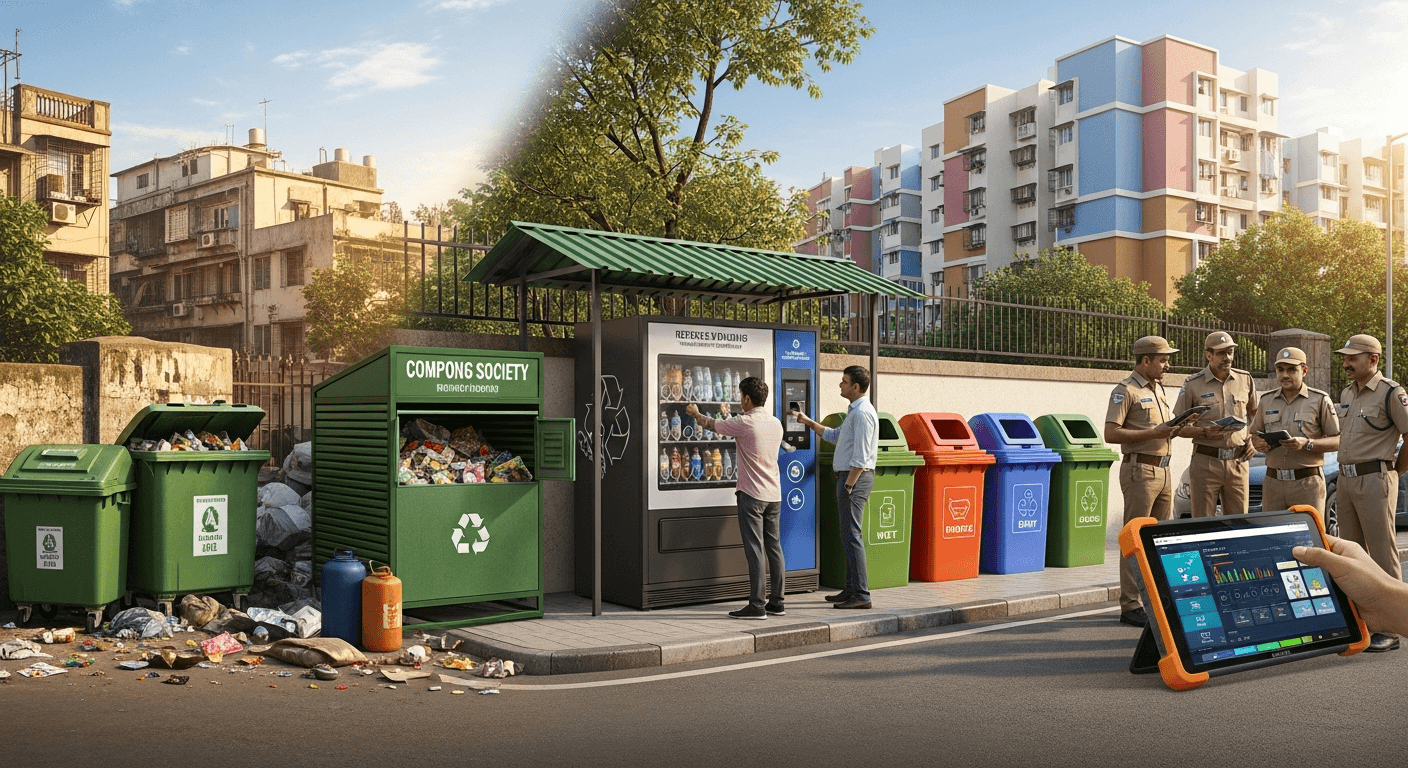
A fresh push to keep Mumbai clean
I read a recent report about the Mumbai civic chief directing the administration to implement innovative ideas to keep the city clean. As someone who has written about urban waste and incentives for years, I welcome the renewed focus. Mumbai’s scale — the millions of residents, dense housing societies and daily tonnes of municipal waste — makes this an issue of governance, civic behaviour and technology working together.
Where we are: the cleanliness challenge
Mumbai faces persistent problems across the waste-management chain:
- Massive daily volumes of wet and dry waste that strain collection, transport and processing capacity.
- Incomplete segregation at source: households and housing societies often mix organic and recyclable waste, undermining downstream recovery.
- Overflowing dumping grounds and informal disposal in public spaces.
- Coordination gaps between municipal teams, contractors, informal waste workers and private partners.
These are not new observations. In earlier pieces I argued that without altering incentives and engaging citizens directly, municipal efforts will always be fighting the tide Incentivize Housing Societies.
What the civic chief asked for (paraphrased)
The civic chief has asked the administration to move beyond routine cleaning and pilot or scale several innovative approaches, including:
- Tech-enabled monitoring (apps, sensors, dashboards) to track collection performance and overflowing bins.
- Stronger public engagement campaigns to change household behaviour on segregation.
- Targeted sanitation drives in neighbourhoods with chronic litter or open dumping.
- Incentive mechanisms for housing societies and bulk generators to segregate and treat organic waste locally.
- Collaborations with private players and social enterprises to bring equipment (composters, compactors, reverse-vending machines) and operational expertise.
Those directions are practical. They align with policy options I’ve advocated before: mix of incentives, local treatment, and public education.
Practical ideas and real-world parallels
Reverse-vending / deposit-return concepts: Machines that accept plastics, glass and cans and return a small monetary reward are already used in many countries to motivate recycling. Local pilots in urban India — conceptualized by student teams and civic innovators in the past — show strong public interest when cash or discount-based incentives are visible.
Local composting and biogas units in housing societies: Small-scale wet-waste treatment on premises reduces truck trips and creates value (compost / biogas). I have suggested tax rebates or fee discounts to help societies invest in such plants; a clear incentive can accelerate adoption Incentivize Housing Societies.
Integrating waste pickers and micro-enterprises: Many Indian cities have successful models where waste-picker collectives or private micro-enterprises operate door-to-door segregation and recycling services. Formal support, training and payment guarantees turn informal actors into reliable partners.
Tech for monitoring and citizen reporting: Simple mobile apps, QR-tagged bins and route-optimization for collection vehicles reduce missed pickups and make performance measurable.
Implementation steps I would recommend
- Prioritise pilots: Choose 4–6 wards representing varied urban forms (high-rise suburbs, dense chawls, market areas) and deploy a package of interventions — sensors, society-level composters, reverse-vending units, and intensified outreach.
- Incentivise housing societies: Offer time-bound property-tax rebates or collection-fee discounts to societies that certify daily segregation and on-site wet-waste processing.
- Partner with social enterprises and reverse-logistics firms: Use public–private contracts that reward outcomes (tonnes diverted from landfill, percentage of segregation) rather than inputs.
- Formalise the informal sector: Provide PPE, training, digital payment and collection tools to waste workers and integrate them into the formal collection chain.
- Measure and publish results: Weekly dashboards for citizens and elected representatives will create accountability and allow rapid course correction.
Potential challenges and ways to address them
- Behavioural inertia: Long-standing habits are hard to change. Combine education with visible incentives and neighbourhood-level champions to shift norms.
- Funding and procurement delays: Use small-scale concessional grants and outcome-based contracts to speed implementation without large upfront budgets.
- Technical maintenance: Composters and machines need local maintenance. Mobilise vendor warranties, local technicians and operator training as part of procurement.
- Equity risks: Ensure that low-income neighbourhoods receive equal access to solutions and that informal workers benefit from formalisation rather than displacement.
Conclusion — a civic call to action
The civic chief’s direction is timely: Mumbai needs a reboot that pairs municipal capacity with citizen action, private innovation and clear incentives. I believe we can move from an endless cycle of cleaning to a model of reducing, reusing and recycling at the source. Practical pilots, supported by measurable incentives and community engagement, will prove what scales and what doesn’t.
If you live in Mumbai, you can help right now:
- Start segregating waste at home — wet and dry, in separate bags.
- Ask your housing society to discuss local composting or join a bulk-sorting programme.
- Support local waste workers by ensuring recyclables are clean and not contaminated.
- Share ideas with your councillor or ward office and ask for pilot projects in your area.
This is not only an administrative task; it is a civic project. The administration can provide the tools and the framework, but the city’s cleanliness will ultimately depend on millions of small decisions by residents, businesses and local leaders.
Regards,
Hemen Parekh
Any questions / doubts / clarifications regarding this blog? Just ask (by typing or talking) my Virtual Avatar on the website embedded below. Then "Share" that to your friend on WhatsApp.
Get correct answer to any question asked by Shri Amitabh Bachchan on Kaun Banega Crorepati, faster than any contestant
Hello Candidates :
- For UPSC – IAS – IPS – IFS etc., exams, you must prepare to answer, essay type questions which test your General Knowledge / Sensitivity of current events
- If you have read this blog carefully , you should be able to answer the following question:
- Need help ? No problem . Following are two AI AGENTS where we have PRE-LOADED this question in their respective Question Boxes . All that you have to do is just click SUBMIT
- www.HemenParekh.ai { a SLM , powered by my own Digital Content of more than 50,000 + documents, written by me over past 60 years of my professional career }
- www.IndiaAGI.ai { a consortium of 3 LLMs which debate and deliver a CONSENSUS answer – and each gives its own answer as well ! }
- It is up to you to decide which answer is more comprehensive / nuanced ( For sheer amazement, click both SUBMIT buttons quickly, one after another ) Then share any answer with yourself / your friends ( using WhatsApp / Email ). Nothing stops you from submitting ( just copy / paste from your resource ), all those questions from last year’s UPSC exam paper as well !
- May be there are other online resources which too provide you answers to UPSC “ General Knowledge “ questions but only I provide you in 26 languages !



No comments:
Post a Comment