
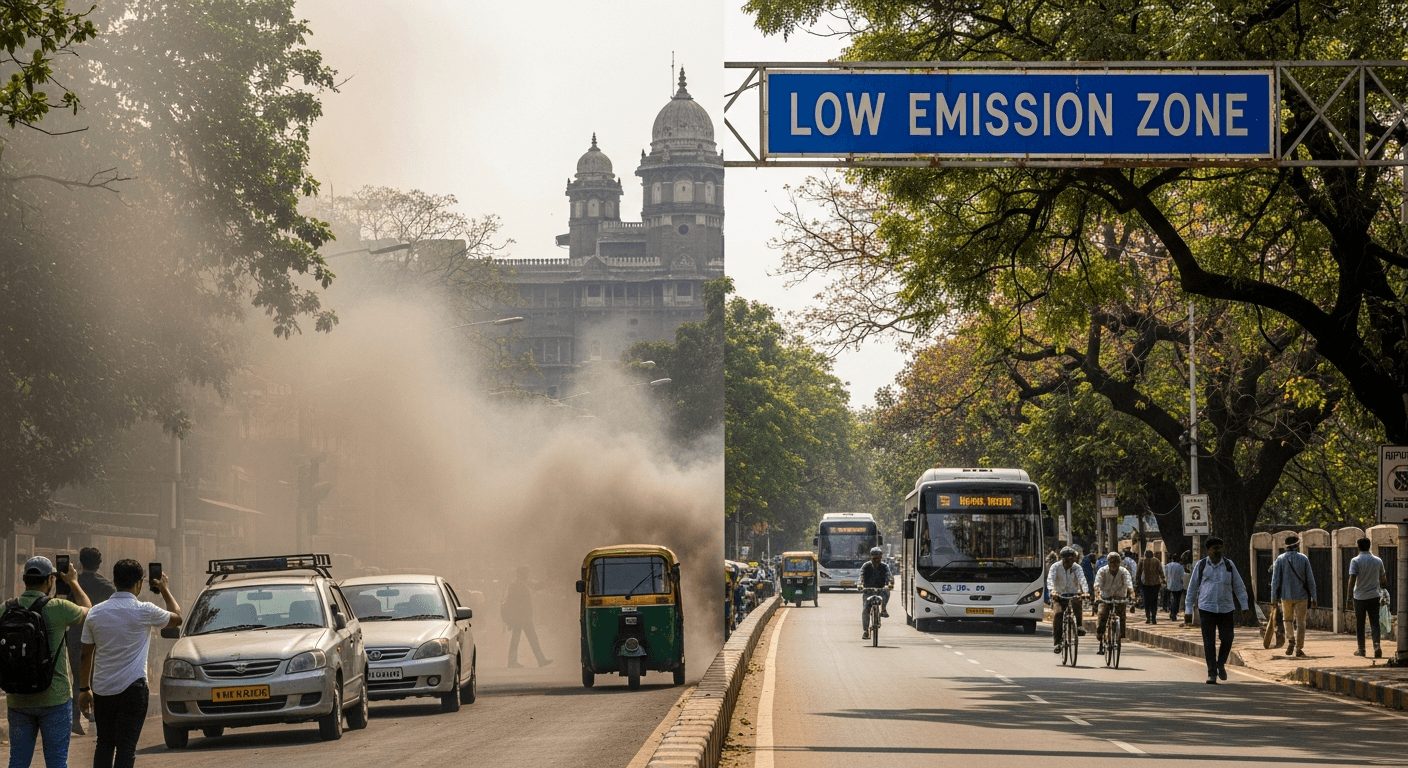
Why Pune's Low Emission Zone matters
I read the announcement about Pune becoming home to what is being called India’s first Low Emission Zone (LEZ) with cautious optimism. As someone who has written about pollution, transport policy and market-based solutions before, I see this as a potentially important step — but one that needs careful design and clear public communication to succeed.
What is a Low Emission Zone (LEZ)?
A Low Emission Zone is a defined urban area where vehicles that produce higher levels of air pollution are restricted or charged for entry. LEZs can be implemented in several ways:
- Restrictions (only low-emission vehicles allowed)
- Access charges (fees for high-emission vehicles)
- Time-based controls (limits during peak pollution periods)
The goal is to reduce local concentrations of nitrogen oxides (NOx), particulate matter (PM2.5/PM10) and other traffic-related pollutants, improving public health and urban liveability.
Why Pune is implementing an LEZ
Pune has experienced rising traffic and air-quality concerns for years. Several factors are prompting the LEZ move:
- Vehicle growth and older diesel fleets that contribute disproportionately to NOx and particulates
- Legal and policy pressure from state and national agencies to tackle urban air pollution
- Public health concerns: respiratory and cardiovascular illnesses linked to long-term exposure
- A broader push to modernize urban transport and encourage cleaner modes
This aligns with ideas I have shared earlier about market instruments and transport planning as tools to control pollution (Pigovian Tax for Polluters ?, Transport : an Integrated Logistic Plan ?).
Anticipated impacts
An LEZ in Pune could influence health, traffic, public transport, businesses and tourism in multiple ways.
Health and environment
- Reduced exposure to PM2.5 and NOx in the LEZ footprint, with potential short- and long-term benefits for respiratory and cardiovascular health.
- Lower urban background pollution if complementary city-wide measures are adopted.
Traffic and mobility
- Short-term traffic redistribution as older, high-emission vehicles avoid the zone or are replaced.
- Possible congestion reduction inside the LEZ if private vehicle trips fall and modal shift to public and non-motorized transport occurs.
Public transport and active mobility
- Higher demand for buses, metro, trams, taxis, and shared mobility — a chance to invest in service quality.
- More walking and cycling if street-level conditions improve.
Businesses and tourism
- Mixed short-term effects: logistics and small businesses that rely on older vehicles could face higher costs or logistical changes.
- For tourist areas, cleaner streets and improved air quality can enhance the visitor experience and lengthen stays.
How tourist hotspots might be included — what it means for visitors
If Pune extends LEZ rules to key tourist precincts — historical sites, promenades, popular markets — visitors will notice:
- Quieter, cleaner streets and better photo conditions (less haze) around attractions
- Possible parking or vehicle restrictions near sites; hotels and tour operators may need to adapt pickup/drop-off routines
- Need to use registered tour operators with compliant vehicles, or switch to electric taxis, shuttle services, or walking tours
Practical implications for tourists:
- Check with hotels or tour providers about vehicle arrangements before arrival
- Favor walking tours, e-bikes, electric rickshaws and public transport for short intra-city trips
- Expect some delivery or service vehicles to operate during restricted hours only
Potential challenges and criticisms
No urban policy is politically frictionless. Common challenges for LEZs include:
- Equity: Low-income drivers often own older vehicles and may bear disproportionate costs unless subsidies or scrappage schemes exist.
- Enforcement: Effective monitoring (cameras, number-plate recognition, emissions checks) requires robust technology and administration.
- Cost: Compliance, retrofitting, or replacement of vehicles has real costs for households and small businesses.
- Displacement: Pollution and traffic can shift to adjacent neighborhoods if the policy isn’t part of a wider mobility plan.
These are not fatal flaws, but they must be anticipated with clear transitional support: targeted subsidies, trade-in programs, exemptions for essential services, and improved public transport capacity.
Brief case studies — what other cities teach us
- London (Ultra Low Emission Zone): Phased tightening of standards coupled with data-driven enforcement and public outreach. Saw measurable air-quality improvements but raised debates on fairness and costs.
- Milan (Area C) and Madrid: Combined congestion pricing and low-emission rules to both reduce traffic and encourage cleaner fleets; complementary investments in public transport helped acceptance.
- Cities that pair LEZs with social support (scrappage schemes, targeted discounts) generally face less political backlash.
Practical tips for travelers and residents
For residents and commuters:
- Check whether your vehicle meets the LEZ emission standard; consider retrofit or replacement options.
- Use public transit, car-share, or electric two/three-wheeler options during restricted hours.
- Small businesses should plan logistics to use compliant vehicles or adjust delivery times.
For visitors and tourists:
- Ask your hotel or tour operator how they handle LEZ zones for pickups and tours.
- Choose walking, cycling, or electric shuttles for exploring central Pune.
- Allow extra time for transfers if you arrive by private vehicle that may not meet LEZ rules.
Conclusion
Pune’s planned LEZ can be an important experiment for Indian cities: it targets a major source of urban pollution and, if paired with smart enforcement, fair transitional support, and improved public transport, it can deliver health and experiential benefits. The risks — equity impacts, enforcement gaps, and displacement — are real but manageable with foresight and political will. I’ll be watching closely to see whether Pune’s policymakers pair strict standards with empathetic support and system-wide mobility improvements.
I’d love to hear your perspective: do you support LEZs for Indian cities? What would make an LEZ fairer or more effective where you live? Share your thoughts in the comments below.
Regards,
Hemen Parekh
Any questions / doubts / clarifications regarding this blog? Just ask (by typing or talking) my Virtual Avatar on the website embedded below. Then "Share" that to your friend on WhatsApp.
Get correct answer to any question asked by Shri Amitabh Bachchan on Kaun Banega Crorepati, faster than any contestant
Hello Candidates :
- For UPSC – IAS – IPS – IFS etc., exams, you must prepare to answer, essay type questions which test your General Knowledge / Sensitivity of current events
- If you have read this blog carefully , you should be able to answer the following question:
- Need help ? No problem . Following are two AI AGENTS where we have PRE-LOADED this question in their respective Question Boxes . All that you have to do is just click SUBMIT
- www.HemenParekh.ai { a SLM , powered by my own Digital Content of more than 50,000 + documents, written by me over past 60 years of my professional career }
- www.IndiaAGI.ai { a consortium of 3 LLMs which debate and deliver a CONSENSUS answer – and each gives its own answer as well ! }
- It is up to you to decide which answer is more comprehensive / nuanced ( For sheer amazement, click both SUBMIT buttons quickly, one after another ) Then share any answer with yourself / your friends ( using WhatsApp / Email ). Nothing stops you from submitting ( just copy / paste from your resource ), all those questions from last year’s UPSC exam paper as well !
- May be there are other online resources which too provide you answers to UPSC “ General Knowledge “ questions but only I provide you in 26 languages !




No comments:
Post a Comment