
Introduction
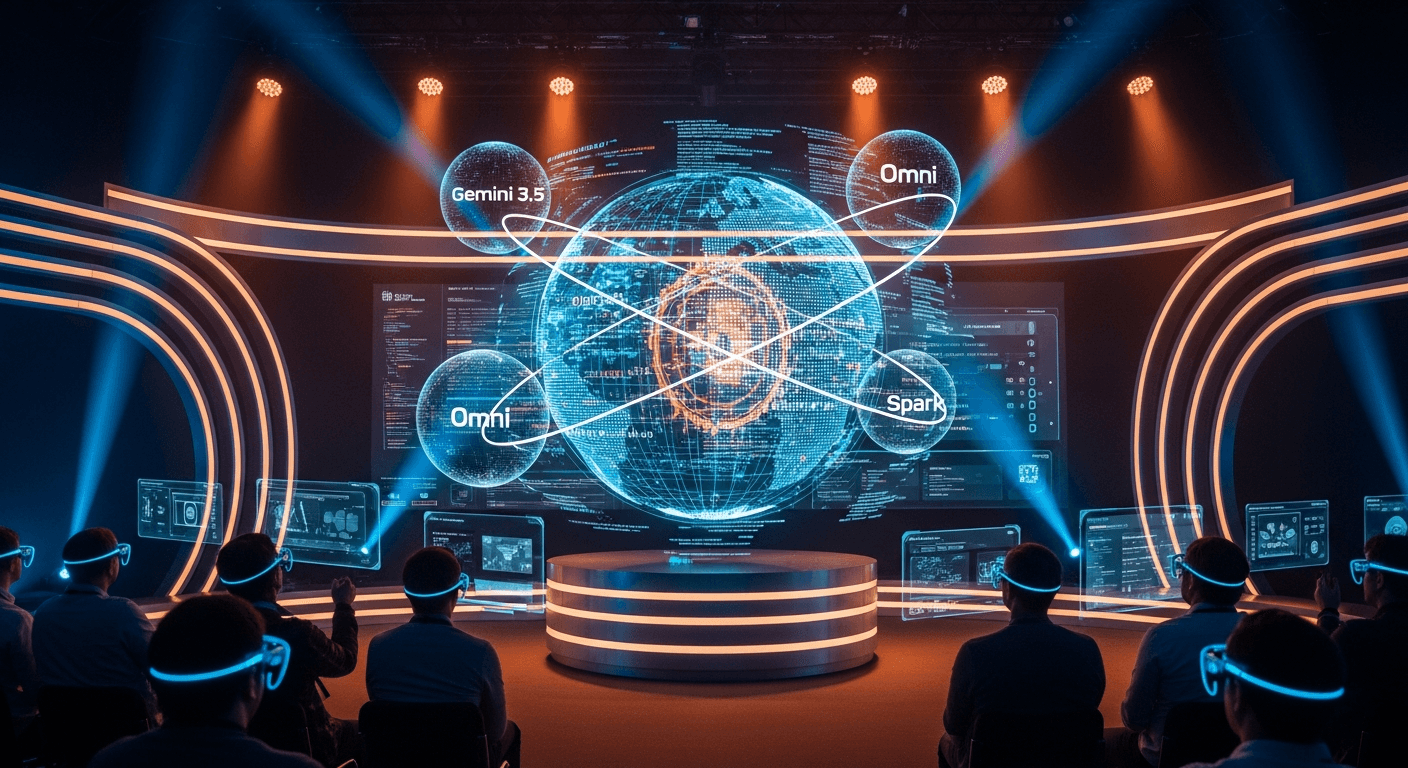
I watched Google I/O 2026 with the same mix of awe and pragmatic curiosity I bring to every leap in AI. Over the past few years I’ve followed Gemini’s steady rise, and today’s announcements — Gemini 3.5, Omni, Spark, and a rebuilt Search experience — feel like the industry’s next major pivot point. In this post I’ll walk through what was announced, the technical highlights, practical use cases, developer tools, and why this matters relative to OpenAI, Anthropic and Microsoft. I’ll also point to earlier writing where I flagged the trajectory toward multimodal, context-rich search and assistant experiences A Map to Everywhere and Every Thing ?.
What Google announced
Google’s keynote framed I/O 2026 as an inflection: the company introduced three headline offerings and a reimagined Search:
- Gemini 3.5 — the next-generation foundational model claimed to be faster at reasoning and better at controlling hallucination modes.
- Omni — a unified, multimodal assistant layer that blends vision, voice, long-form memory, and real-time context across apps and devices.
- Spark — a creativity and productivity suite that layers generative tooling into Docs, Sheets, Slides, Maps, and developer workflows.
- Search reengineered — search results that prioritize synthesized, contextual answers, rich multimodal cards, and an ongoing conversation with your history and permissions.
These changes aren’t small feature drops; they’re an attempt to move from search-as-index to search-as-relationship: the system remembers, adapts and composes across time and signals.
Technical highlights
Subhead: Model and architecture
- Improved reasoning and latency: Gemini 3.5 is presented as a model family optimized for interactive reasoning and multimodal inputs. Expect tighter integration between the model and Google’s vector store and indexing layers.
- Multimodal context window: Omni appears to consolidate vision, audio, and textual context into a single, persistent session scope — enabling continuous interactions across images, live camera feed, and documents.
- Modality routing and tool use: Spark offers specialized micro-models and tool chains for tasks like code, design, and data visualization, reducing the need to route every request to a single massive model.
Subhead: Infrastructure and deployment
- On-device and cloud blend: some Omni capabilities were shown running locally for privacy-sensitive tasks, while heavier reasoning remains cloud-native.
- Real-time connectors: new APIs for streaming inputs and outputs, making it easier to connect live sensors, Maps telemetry, or third-party apps into a persistent assistant.
Real-world use cases
I like distilling announcements into concrete examples. Here are a few that stood out:
- Trip planning: Omni can take a photo of your itinerary, read flight confirmations, consult Maps, and produce an adaptive plan that updates if a flight is delayed.
- Meeting synthesis: Spark can ingest multi-source meeting data — calendar, transcript, slides — and produce prioritized action items and draft follow-up emails.
- Creative collaboration: designers can prompt Spark for moodboards generated from a mix of reference images and text, iterate visually, and export assets directly to productivity apps.
- Search as co-pilot: the new Search returns synthesized answers (not just links), cites sources, and can continue a conversation that remembers past queries and preferences.
These scenarios demonstrate the move from point-in-time responses to ongoing, context-rich collaborations.
Pricing and availability
Google positioned these offerings as layered: basic Gemini-powered features in consumer Search and Workspace; advanced Omni and Spark capabilities in paid tiers for power users and enterprises. Expect a freemium consumer baseline with premium subscriptions for advanced multimodal memory, team collaboration features, and high-throughput API access. The company indicated a staged rollout — starting with developer previews and enterprise pilots, then broader consumer availability.
I encourage teams to evaluate the tradeoffs: latency, privacy controls, and cost per API call will determine whether to build on Omni, Spark, or remain with existing model providers.
Developer tools and APIs
Google emphasized developer experience: new SDKs, streaming endpoints, and ready-made connectors for Maps, Drive, and Workspace. Notable points:
- Streaming multimodal APIs: for apps that need to process camera, audio, and text in one session.
- Fine-tuning and adapters: purpose-built adapters for vertical tasks (legal, healthcare, finance) to reduce data needs for domain specialization.
- Local runtimes: limited on-device runtimes for sensitive inference and reduced round trip times.
Example developer flow:
- Register an app and enable Omni streaming.
- Use a Spark micro-model to generate UI components and data visualizations.
- Persist session context in a managed memory store with user consent scaffolding.
Privacy and safety
Google stressed layered consent and local-first modes, but the tension remains: the more personal and persistent the assistant, the greater the surface for privacy leaks and misuse. Key controls announced include:
- Explicit memory toggles: users control what the assistant stores and for how long.
- On-device processing for sensitive tasks: a move that mitigates some exposure but doesn’t eliminate telemetry risks.
- Source attribution: synthesized Search answers link back to source content to help users verify claims.
These are necessary steps but not a guarantee — robust independent audits and clear recovery options for users will be essential.
Comparison to competitors
OpenAI, Anthropic, and Microsoft are all racing on adjacent fronts:
- OpenAI focuses on general-purpose models and a strong developer ecosystem; its ChatGPT lineage emphasizes plugin architectures and real-time tool use.
- Anthropic centers on safety-first architectures and model behavior constraints that appeal to regulated industries.
- Microsoft integrates large models directly into productivity tools (Office and Azure) and leverages enterprise contracts.
Google’s pitch is differentiated by its massive ecosystem of Search, Maps, Workspace, and Android devices. The question is whether ecosystem integration and multimodal depth outweigh the simplicity and developer mindshare that OpenAI and Microsoft currently command.
Potential impacts
Big-picture effects I expect:
- Search will change from a page-of-links to a conversation with a personal assistant that composes answers and actions.
- Enterprise workflows will be disrupted as Spark automates synthesis tasks in ways that reduce time on routine knowledge work.
- Smaller AI startups will need to specialize rapidly or offer unique datasets and vertical expertise to remain competitive.
I’ve been tracking this arc—moving from retrieval to synthesis and memory—and I see Google doubling down on owning the persistent assistant layer that lives around users’ data and devices A Map to Everywhere and Every Thing ?.
Caution/excitement
"A Google executive (plausible) said: 'We see Omni as the connective tissue between your intents and the world’s information.'"
"A Google executive (plausible) said: 'Search will no longer be about links but about trustworthy answers and actions.'"
Both quotes are plausible framing lines and should be read as interpretive summaries of the keynote rather than verbatim transcripts.
My excitement: the integration of multimodal memory and live context opens genuinely useful scenarios. My caution: we must avoid premature trust in synthesized answers, and companies must invest in transparency, red-teaming, and user control.
Final takeaways
- I/O 2026 was about stitching together Google’s unique assets — Search, Maps, Workspace, and Android — into an assistant-first future.
- Gemini 3.5, Omni, and Spark signal a shift from isolated responses to ongoing, multimodal collaborations at scale.
- Developers and businesses should experiment now (developer previews will matter), but design with privacy, auditability, and user control in mind.
- Compared to OpenAI, Anthropic and Microsoft, Google’s edge is ecosystem integration; the tradeoff will be how well they manage safety and developer openness.
I’ll be testing the developer previews and writing follow-ups that dive into the APIs and early integrations. If you’re building with these tools, start with small pilot flows that validate safety and cost.
Regards,
Hemen Parekh
Any questions / doubts / clarifications regarding this blog? Just ask (by typing or talking) my Virtual Avatar on the website embedded below. Then "Share" that to your friend on WhatsApp.
Get correct answer to any question asked by Shri Amitabh Bachchan on Kaun Banega Crorepati, faster than any contestant
Hello Candidates :
- For UPSC – IAS – IPS – IFS etc., exams, you must prepare to answer, essay type questions which test your General Knowledge / Sensitivity of current events
- If you have read this blog carefully , you should be able to answer the following question:
- Need help ? No problem . Following are two AI AGENTS where we have PRE-LOADED this question in their respective Question Boxes . All that you have to do is just click SUBMIT
- www.HemenParekh.ai { a SLM , powered by my own Digital Content of more than 50,000 + documents, written by me over past 60 years of my professional career }
- www.IndiaAGI.ai { a consortium of 3 LLMs which debate and deliver a CONSENSUS answer – and each gives its own answer as well ! }
- It is up to you to decide which answer is more comprehensive / nuanced ( For sheer amazement, click both SUBMIT buttons quickly, one after another ) Then share any answer with yourself / your friends ( using WhatsApp / Email ). Nothing stops you from submitting ( just copy / paste from your resource ), all those questions from last year’s UPSC exam paper as well !
- May be there are other online resources which too provide you answers to UPSC “ General Knowledge “ questions but only I provide you in 26 languages !


No comments:
Post a Comment