
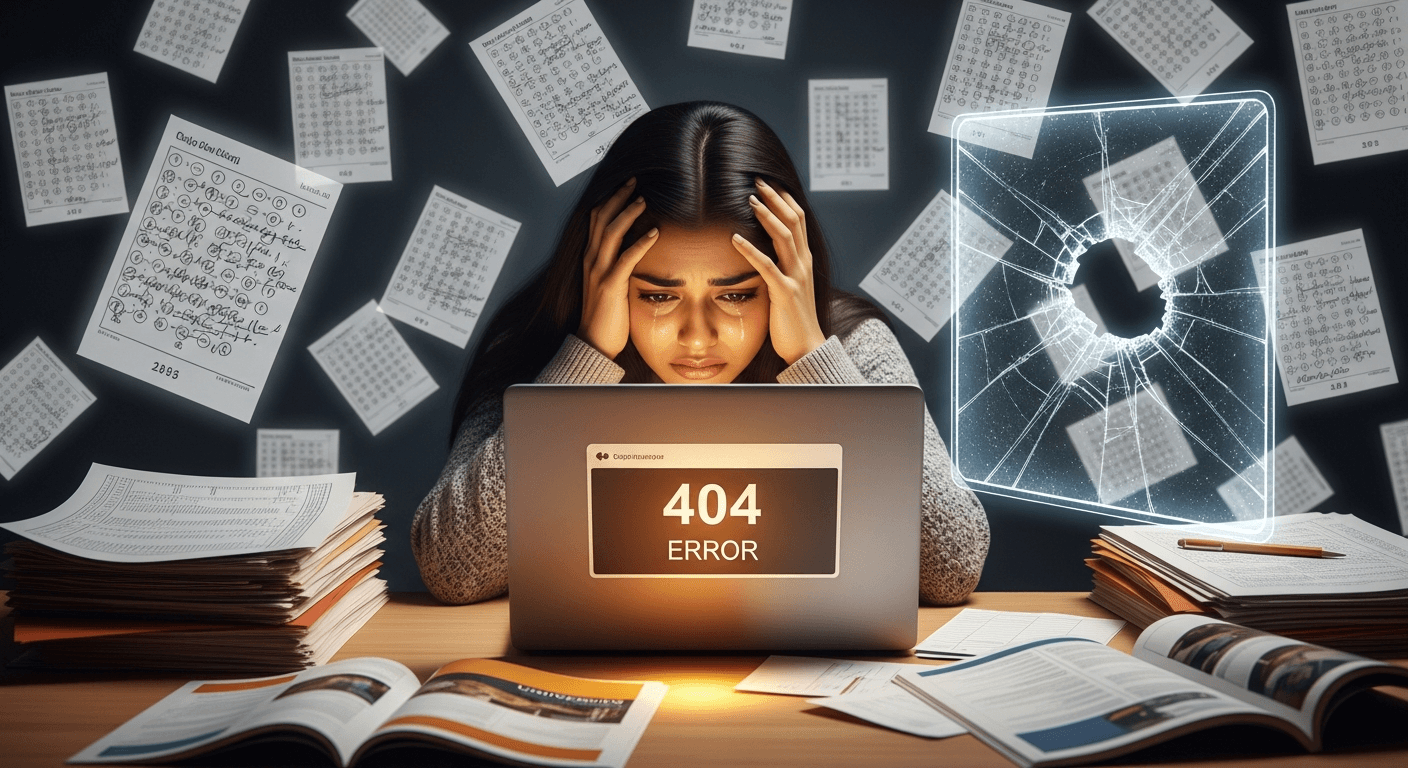
CBSE’s answer-sheet portal failure has left lakhs of students unable to access scanned responses, jeopardising admissions, scholarships and mental health. I investigate what went wrong, how students were stranded, and practical fixes for the next 72 hours and beyond.
Answer Sheet Portal Chaos
I write this as someone who believes technology can amplify opportunity — and, when it fails, amplify harm. Over the last few days, reports and messages have come flooding in from students, parents and school staff describing how the Central Board of Secondary Education’s (CBSE) answer-sheet portal went offline, lost scanned response files, or presented mismatched data. The result: lakhs of students across the country have been left confused, unable to verify their evaluated answers, and fearful about admissions and future plans.
What happened — a short summary
The CBSE introduced the answer-sheet portal to provide scanned copies of evaluated papers and make the results verification transparent. Instead, a combination of system outages, slow uploads, missing scans and confusing user interfaces prevented many students from accessing their answer sheets or finding the correct files linked to their roll numbers. For students waiting for board results that decide college admissions and scholarship eligibility, the portal’s collapse was not a technical glitch — it was a crisis.
Background: CBSE and the portal
CBSE runs one of the largest school-examination ecosystems in the world. Digitisation initiatives over the last decade aimed to reduce opacity around evaluation and speed up results. The answer-sheet portal was meant to be a positive step in that direction: scanned evaluated copies, transparent marking, and a mechanism for schools and students to raise rechecking requests.
But scale matters. When a system meant to serve millions isn’t built or tested for peak, and when contingency plans are thin, transparency can quickly turn into chaos. In earlier writing, I’ve argued for resilient, low-friction digital tools for students — see my work on digital learning platforms like My-Teacher for context My-Teacher.
Students’ experiences — concrete anecdotes
The human cost is what stays with me. I heard from a Class XII student who stayed up all night waiting for a scan that never appeared; their application deadlines for a coveted undergraduate program closed while they waited. A school counsellor described dozens of calls from panic-stricken parents after the portal showed blank pages or wrong roll numbers. Many students reported:
- Scanned pages that were incomplete or replaced by other students’ answers.
- Repeated login timeouts and error messages while attempting to download PDFs.
- Inability to get confirmation emails or reference IDs needed for re-evaluation requests.
Because I spoke with teachers and listened to dozens of messages, a pattern emerged: this wasn’t isolated to a single region — the problem was systemic and affected lakhs (hundreds of thousands) of students who rely on timely access to verified answer sheets.
Scale and consequences
When I say lakhs, I mean a ripple that reaches admissions offices, scholarship committees, and families making life-defining choices. Consequences include:
- Delayed or missed college admissions and entrance application deadlines.
- Students unable to file re-evaluation requests within prescribed windows because they couldn’t confirm marks or access scans.
- Widespread anxiety and worsening mental health among teenagers already under exam stress.
- Administrative overload at schools forced to act as intermediaries without clear processes.
This is not only about inconvenience; it is about lost opportunities and deep, avoidable distress.
Official responses — and where they fall short
Institutional statements emphasised that teams were “working to restore the portal” and that processes for manual verification existed. While such responses are necessary, they felt reactive and opaque to those on the ground: students were given no clear timelines, no interim channels for urgent verification, and inconsistent instructions from different offices. Effective crisis communication should offer immediate, concrete steps students can follow — an area where the response was weak.
Expert perspective (generalised)
Technology and education-administration experts I’ve spoken with point to three common failures:
- Underestimated peak load and inadequate testing for worst-case traffic scenarios.
- Poor error-handling and user experience design that leaves non-technical users stranded.
- Weak offline contingency processes so that when the portal fails, manual workflows can scale.
These are solvable problems — but they require both technical fixes and administrative humility.
Immediate fixes (48–72 hours)
If I were advising the CBSE and state education officers, here’s what I would insist on within the next 48–72 hours:
Emergency helpline expansion: A central, toll-free number with regional escalation lanes, advertised widely across newspapers, social and SMS. Staff helplines with clear SOPs to issue provisional verification notices.
Manual fallback process: Allow schools to request authenticated physical or scanned copies directly from regional evaluation centres. Issue temporary certificates acknowledging the delay for admission committees.
Clear public timelines: Publish a minute-by-minute restoration plan and weekly checkpoints. Silence breeds mistrust; specifics create accountability.
Temporary freeze on critical deadlines: Coordinate with major universities and scholarship bodies to extend submission timelines for anyone impacted by the portal outage.
Rapid audit of upload integrity: Technical teams must validate which batches are affected, isolate corrupt files, and prioritise critical regions and deadlines.
Long-term reforms
To prevent recurrence, we must think beyond quick patches:
Resilience-first architecture: Build redundant servers, geographically distributed backups, and load-testing that simulates peak concurrency.
Transparent logs and receipts: Every upload/download should generate a cryptographic receipt so students and schools can verify integrity without needing support lines.
Decentralised verification pathways: Empower zonal or school-level nodes that can authenticate and deliver scanned copies when central systems fail.
Regular third-party audits: Annual stress tests and penetration tests by independent auditors, with reports published in summary form.
Student-centred communication design: Portals must be tested with actual students and parents to avoid jargon-heavy errors and confusing UI states.
Closing — a call to action
Lakhs of students deserve more than apologies; they deserve systems designed with scale, failure modes and human consequences in mind. I urge the CBSE to act on immediate fixes now, publish a transparent restoration and compensation plan, and commit to structural reforms that prioritize student wellbeing.
If you are a student, parent or teacher affected by this, document the timestamps, screenshots and communications — they matter when seeking redress. If you are a policymaker or technologist, treat this incident as a lesson in humility: digital tools are only as good as the resilience and care we build into them.
I will continue to follow this closely and push for solutions that protect opportunities and reduce harm. In earlier posts I argued for simple, resilient digital learning and verification tools — the same principles apply now. For reference on building accessible student-first systems, see my previous notes on digital learning platforms like My-Teacher.
Regards,
Hemen Parekh
Any questions / doubts / clarifications regarding this blog? Just ask (by typing or talking) my Virtual Avatar on the website embedded below. Then "Share" that to your friend on WhatsApp.
Get correct answer to any question asked by Shri Amitabh Bachchan on Kaun Banega Crorepati, faster than any contestant
Hello Candidates :
- For UPSC – IAS – IPS – IFS etc., exams, you must prepare to answer, essay type questions which test your General Knowledge / Sensitivity of current events
- If you have read this blog carefully , you should be able to answer the following question:
- Need help ? No problem . Following are two AI AGENTS where we have PRE-LOADED this question in their respective Question Boxes . All that you have to do is just click SUBMIT
- www.HemenParekh.ai { a SLM , powered by my own Digital Content of more than 50,000 + documents, written by me over past 60 years of my professional career }
- www.IndiaAGI.ai { a consortium of 3 LLMs which debate and deliver a CONSENSUS answer – and each gives its own answer as well ! }
- It is up to you to decide which answer is more comprehensive / nuanced ( For sheer amazement, click both SUBMIT buttons quickly, one after another ) Then share any answer with yourself / your friends ( using WhatsApp / Email ). Nothing stops you from submitting ( just copy / paste from your resource ), all those questions from last year’s UPSC exam paper as well !
- May be there are other online resources which too provide you answers to UPSC “ General Knowledge “ questions but only I provide you in 26 languages !




No comments:
Post a Comment