
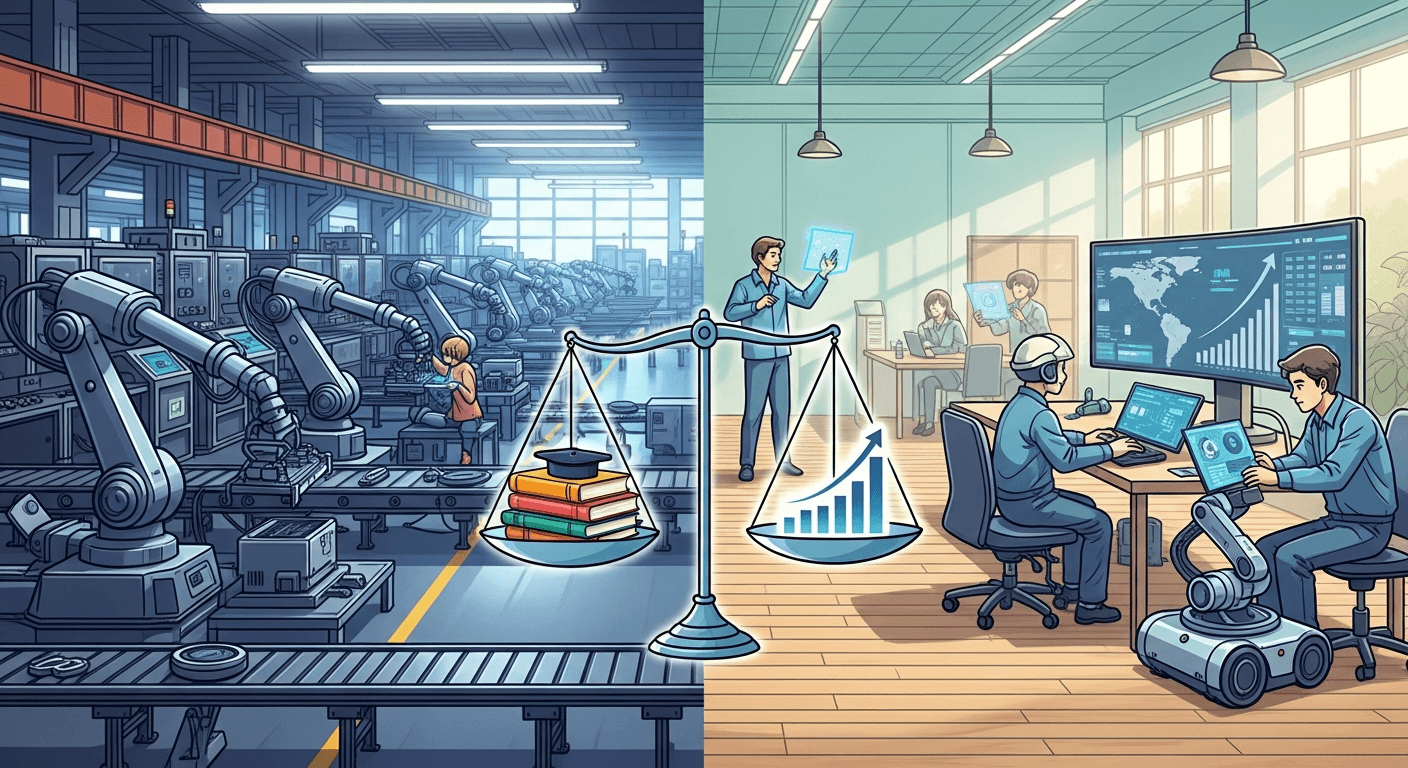
The debate I keep returning to
Lately I’ve been thinking about the chorus of “doomers” who say AI will steal our jobs — and about a contrasting voice I quoted in an earlier piece. In that post I noted that the billionaire venture capitalist Vinod Khosla (vk@khoslaventures.com) warned that “slowing down could kick up a different set of problems.” I want to revisit that tension: the doomer argument, the counterarguments from successful technologists and investors, and what I, personally, think good policy should look like.
What do the doomers say?
Doomers generally advance a few core claims:
- AI will automate entire occupations, not just tasks, leaving many workers permanently unemployed.
- The pace of change is faster than our institutions can adapt — education, social safety nets, and re-training programs will lag.
- New jobs created by technology will be fewer and require skills that displaced workers don’t have, producing sustained inequality.
These are not idle fears. They are rooted in historical anxieties about technological disruption, and they force us to take the social consequences of rapid automation seriously.
The billionaire’s counterarguments — quoted and paraphrased
When I brought up the issue previously, I cited Vinod Khosla (vk@khoslaventures.com). His brief quoted point — that “slowing down could kick up a different set of problems” — captures a common rejoinder among many tech investors and entrepreneurs. Paraphrasing that position more broadly:
- Rapid automation increases productivity and lowers costs, which in turn can expand markets and create demand for entirely new lines of work.
- Historical patterns show that while specific tasks are automated, new roles often appear that humans fill — frequently in ways that are complementary to machines rather than directly competitive.
- Trying to freeze progress can hurt the poorest by denying them cheaper goods and services and the new opportunities that growth can bring.
Put simply, the counterargument is not naïve techno-optimism. It is an empirical claim about dynamic economies: automation reshapes work, and—if managed well—reshaping can lead to net job creation and higher living standards.
History offers lessons — displacement and creation
We don’t have to guess. There are well-known historical examples:
- The Industrial Revolution mechanized many manual trades and transformed labor markets radically. It displaced certain jobs but also created new industries, urban professions, and mass employment over decades.
- The introduction of ATMs is a useful modern example. ATMs automated many cash-handling tasks but did not eliminate bank-teller employment; instead, banks redeployed human staff to customer service, sales, and branch expansion. The nature of teller work changed, and bank employment eventually rose as banking reached more customers.
The pattern I see is repeated: automation removes tasks; it rarely removes the need for human judgment, empathy, creativity, entrepreneurship, and the social processes that enable markets to function.
Where the argument needs honesty
That’s not to minimize the very real transition costs. Some truths we should admit:
- Transitions are painful and often geographically concentrated. Regions built around a single industry can suffer for years.
- Not all displaced workers can pivot to the new jobs without deliberate, high-quality retraining and support.
- Market-driven invention doesn’t guarantee equitable distribution of the benefits.
So optimism without policy is hollow; skepticism without solutions is paralyzing.
Practical policy recommendations (what I argue for)
We need a multi-pronged policy response that reflects both the promise and the risks of AI:
- Retraining and lifelong learning: Invest in scalable, employer-aligned retraining programs. Short, modular credentials tied to local demand can help workers transition more quickly.
- Education reform: Move fast on curricula that build digital literacy, critical thinking, and adaptability — not just narrow vocational skills that may quickly become obsolete.
- Stronger safety nets: Enhance unemployment support, portable benefits, and targeted wage insurance during transitions so people can retrain without falling into poverty.
- Tax policy and corporate incentives: Consider tax credits for firms that invest in worker retraining or that create new roles requiring human-AI collaboration. Some have proposed levying taxes on automation gains (a “robot tax”) and using proceeds to finance transition programs; it’s worth debating seriously, but we must design any levy to avoid stifling innovation.
- Universal Basic Income (UBI) — think carefully: UBI is an important conversation to have, but it’s not a silver bullet. A modest, well-targeted basic support could complement retraining and active labor-market policies. Large, unconditional UBI would reshape fiscal priorities and should be tested with pilots first.
A balanced path forward
I side with neither doomsayers who predict mass, permanent joblessness nor with unfettered techno-utopians who promise effortless benefits for all. I accept the core of Vinod Khosla (vk@khoslaventures.com)’s admonition that halting progress has costs — but I add this: we must distribute the gains fairly and invest in human capital.
That means treating automation as both an economic opportunity and a public responsibility. Companies gain from higher productivity; society must ensure those gains are used to support transitions, not just concentrate wealth.
Conclusion
AI will change what work looks like. History suggests that new jobs will emerge even as tasks disappear. The real question is whether our institutions — education systems, social safety nets, and tax frameworks — evolve fast enough to help people move from displaced tasks into meaningful, compensated roles. I believe we can do that, but only if we combine the innovation that investors like Vinod Khosla (vk@khoslaventures.com) defend with robust public policy aimed at fairness and resilience.
Regards,
Hemen Parekh
Any questions / doubts / clarifications regarding this blog? Just ask (by typing or talking) my Virtual Avatar on the website embedded below. Then "Share" that to your friend on WhatsApp.
Get correct answer to any question asked by Shri Amitabh Bachchan on Kaun Banega Crorepati, faster than any contestant
Hello Candidates :
- For UPSC – IAS – IPS – IFS etc., exams, you must prepare to answer, essay type questions which test your General Knowledge / Sensitivity of current events
- If you have read this blog carefully , you should be able to answer the following question:
- Need help ? No problem . Following are two AI AGENTS where we have PRE-LOADED this question in their respective Question Boxes . All that you have to do is just click SUBMIT
- www.HemenParekh.ai { a SLM , powered by my own Digital Content of more than 50,000 + documents, written by me over past 60 years of my professional career }
- www.IndiaAGI.ai { a consortium of 3 LLMs which debate and deliver a CONSENSUS answer – and each gives its own answer as well ! }
- It is up to you to decide which answer is more comprehensive / nuanced ( For sheer amazement, click both SUBMIT buttons quickly, one after another ) Then share any answer with yourself / your friends ( using WhatsApp / Email ). Nothing stops you from submitting ( just copy / paste from your resource ), all those questions from last year’s UPSC exam paper as well !
- May be there are other online resources which too provide you answers to UPSC “ General Knowledge “ questions but only I provide you in 26 languages !


No comments:
Post a Comment