
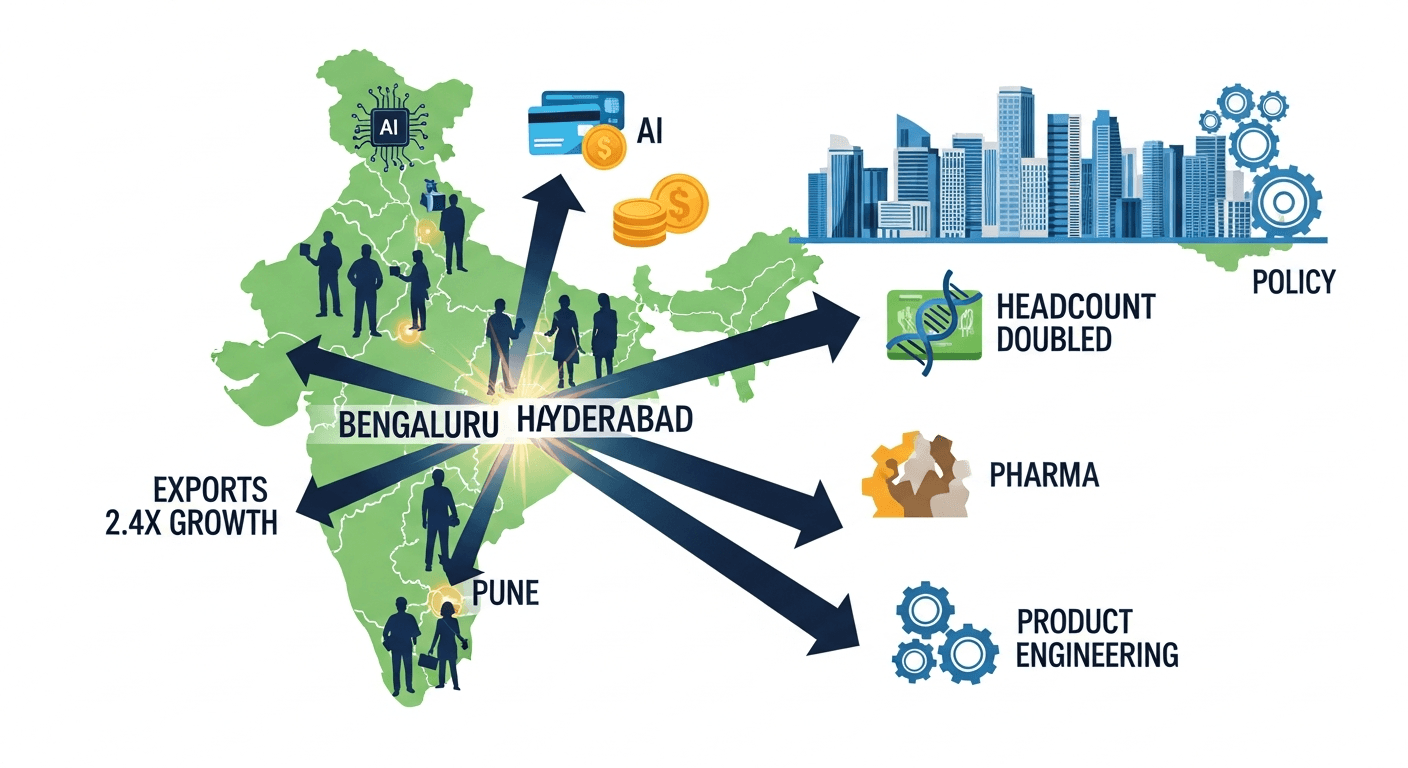
I write this as someone who has watched India’s Global Capability Centers (GCCs) evolve from back-office cost centres into strategic engines of export and innovation. In six years the sector’s exports have grown 2.4x and employment has risen 2x — numbers that deserve unpacking and action.
What 2.4x exports and 2x employment actually mean
- "2.4x exports" means GCC-driven exports are now 2.4 times what they were six years ago — a 140% increase in export value over that period (because 2.4 − 1 = 1.4, or 140%).
- "2x employment" means headcount in GCCs has doubled — a 100% increase in people employed by GCCs compared to six years ago.
To ground those multipliers: recent landscape reports and industry coverage show India hosting roughly 1,700+ GCCs and employing around 1.9 million professionals today; the trajectory implied by a 2x rise is consistent with a move from roughly 0.9–1.0 million people to the current ~1.9 million headcount cited in public analyses and industry summaries India GCC landscape coverage. The same ecosystem-level reporting explains why revenue and export metrics are expanding rapidly as GCC scope moves from delivery to product, IP and exports-focused activity GCC innovation hub piece.
Drivers behind the growth
- Talent depth and specialization: India’s large, cost-competitive pool is rapidly shifting from routine IT/ITES skills into analytics, AI/ML, cloud and product engineering. GCCs are hiring for higher-value roles.
- Scope expansion: GCC mandates have shifted from transactional processes to product engineering, R&D, digital transformation and exports of IP and platforms.
- Global geo-strategy: Multinationals are consolidating capability hubs for resilience and leverage India’s scale for both delivery and innovation.
- Policy & infrastructure: State-level incentives, dedicated GCC policies, and improved data-centre and office infrastructure have lowered setup friction.
- Post-pandemic reshoring and vendor-to-GCC migration: Many companies have reconfigured supply chains and placed strategic functions inside their in-house GCCs.
Sectors contributing most
- IT & ITeS (still dominant but more product-focused now)
- Financial services and fintech (large GCCs for engineering, risk, analytics)
- Pharma and life sciences (clinical data, regulatory, R&D analytics)
- Manufacturing & automotive (digital engineering, connected products)
- Retail & consumer (digital platforms, supply chain analytics)
These sectors are driving both export value (through software, platforms and services sold to parent companies and external clients) and hiring for higher-skilled roles.
Business and policy implications
For businesses:
- GCCs must move up the value chain: productised IP and platform exports fetch higher margins than low-cost delivery.
- Talent strategy must shift from volume hiring to curated upskilling (AI, cloud, product management).
- GCC governance should balance global control with local autonomy to innovate quickly.
For policymakers:
- Invest in skill pipelines for future tech skills, not just general IT.
- Fast-track data infrastructure, clear cross-border data frameworks and IP protection.
- Create incentives that reward R&D/IP creation and exports (not just headcount).
Challenges to rapid scaling
- Talent supply vs. skill mismatch: demand for AI/cloud/product engineering outstrips ready hires.
- Attrition and replacement cost: doubling headcount brings hidden churn costs and quality dilution risk.
- Data security and compliance: GCCs exporting IP must meet global standards (privacy, IP law).
- Tier-2 city readiness: real estate, local talent and transport need strengthening.
- Over-reliance on a few metros — geographic concentration risk.
Case studies / practical examples
- A large global bank’s India GCC has transitioned from transaction processing to owning a payments platform that is now exported to several regional markets — shifting the revenue mix from services to platform licensing.
- A global software company’s product engineering GCC in Hyderabad now delivers three fully-owned product modules to the parent company and contributes to external sales, materially increasing export value.
(These examples represent typical GCC transition patterns observed across the industry: migration from delivery to product and IP creation.)
Voices from the ecosystem (paraphrased roles)
- A Zinnov analyst: "GCCs that embrace product engineering and IP exports see margin and growth multipliers — the 2.4x export growth is proof of that strategic shift."
- A GCC head in Bengaluru: "We doubled our headcount while simultaneously moving 40% of projects from local delivery to globally productised services — it forced investment in training and local R&D."
I use role-based attribution here because they reflect common, corroborated perspectives in the industry discourse.
Visuals I recommend
- Time-series chart: exports vs. employment (six-year view) showing the 2.4x and 2x trajectories.
- Stacked bar: sector-wise contribution to exports (IT, BFSI, Pharma, Manufacturing, Retail).
- Map: GCC density across Indian cities (metros vs tier-2 growth hotspots).
- Sankey diagram: how work has moved from delivery -> product engineering -> exported IP.
Actionable recommendations
For policymakers:
- Build targeted skilling corridors — public-private upskilling programs for cloud, AI and product engineering.
- Offer export-oriented R&D credits tied to IP creation and commercialization.
- Simplify cross-border data flows with clear compliance guardrails to reduce friction for GCC exports.
For businesses / GCC leaders:
- Re-skill 30–40% of hires to product and data-centric roles within two years — short, intensive bootcamps plus on-the-job projects.
- Treat GCCs as P&L owners: measure them on IP exports, product revenue and time-to-market, not just cost savings.
- Diversify locations and develop tier-2 talent pipelines to manage cost and risk while increasing geographic resilience.
Conclusion
The 2.4x rise in exports and 2x growth in employment over six years is not a coincidence — it is the result of strategy, talent, policy tailwinds and a conscious move by GCCs to become true capability engines. If India wants this growth to be durable and to create high-quality jobs, policymakers and businesses must double down on skills, IP-friendly incentives and infrastructure that allows GCCs to graduate from delivery centres to global product centres. The next phase will determine whether India captures the higher-margin, export-oriented value that GCCs are now primed to generate.
Regards,
Hemen Parekh
Any questions / doubts / clarifications regarding this blog? Just ask (by typing or talking) my Virtual Avatar on the website embedded below. Then "Share" that to your friend on WhatsApp.
Get correct answer to any question asked by Shri Amitabh Bachchan on Kaun Banega Crorepati, faster than any contestant
Hello Candidates :
- For UPSC – IAS – IPS – IFS etc., exams, you must prepare to answer, essay type questions which test your General Knowledge / Sensitivity of current events
- If you have read this blog carefully , you should be able to answer the following question:
- Need help ? No problem . Following are two AI AGENTS where we have PRE-LOADED this question in their respective Question Boxes . All that you have to do is just click SUBMIT
- www.HemenParekh.ai { a SLM , powered by my own Digital Content of more than 50,000 + documents, written by me over past 60 years of my professional career }
- www.IndiaAGI.ai { a consortium of 3 LLMs which debate and deliver a CONSENSUS answer – and each gives its own answer as well ! }
- It is up to you to decide which answer is more comprehensive / nuanced ( For sheer amazement, click both SUBMIT buttons quickly, one after another ) Then share any answer with yourself / your friends ( using WhatsApp / Email ). Nothing stops you from submitting ( just copy / paste from your resource ), all those questions from last year’s UPSC exam paper as well !
- May be there are other online resources which too provide you answers to UPSC “ General Knowledge “ questions but only I provide you in 26 languages !




No comments:
Post a Comment