
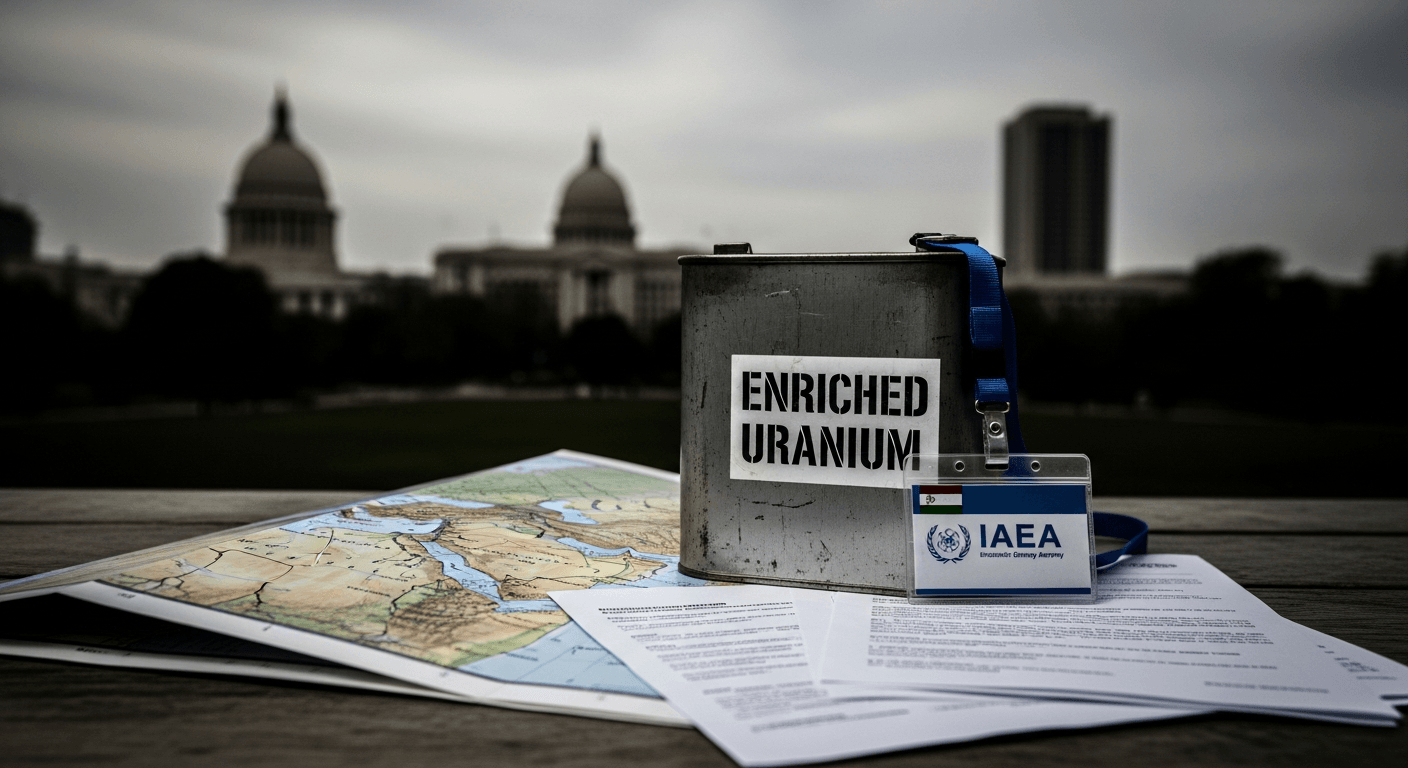
A report, a deal, and a widening question
A recent report said that Iran had agreed — in principle and in writing, according to those sources — to give up its stockpile of enriched uranium as part of a negotiated settlement largely completed with the U.S. side during the previous U.S. administration. The phrasing in the report — "largely negotiated" — implies a near-final architecture that, for reasons not fully clear in public accounts, was not implemented.
I read that report with the mix of professional curiosity and private unease that comes from watching nuclear diplomacy play out in fits and starts. What matters now is not only whether the account is accurate, but what it tells us about incentives, limits of executive diplomacy, the role of domestic politics on both sides, and the hard realities of verification.
Background: why enriched uranium matters
To understand the significance of the reported concession, a brief primer helps:
- Uranium enrichment increases the concentration of the fissile isotope U-235. Low-enriched uranium (LEU, typically <20% U-235) is used for power reactors; highly enriched uranium (HEU, ~90%) is suitable for weapons.
- The 2015 nuclear agreement (the JCPOA) capped Iran’s enrichment level and stockpile and introduced strict IAEA monitoring to extend the so-called breakout time to build a nuclear weapon.
- After the U.S. withdrew from that deal in 2018 and reimposed sanctions, Iran began incrementally rolling back its JCPOA limits, increasing enrichment levels and stockpiles and complicating verification.
Giving up enriched uranium — as the report said Iran had agreed — would be one of the most concrete and verifiable concessions Tehran could make, because stockpiles and enrichment levels are measurable and monitorable by the IAEA.
What the report said about the negotiation
According to the report said (media description), the framework under discussion would have required Iran to transfer or dilute existing enriched uranium and cap future enrichment in exchange for a phased relief of U.S. sanctions and other security assurances. The report characterized the arrangement as "largely negotiated" by officials of the then-U.S. administration and Iranian negotiators, though key implementation steps — timing, sequencing, and mechanisms for verification and sanctions relief — reportedly remained unresolved.
Where this differs from prior arrangements is the explicitity of the concession: rather than simply capping enrichment, the reported deal would have involved active removal or irreversible dilution of a portion of Iran’s enriched stock.
Possible implications for U.S.–Iran relations
If the report accurately reflects a salvageable framework, the implications are substantial:
- Diplomacy: a negotiated, verifiable rollback would re-open a pathway to de-escalation and a sequence for sanctions relief linked to concrete nuclear steps.
- Trust and credibility: implementing such a deal would require careful sequencing and credible verification to overcome mutual distrust that grew after the previous agreement collapsed.
- Domestic politics: both capitals would need political cover to accept and defend concessions at home — something often harder than the technical work of agreements.
But if elements of the reported negotiation were never fully agreed — or were overtaken by competing domestic imperatives — the practical prospects are weaker.
Reactions likely from key stakeholders
Iran: Tehran’s response will be filtered through the prism of domestic factions. Hardliners will view any nuclear rollback as strategically risky; pragmatists will argue a verifiable deal eases sanctions pain.
The U.S. executive branch (the prior administration): the report said it had invested political capital in the talks. Any successor government would inherit the technical scaffolding but not its political commitments.
Congress: many in the legislature remain skeptical of swift sanctions relief before ironclad verification measures are in place. Congressional posture can complicate presidential flexibility on timing and scope of relief.
Regional players (Israel, Saudi Arabia and others): these states historically view robust Iranian capabilities as existential threats and are likely to pressure for stringent verification and limits. They may welcome genuine rollback but remain skeptical of any deal perceived as insufficiently tight.
International bodies (IAEA): the Agency is the central guarantor for verification. Any credible deal depends on expanded, continuous access, and the Agency’s public assessments would shape international acceptance.
Domestic politics inside Iran
Iranian domestic politics matters more than most outside observers expect. The report said Tehran’s negotiating team was prepared to make concessions, but acceptance at home depends on:
- Economic calculus: sanctions relief that tangibly improves livelihoods strengthens the hand of moderates and pragmatists.
- Political legitimacy: hardliners oppose perceived capitulation, and Supreme or revolutionary authorities prioritize regime survival and deterrence.
- Timing and sequencing: Iranian officials will demand that relief be real and irreversible, not simply promises that can be reversed by a future administration.
Any successful deal would therefore require carefully staged deliverables that balance domestic demands for economic relief with national-security imperatives.
Likely scenarios going forward
- Implementation: the two sides refurbish the reported framework, add technical safeguards, and sequence verification and relief. This is difficult but possible if mutual incentives align.
- Partial salvage: elements are adopted (e.g., limits on enrichment) but not active removal of stockpiles — a compromise that reduces immediate risk but leaves contentious issues for later.
- Collapse: domestic politics or regional pushback stalls any revival, and Iran continues its current nuclear trajectory, increasing tensions and regional arms dynamics.
Which path unfolds will depend on political will, credible verification, and whether key regional actors can be reassured.
I have long thought that nuclear diplomacy follows patterns: technical fixes are available; the real barriers are politics and trust. I explored similar themes about the fragility of negotiated outcomes in an earlier essay on the strategic calculus of nuclear diplomacy Precariously Perched at Cliff Edge.
Reports like the one discussed here matter because they show that, even after public breakdowns, technical solutions can be on the table. The harder question is always human: can leaders sell those solutions at home and to skeptical neighbors? Until we see concrete verification steps, the world should treat such accounts as hopeful indicators rather than finished breakthroughs.
Regards,
Hemen Parekh
Any questions / doubts / clarifications regarding this blog? Just ask (by typing or talking) my Virtual Avatar on the website embedded below. Then "Share" that to your friend on WhatsApp.
Get correct answer to any question asked by Shri Amitabh Bachchan on Kaun Banega Crorepati, faster than any contestant
Hello Candidates :
- For UPSC – IAS – IPS – IFS etc., exams, you must prepare to answer, essay type questions which test your General Knowledge / Sensitivity of current events
- If you have read this blog carefully , you should be able to answer the following question:
- Need help ? No problem . Following are two AI AGENTS where we have PRE-LOADED this question in their respective Question Boxes . All that you have to do is just click SUBMIT
- www.HemenParekh.ai { a SLM , powered by my own Digital Content of more than 50,000 + documents, written by me over past 60 years of my professional career }
- www.IndiaAGI.ai { a consortium of 3 LLMs which debate and deliver a CONSENSUS answer – and each gives its own answer as well ! }
- It is up to you to decide which answer is more comprehensive / nuanced ( For sheer amazement, click both SUBMIT buttons quickly, one after another ) Then share any answer with yourself / your friends ( using WhatsApp / Email ). Nothing stops you from submitting ( just copy / paste from your resource ), all those questions from last year’s UPSC exam paper as well !
- May be there are other online resources which too provide you answers to UPSC “ General Knowledge “ questions but only I provide you in 26 languages !





No comments:
Post a Comment