
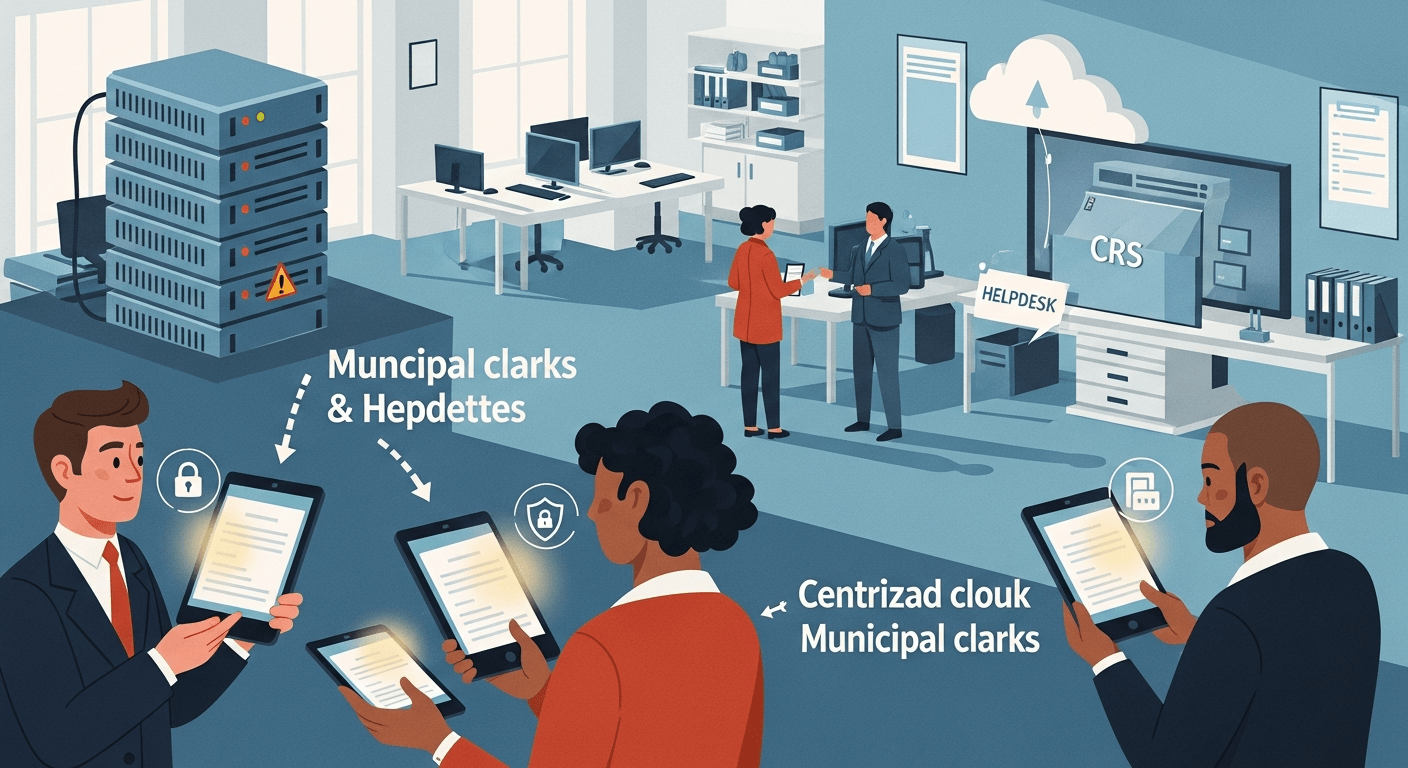
I write this as both an observer of civic systems and someone who has followed India’s long march toward digital registration for years. The Brihanmumbai Municipal Corporation (BMC) has shut down its SAP-based birth and death registration module and migrated those functions to the central Civil Registration System (CRS) portal. The change is significant for municipal staff, hospitals, and millions of citizens who rely on timely certificates for schooling, welfare, and legal matters.
What happened — a clear timeline
- Decision and announcement: The BMC issued an internal order to retire the local SAP registration module and adopt the CRS portal as the authoritative online channel.
- Data migration and cutover: The IT team performed a staged migration of active cases and master data, followed by a cutover in which the SAP module was taken offline and the CRS portal became the transactional platform.
- Post-migration period: Staff were directed to register new events only through the CRS portal; legacy requests are being processed through a temporary helpdesk-and-verification workflow while records reconcile.
This sequence — announcement, staged migration, cutover, and reconciliation — is now the operating reality across affected BMC wards.
Why BMC made the switch
The reasons are both administrative and technical:
- Interoperability: CRS is a national standard and makes data exchange with state and central registries easier.
- Standardization: Moving to CRS reduces the fragmentation that comes from multiple local customizations of SAP modules.
- Cost and maintenance: Running a local SAP module incurs licensing, customization, and staffing overhead; CRS centralization can shift maintenance to a shared national stack.
- Compliance and reporting: CRS is designed to meet statutory reporting formats for national vital statistics, simplifying compliance for municipal bodies.
Technical differences: SAP module vs CRS portal (high level)
Architecture
SAP-based local system: Typically a municipally hosted/customized ERP module with integrated workflows, local databases, and custom forms.
CRS portal: A centrally hosted, standardized web application maintained at the national level with APIs for data exchange.
Data model and standards
SAP: May use local schemas and customized fields; porting between versions often requires mapping and conversion.
CRS: Uses standardized schemas for birth and death events, aligned with national statistical needs.
Authentication and access
SAP: Local user accounts and role-based access managed by municipal IT.
CRS: Central authentication, often with layered e-KYC or integration with national identity systems.
Integration
SAP: Integrates with municipal processes; linking to national services may require bespoke connectors.
CRS: Designed to integrate with state registries, Aadhaar-enabled flows, and national dashboards out of the box.
Impact on citizens and staff
Citizens
Short-term: Some applicants will experience delays while legacy records reconcile. People used to ward-level SAP counters may need to adapt to a new portal interface or use hospital-assisted registration.
Long-term: Faster national recognition of certificates, easier verification for passports and welfare schemes, and potential access to e-certificates from a central source.
Staff
Short-term: Training needs and changed workflows; municipal staff will face data reconciliation work and new verification procedures.
Long-term: Reduced local maintenance burden, clearer standard operating procedures, and simpler reporting to state and national agencies.
Steps citizens must now take (practical guide)
For births
Ask the hospital to register the birth through the CRS-enabled workflow immediately after delivery.
If registering from home, use the CRS portal (or the BMC helpdesk) to submit required documents: proof of birth, parents’ IDs, address proof, and a signed declaration.
Download the provisional e-certificate from the CRS portal once issued; request a printed copy from the ward office if needed for official purposes.
For deaths
Hospitals or treating doctors should file the death event through CRS with cause-of-death details.
Families should obtain the temporary certificate and then request the formal CRS certificate after local verification.
If you need an older SAP-era certificate
Visit the BMC helpdesk or use the designated reconciliation channel; retain any temporary acknowledgements and reference numbers.
Representative quotes (attributed to roles)
"We have moved to the CRS portal to ensure uniformity and faster cross-jurisdictional verification," said the BMC Commissioner. "This is about putting citizen convenience and national standards first."
"During the migration window, some queues and processing delays are inevitable — we are prioritizing vulnerable cases and urgent certificates," said the Municipal Health Officer.
"Our IT team has set up a verification helpdesk and hotlines to resolve mismatches between legacy SAP records and CRS profiles," added the CRS Project Director overseeing the city rollout.
Potential short-term issues and long-term benefits
Short-term issues
Delays in certificate issuance during reconciliation.
Confusion for citizens used to ward-level counters and SAP workflows.
Training gaps among staff and temporary increased call-center volume.
Long-term benefits
Standardized records, faster inter-agency verification, and smoother issuance of linked services (passports, Aadhaar updates, welfare claims).
Reduction in duplicate registrations and improved national vital statistics.
Data security and privacy considerations
Centralization raises important questions:
- Data protection: CRS must enforce strong encryption, strict access logs, and role-based controls to prevent misuse.
- Minimization: Only fields necessary for the event should be shared across systems; sensitive fields should retain constrained access.
- Auditability: Citizens and oversight bodies should have mechanisms to audit who accessed personal records and why.
I have written about the promise and risks of digitizing life-event data before; see my earlier reflections on birth-and-death registration and national ID linkage Registration of Birth and Death.
Recommendations
For citizens
Keep digital copies of hospital discharge forms and photo IDs; use the CRS portal to track application status.
If a certificate is urgently needed, contact the BMC helpdesk and request priority handling.
For the municipal corporation
Publish clear step-by-step guidance and videos for citizens and staff.
Run an intensive two-week training and a staffed reconciliation cell for legacy records.
Implement audit logs, encryption, and an external privacy review of the CRS integration.
Brief summary
BMC’s move from a local SAP module to the CRS portal is a step toward standardized, interoperable vital records — it will cause short-term friction but promises long-term gains in accuracy and access. Citizens and the corporation both must invest modest effort now (training, documentation, and helpdesks) to realize those benefits.
Regards,
Hemen Parekh
Any questions / doubts / clarifications regarding this blog? Just ask (by typing or talking) my Virtual Avatar on the website embedded below. Then "Share" that to your friend on WhatsApp.
Get correct answer to any question asked by Shri Amitabh Bachchan on Kaun Banega Crorepati, faster than any contestant
Hello Candidates :
- For UPSC – IAS – IPS – IFS etc., exams, you must prepare to answer, essay type questions which test your General Knowledge / Sensitivity of current events
- If you have read this blog carefully , you should be able to answer the following question:
- Need help ? No problem . Following are two AI AGENTS where we have PRE-LOADED this question in their respective Question Boxes . All that you have to do is just click SUBMIT
- www.HemenParekh.ai { a SLM , powered by my own Digital Content of more than 50,000 + documents, written by me over past 60 years of my professional career }
- www.IndiaAGI.ai { a consortium of 3 LLMs which debate and deliver a CONSENSUS answer – and each gives its own answer as well ! }
- It is up to you to decide which answer is more comprehensive / nuanced ( For sheer amazement, click both SUBMIT buttons quickly, one after another ) Then share any answer with yourself / your friends ( using WhatsApp / Email ). Nothing stops you from submitting ( just copy / paste from your resource ), all those questions from last year’s UPSC exam paper as well !
- May be there are other online resources which too provide you answers to UPSC “ General Knowledge “ questions but only I provide you in 26 languages !


No comments:
Post a Comment