
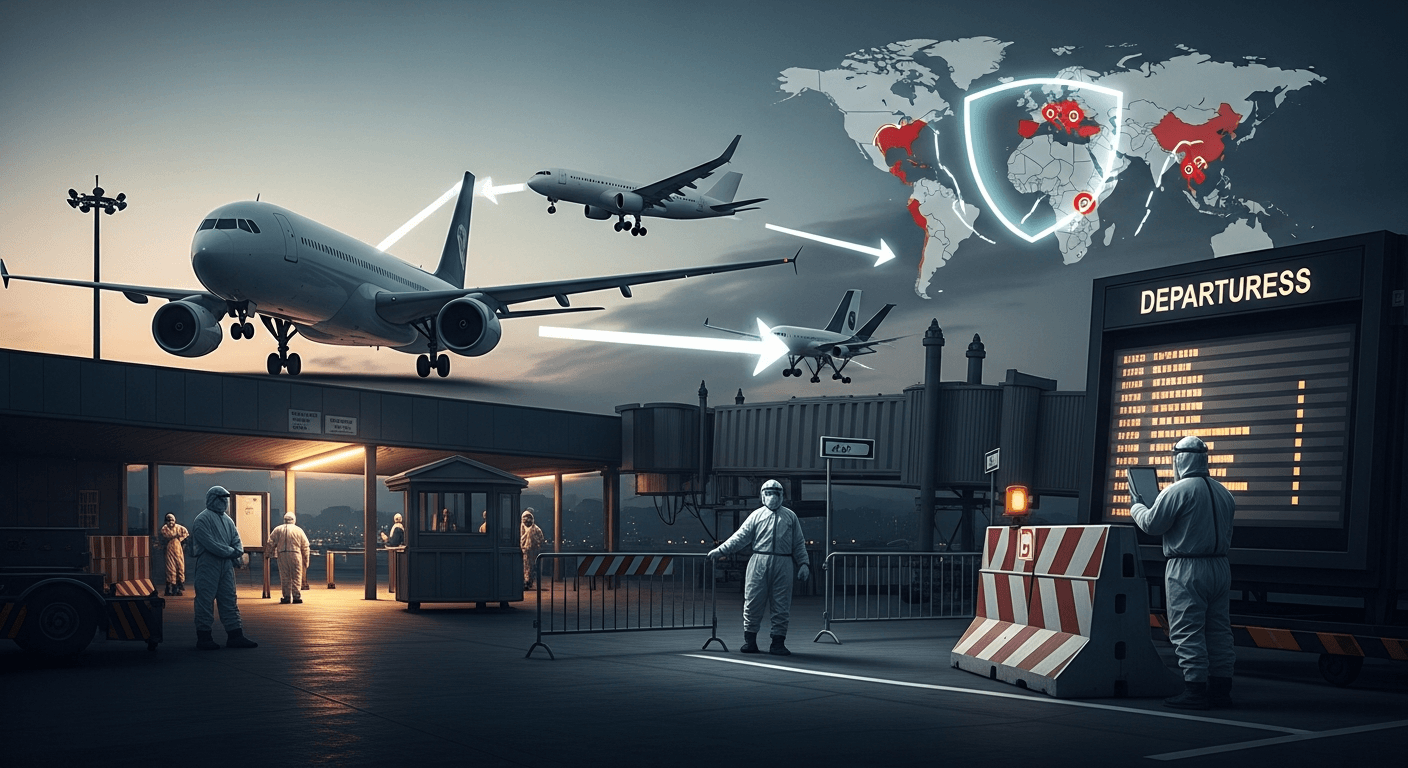
When Borders Tighten
I write this as someone who has watched pandemics reshape travel, economies, and the small rituals of daily life. The news of an Ebola outbreak — and the immediate reactions that follow — is always a reminder that our global systems are vulnerable and that governments will rapidly revert to the oldest tool in the toolbox: control of movement.
Why flights get diverted and borders are tightened
When an outbreak like Ebola appears, authorities take three overlapping aims seriously:
- Protect public health by slowing or containing spread.
- Reassure domestic audiences that leaders are acting decisively.
- Preserve critical infrastructure (hospitals, labs, supply chains) from sudden overload.
These goals explain why we see measures such as flight diversions, temporary airspace restrictions, enhanced screening at points of entry, and selective border closures. Each action is an attempt to buy time — for tracing, testing, isolation, and for health systems to prepare.
Typical country responses I’ve seen (and why they matter)
- Enhanced arrival screening at airports and land crossings: temperature checks, health declarations, and targeted rapid testing for travelers from affected regions.
- Flight diversions and quarantine corridors: some flights are rerouted to designated airports with better isolation facilities so suspected cases can be handled with trained teams and controlled transfers.
- Temporary suspension of direct flights to affected areas: this reduces cross-border seeding but creates logistical challenges for citizens and cargo.
- Land border controls and temporary checkpoints: these slow cross-border informal travel that is harder to monitor than commercial flights.
- Quarantine and close-contact tracing: immediate isolation of suspected cases and aggressive tracing to reduce onward transmission.
- Coordination with international agencies and neighboring countries: pooled resources for lab testing, PPE distribution, and clinical guidance.
Each measure has trade-offs. Stopping flights may delay introduction of cases, but it can also complicate repatriation and reduce the flow of medical supplies. Border checks can deter casual travel, but they are blunt and expensive instruments that can disrupt livelihoods.
The human and economic ripple effects
When borders tighten, effects cascade:
- Supply chains strain: medical supplies, food, and critical components may be delayed, affecting hospitals and businesses.
- Travel and tourism collapse locally: airlines and local economies suffer immediate losses.
- Migrant workers and informal cross-border communities face uncertainty: livelihoods are disrupted and trust in authorities can degrade if measures feel arbitrary.
- Misinformation flourishes: as movement is restricted, rumors fill the gaps and complicate public health messaging.
The challenge for policymakers is to be rapid without being reckless — to protect lives without unnecessarily closing off ways to deliver care, aid, and supplies.
What I think good precaution looks like
From my experience watching past outbreaks and from reflections I shared earlier about travel rules during health emergencies New rules for people coming from UK, I believe the best approach blends agility, transparency, and proportionality:
- Designated entry points: funnel arrivals from affected regions to airports and crossings equipped for isolation and testing rather than closing all routes.
- Evidence-based screening: prioritize testing and clinical assessment rather than relying solely on temperature checks, which miss many cases.
- Clear communication: explain who is affected, why specific routes are closed or diverted, and how long measures may last.
- Support for affected travelers and communities: provide clear repatriation plans, humanitarian corridors, and economic support for impacted border communities.
- International cooperation: share genomic data, case definitions, and treatment protocols quickly so local responses are effective and consistent.
The ethical balancing act
I often come back to a single uncomfortable truth: public health measures that restrict movement must also protect rights, dignity, and livelihoods. Asking people to quarantine or forbidding movement is easier when there is a plan to support them. That means food, income support where necessary, mental-health services, and transparent timelines.
When borders tighten in an outbreak, I ask leaders to answer three questions publicly:
- How will this measure reduce risk in measurable terms?
- What supports are in place for affected people and businesses?
- How and when will this policy be reviewed and lifted?
If those answers are vague, the policy will be resented and circumvented — making it less effective.
What individuals can do right now
- Stay informed from reputable public health sources and local authorities.
- If you must travel, check airline and embassy advisories and register your intent to travel where possible.
- Prepare a small kit: essential medicines, documentation, and contact info for consular services.
- Keep a plan for remote work and flexible childcare in case local measures tighten quickly.
A closing reflection
I’ve written before about travel rules and the need to prepare systems that balance speed with care New rules for people coming from UK. That continuity matters: outbreaks teach similar lessons each generation — about logistics, compassion, and the limits of control. When flights are diverted and borders are tightened, it is a sign that societies are improvising under pressure. Our job, collectively, is to make those improvisations smarter, fairer, and more human.
Regards,
Hemen Parekh
Any questions / doubts / clarifications regarding this blog? Just ask (by typing or talking) my Virtual Avatar on the website embedded below. Then "Share" that to your friend on WhatsApp.
Get correct answer to any question asked by Shri Amitabh Bachchan on Kaun Banega Crorepati, faster than any contestant
Hello Candidates :
- For UPSC – IAS – IPS – IFS etc., exams, you must prepare to answer, essay type questions which test your General Knowledge / Sensitivity of current events
- If you have read this blog carefully , you should be able to answer the following question:
- Need help ? No problem . Following are two AI AGENTS where we have PRE-LOADED this question in their respective Question Boxes . All that you have to do is just click SUBMIT
- www.HemenParekh.ai { a SLM , powered by my own Digital Content of more than 50,000 + documents, written by me over past 60 years of my professional career }
- www.IndiaAGI.ai { a consortium of 3 LLMs which debate and deliver a CONSENSUS answer – and each gives its own answer as well ! }
- It is up to you to decide which answer is more comprehensive / nuanced ( For sheer amazement, click both SUBMIT buttons quickly, one after another ) Then share any answer with yourself / your friends ( using WhatsApp / Email ). Nothing stops you from submitting ( just copy / paste from your resource ), all those questions from last year’s UPSC exam paper as well !
- May be there are other online resources which too provide you answers to UPSC “ General Knowledge “ questions but only I provide you in 26 languages !




No comments:
Post a Comment