
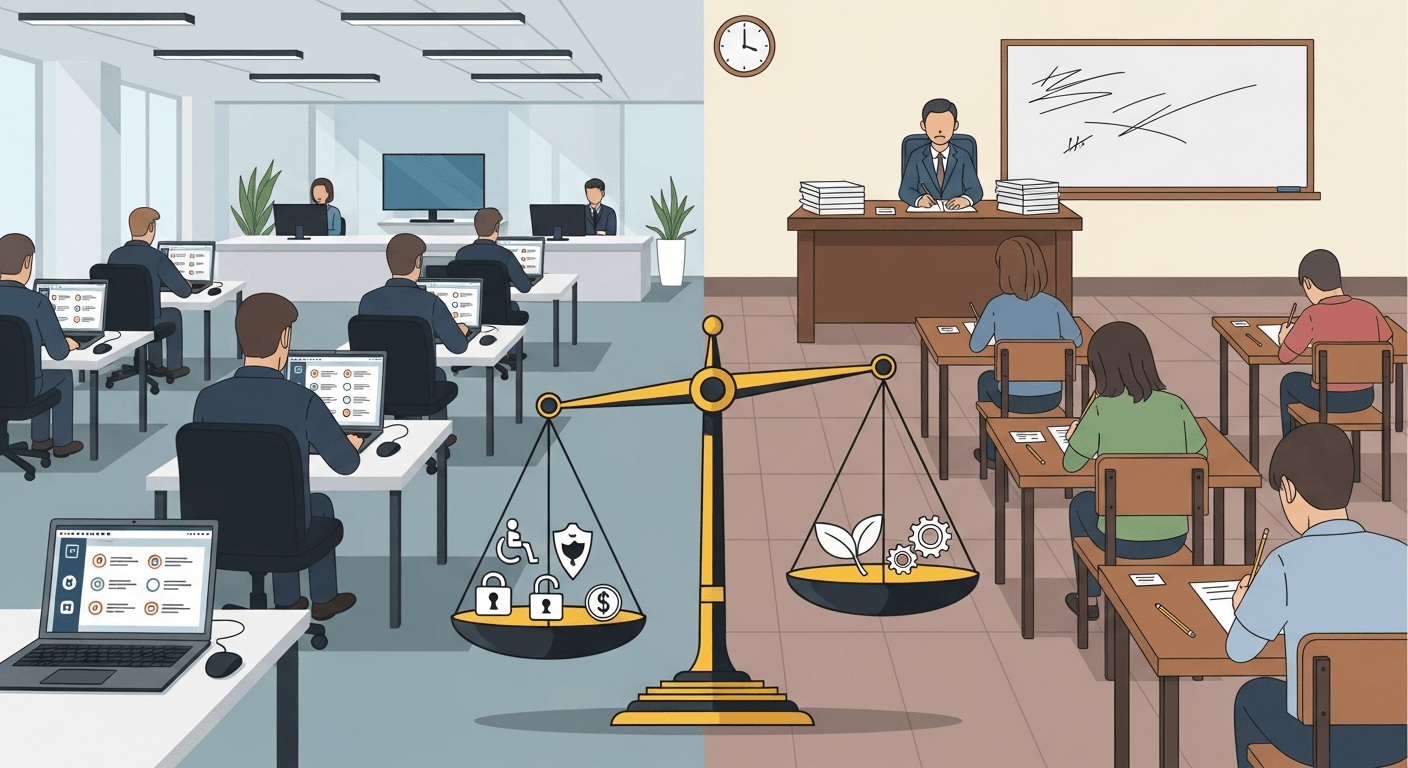
Framing the question
I still see educators and test administrators debating whether to deliver assessments as computer-based tests (CBT) or traditional pen-and-paper. I've been part of those conversations, and my aim here is practical: to help you weigh the trade-offs, focus on the evidence-informed considerations, and walk away with a decision checklist you can apply immediately.
Quick summary: what I recommend
I generally recommend choosing the delivery mode that best aligns with your primary assessment goals, candidate population, and operational constraints. If validity, wide accessibility, and low-tech reliability are paramount, pen-and-paper often wins. If scalability, rapid scoring, adaptive testing, and richer item types matter more, CBT usually makes sense. The rest of this post explains why—and how to decide.
Pros and cons at a glance
Computer-Based Testing (CBT)
Pros
- Faster scoring and reporting; supports automated scoring for objective items and partial automation for constructed responses.
- Enables adaptive testing, multimedia items, and richer item types (simulations, interactive tasks).
- Scales well for large, geographically distributed cohorts when infrastructure exists.
- Can reduce paper handling, storage, and physical logistics.
Cons
- Requires robust technical infrastructure and reliable internet or secure offline delivery systems.
- Proctoring and security considerations are different and sometimes more complex (remote proctoring, device security, item exposure risks).
- May introduce accessibility barriers for digitally inexperienced candidates or in low-resource contexts.
- Upfront costs for platforms, licensing, and technical support can be significant.
Pen-and-Paper Testing
Pros
- Mature, well-understood logistics for many institutions; minimal digital literacy required from candidates.
- Often perceived as lower risk for certain security models where physical control is feasible.
- Lower dependence on electricity, network, or device availability in resource-constrained settings.
- Easier to accommodate certain accessibility needs with human proctors and physical aids.
Cons
- Slower scoring and reporting unless scanned/optical systems are used.
- Logistic burdens: printing, secure transport, storage, and waste management.
- Limited item types—no multimedia or interactive simulations.
- Harder to scale rapidly without large administrative teams.
Evidence-based considerations (what I look for)
When advising teams, I focus on these evidence-informed dimensions. They should be your decision criteria too.
- Accessibility and fairness: consider candidate digital skills, assistive technologies, and language needs. CBT can be highly accessible with the right accommodations, but it can also exclude those without prior exposure.
- Validity and reliability: determine whether item types supported by CBT (e.g., simulations) enhance construct coverage and measurement quality. Equivalence studies often find comparable scores when tests are carefully designed, but mode effects can appear for timing and navigation-dependent tasks.
- Security and cheating risk: CBT shifts some risks (remote proctoring, device spoofing, item exposure) and mitigations (lockdown browsers, randomized forms). Pen-and-paper shifts risks toward leak through physical copies and transport.
- Logistics and operational capacity: evaluate your IT support, test center network, printing and courier pipelines, and contingency plans for failures.
- Candidate experience: measure exam anxiety related to interface, typing vs handwriting, and test pacing. For some competencies, handwriting matters; for others, typing is neutral or preferable.
- Costs and scalability: analyze total cost of ownership—platform licenses, device procurement, proctoring, printing, staffing, and storage—over multiple years.
- Environmental impact: pen-and-paper consumes paper and adds shipping footprint; CBT consumes energy and devices but may reduce recurring material waste.
Practical decision checklist (use this with your team)
- Purpose & construct: Does the assessment require item types only feasible on CBT (simulations, multimedia)? If yes, favor CBT.
- Candidate profile: What percent lack reliable device/internet access or digital literacy? If high, favor pen-and-paper or plan for supervised test centers.
- Equity & accommodations: Can you provide required assistive tech across delivery modes? If not, delay CBT rollout until accommodations are guaranteed.
- Security model: Can you secure items and delivery for CBT (encryption, proctoring, item pools) or for paper (secure printing, chain-of-custody)?
- Infrastructure & support: Do you have IT capacity for real-time troubleshooting and backups? If not, pen-and-paper may be safer.
- Cost analysis: Run a 3–5 year TCO model including hardware refresh cycles and environmental costs.
- Pilot & comparability: Pilot both modes with representative samples to check for mode effects and candidate feedback.
- Contingency planning: Create failover plans (on-site device spares, alternative paper exams, extended windows).
Implementation tips if you choose CBT
- Start with a phased rollout and robust pilot program.
- Invest in clear candidate training materials and practice tests to reduce interface anxiety.
- Use item-exposure controls, randomized item banks, and secure proctoring strategies.
- Monitor analytics (timing patterns, item functioning) to detect unexpected mode effects.
Implementation tips if you choose pen-and-paper
- Standardize printing, transport, and storage procedures with auditable chain-of-custody.
- Use scanning/optical mark recognition where possible to speed scoring.
- Plan for secure destruction/recycling to reduce environmental impact.
- Build a schedule that accounts for shipping time and printed-material contingencies.
Conclusion and recommendation
There is no one-size-fits-all answer. My recommendation: define the highest-priority assessment goals first (validity, access, speed, cost), run targeted pilots that mimic real conditions, and base your final choice on data from those pilots plus your operational capacity. Where possible, design assessments and processes that allow flexibility—hybrid models, multiple test windows, and strong comparability studies will buy you resilience.
Regards,
Hemen Parekh
Any questions / doubts / clarifications regarding this blog? Just ask (by typing or talking) my Virtual Avatar on the website embedded below. Then "Share" that to your friend on WhatsApp.
Get correct answer to any question asked by Shri Amitabh Bachchan on Kaun Banega Crorepati, faster than any contestant
Hello Candidates :
- For UPSC – IAS – IPS – IFS etc., exams, you must prepare to answer, essay type questions which test your General Knowledge / Sensitivity of current events
- If you have read this blog carefully , you should be able to answer the following question:
- Need help ? No problem . Following are two AI AGENTS where we have PRE-LOADED this question in their respective Question Boxes . All that you have to do is just click SUBMIT
- www.HemenParekh.ai { a SLM , powered by my own Digital Content of more than 50,000 + documents, written by me over past 60 years of my professional career }
- www.IndiaAGI.ai { a consortium of 3 LLMs which debate and deliver a CONSENSUS answer – and each gives its own answer as well ! }
- It is up to you to decide which answer is more comprehensive / nuanced ( For sheer amazement, click both SUBMIT buttons quickly, one after another ) Then share any answer with yourself / your friends ( using WhatsApp / Email ). Nothing stops you from submitting ( just copy / paste from your resource ), all those questions from last year’s UPSC exam paper as well !
- May be there are other online resources which too provide you answers to UPSC “ General Knowledge “ questions but only I provide you in 26 languages !



No comments:
Post a Comment