
Introduction — the economic context
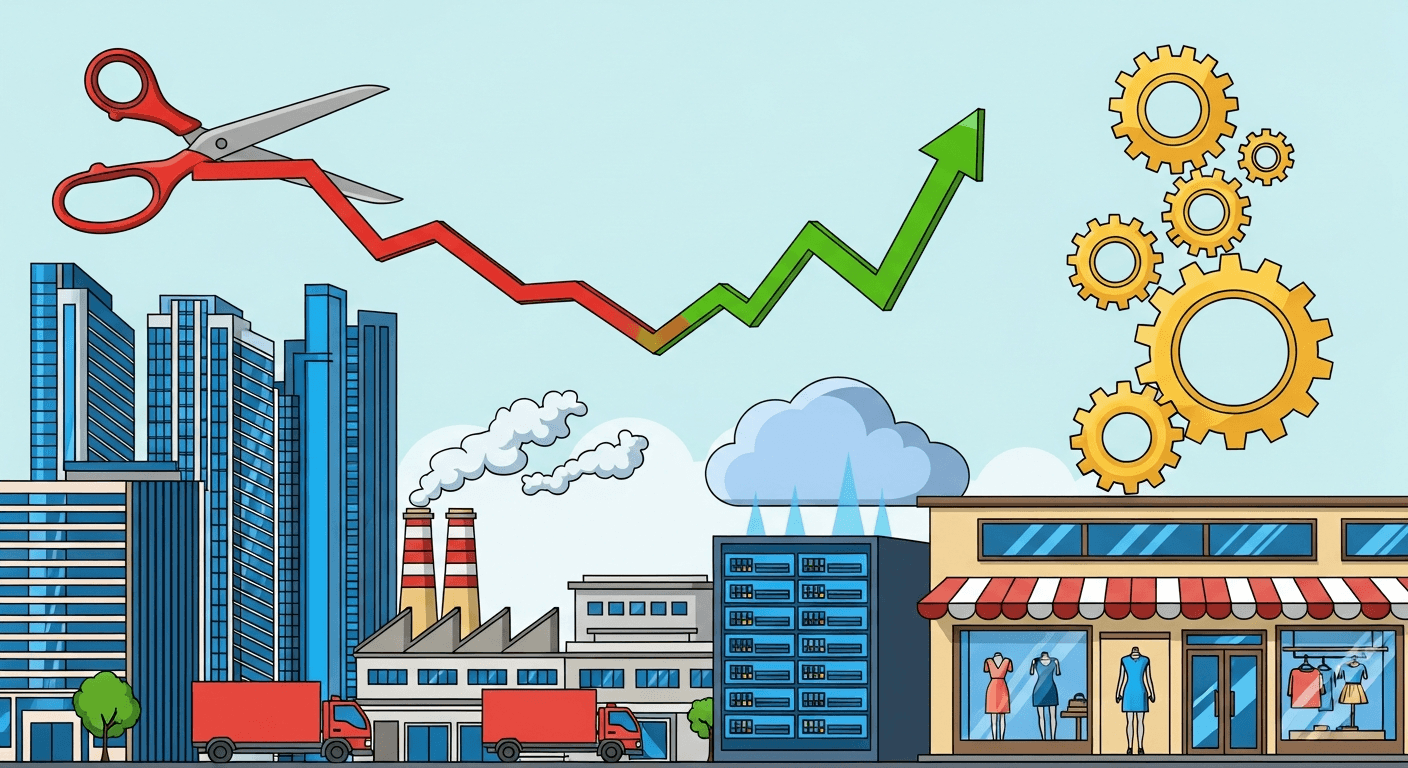
I write this at a moment when global headwinds and domestic rebalancing are forcing boards, CEOs and founders in India to rethink growth. Inflation has moderated from its peaks, but demand is uneven; credit costs have climbed and capital allocation is under scrutiny. In this environment, growth through spending alone is neither sustainable nor prudent. Instead, doing more with less has become India Inc’s new operational mantra: not austerity for its own sake, but a disciplined way to protect margins, redeploy capital and keep innovation alive.
This is not a novel idea: I have argued previously that lowering all types of costs is central to making India a competitive, low-cost economy How to make India a low cost economy. Today the mantra shows up in boardroom priorities and on operating dashboards.
What "doing more with less" means for corporate India
When I say "doing more with less" I mean a deliberate set of choices that increase output, resilience and customer value while reducing or reallocating inputs. In practice this shows up across five repeatable levers:
- Cost optimization: pruning non-essential spend, right-sizing fixed costs, renegotiating supplier terms and rationalizing SKUs.
- Productivity improvement: automation of repeatable work, tighter performance metrics, and culture changes that reduce waste.
- Digital adoption: shifting processes to cloud, using analytics to prioritize resources, and automating customer journeys.
- Strategic outsourcing and partnerships: focusing in-house effort on core competencies while outsourcing non-core functions to specialist providers.
- Lean processes and design thinking: removing handoffs, simplifying approvals, and designing products and services for cost-efficiency (e.g., pack-size economics in FMCG).
These are not academic categories. They are the operational grammar senior leaders use to ensure every rupee spent produces measurable value.
Case studies — India Inc. in action
I avoid speculation about internal numbers, but I want to highlight publicly visible shifts by large Indian companies that illustrate the mantra.
Tata (group companies)
Across the Tata Group, leaders have repeatedly emphasized operational efficiency and integration—whether through consolidation of shared services, digital procurement, or manufacturing modernization. Tata Steel and Tata Motors, for example, have pursued capacity rationalization and process modernization to protect margins as cyclicality returns to metals and auto.
Infosys
Infosys is emblematic of an IT services firm that scaled digital and automation services to improve productivity per employee. Investments in automation platforms and cloud-led delivery lowered delivery costs and created higher-margin service lines, allowing the firm to serve more clients with fewer manual interventions.
Hindustan Unilever (HUL)
HUL’s playbook has long included tight SKU management, relentless supply-chain discipline and innovation in pack sizes to sustain volumes while managing working capital. Their focus on distribution efficiencies and localized manufacturing is a classic example of doing more for the consumer while optimizing cost.
Mahindra Group
In automotive and farm equipment, Mahindra has emphasized lean manufacturing, modular platforms and dealer network rationalization to reduce overhead. The group’s sustained focus on process improvement—across product development and aftermarket—helps sustain competitiveness without proportional increases in fixed costs.
Reliance
Reliance’s integrated approach—combining scale in connectivity (Jio), retail (Reliance Retail) and digital services—shows how vertical integration and technology investment can lower unit costs. Jio’s network scale reduced per-unit delivery costs for data and enabled new service bundles without proportional increases in customer acquisition spend.
Each of the above is a public illustration of a broader truth: companies that systematize efficiency while investing selectively in growth options emerge stronger from tough cycles.
Practical steps leaders can take (actionable)
- Rebase costs to outcomes — tie every major budget line to a measurable business outcome (revenue, retention, throughput). If the link is weak, pause the spend.
- Map end-to-end processes — identify the 10% of steps that create 90% of delays or cost; automate or eliminate them.
- Move to variable cost structures — where possible convert fixed costs into variable ones (cloud, contract manufacturing, pay-per-use services).
- Consolidate procurement and renegotiate — use group buying power or long-term supplier partnerships to reduce input cost and improve service levels.
- Deploy digital twins and analytics — simulate capacity and demand scenarios to avoid overinvestment and to quickly redeploy resources.
- Design for disposability and reuse — modular product/platform design reduces rework and accelerates time-to-market.
- Protect talent and morale — invest in reskilling; communicate transparently so efficiency drives don’t become morale drains.
Each step is practical: they are implementable in 3–9 months and can create runway for strategic bets.
Risks and pitfalls to watch for
- Efficiency vs. capability erosion: Cost cuts that remove future capabilities (R&D, customer success, key talent) cripple long-term competitiveness.
- Short-term optics over long-term value: Focusing on headline savings while ignoring customer experience or brand erosion is dangerous.
- Over-automation without governance: Automating flawed processes amplifies waste; fix the process first.
- Supplier concentration risk: Aggressive cost pressure that forces suppliers into distress can break supply chains.
- Cultural damage: Efficiency programs implemented as one-way mandates can depress innovation and voluntary effort.
Good leaders balance urgency with prudence: they protect strategic optionality while extracting immediate gains.
Conclusion — a forward-looking statement
India Inc’s response to tougher times is not retreat but refinement. Firms that internalize the discipline of doing more with less—by pairing ruthless efficiency with targeted investment in digital and capability—will not only survive downturns but will expand market share when recovery arrives. I remain optimistic: when frugality is combined with imagination, efficiency becomes the scaffolding for a more resilient, innovative India.
Regards,
Hemen Parekh
Any questions / doubts / clarifications regarding this blog? Just ask (by typing or talking) my Virtual Avatar on the website embedded below. Then "Share" that to your friend on WhatsApp.
Get correct answer to any question asked by Shri Amitabh Bachchan on Kaun Banega Crorepati, faster than any contestant
Hello Candidates :
- For UPSC – IAS – IPS – IFS etc., exams, you must prepare to answer, essay type questions which test your General Knowledge / Sensitivity of current events
- If you have read this blog carefully , you should be able to answer the following question:
- Need help ? No problem . Following are two AI AGENTS where we have PRE-LOADED this question in their respective Question Boxes . All that you have to do is just click SUBMIT
- www.HemenParekh.ai { a SLM , powered by my own Digital Content of more than 50,000 + documents, written by me over past 60 years of my professional career }
- www.IndiaAGI.ai { a consortium of 3 LLMs which debate and deliver a CONSENSUS answer – and each gives its own answer as well ! }
- It is up to you to decide which answer is more comprehensive / nuanced ( For sheer amazement, click both SUBMIT buttons quickly, one after another ) Then share any answer with yourself / your friends ( using WhatsApp / Email ). Nothing stops you from submitting ( just copy / paste from your resource ), all those questions from last year’s UPSC exam paper as well !
- May be there are other online resources which too provide you answers to UPSC “ General Knowledge “ questions but only I provide you in 26 languages !




No comments:
Post a Comment