
Lede
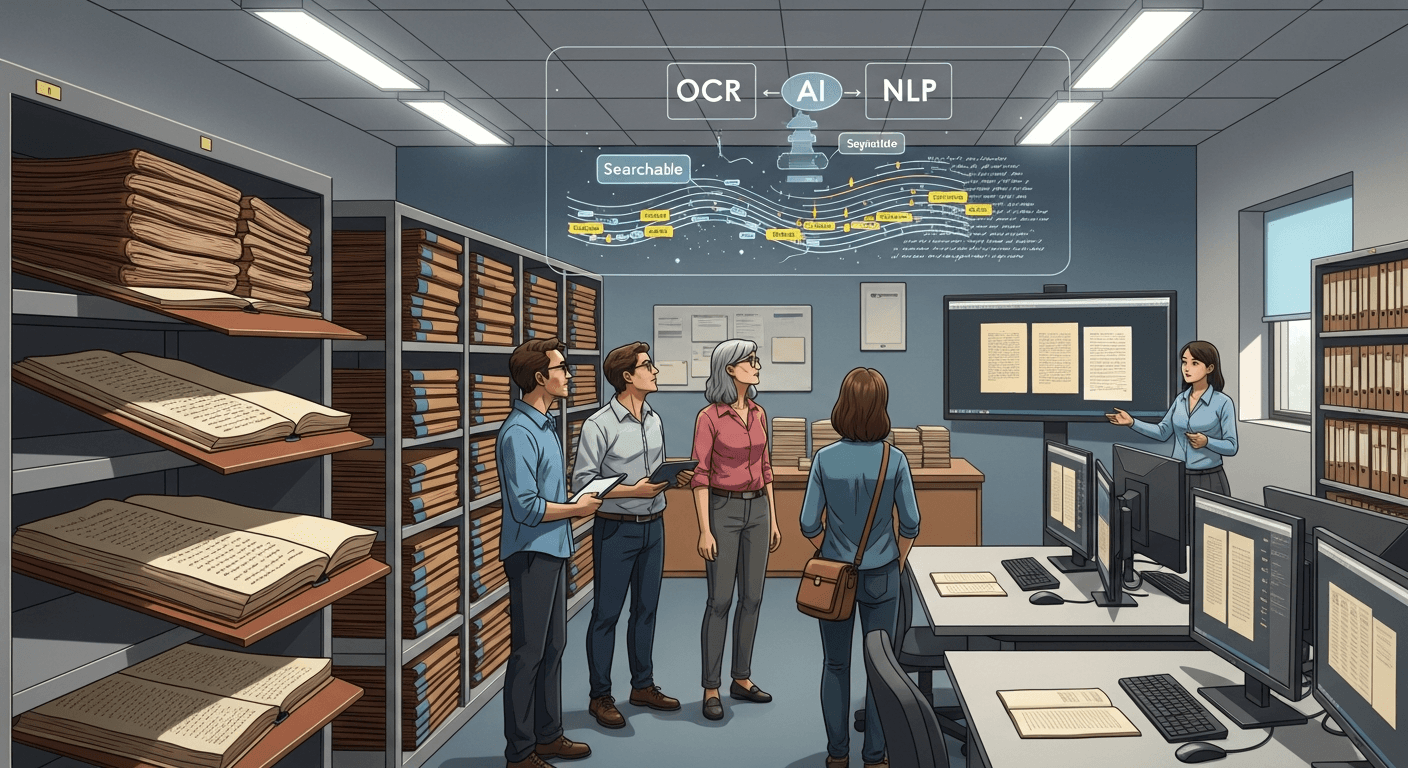
The Brihanmumbai Municipal Corporation (BMC) has launched a pilot to digitise decades of paper records from its E ward using AI-assisted tools — a small but important experiment that could reshape how the city manages property, licensing, tax and civic complaints. The pilot combines optical character recognition (OCR), natural language processing (NLP) and human-in-loop verification to convert fragile, handwritten and printed files into searchable digital records over the next few months.
Why this matters: BMC and the paper problem
I’ve followed municipal digitisation efforts for years. BMC — India’s largest civic body — manages thousands of land, building, licensing and tax records across Mumbai’s wards. Much of that archive still lives in ledgers, boxes and brittle files. Paper records are slow to search, vulnerable to water, fire and pests, and costly to reproduce after a disaster. Digitisation is not just about convenience; it is a resilience measure and a foundation for faster citizen services.
In earlier writings I argued for large-scale record digitisation across public services as a platform for better delivery and analytics Patient records at 2,100 centres to be digitised and I have discussed data vaulting and governance at length Health Data Vault. Those threads are directly relevant to the BMC pilot today.
The E ward pilot: scope and approach
What BMC is piloting in E ward is deliberately focused and pragmatic:
- Scope: Historic property ledgers, building plan approvals, trade licence files and complaint registers dating back several decades.
- Volume: A few thousand files selected for diversity (handwritten, typed, annotated) rather than a blanket sweep.
- Timeline: A 3–6 month pilot to validate workflows and error rates, with progress reported publicly at the end of the pilot.
- Partners: BMC officials are working with a municipal archiving team, a civic-technology NGO providing community engagement support, and a technology partner supplying OCR + AI tools. All partner names will be clarified in BMC communications as the pilot progresses.
- Technology: Scanning and OCR to extract printed and typed text; AI/NLP to interpret structure (names, addresses, plot numbers, dates); human-in-loop verification and correction to ensure accuracy for difficult handwriting and ambiguous entries.
The pilot emphasizes iterative improvement: models will be retrained with validated corrections so accuracy improves over time.
Data privacy, security and governance
Digitising civic records raises legitimate privacy and legal questions. The pilot outlines several safeguards:
- Encryption in transit and at rest for scanned images and extracted data.
- Role-based access controls and audit logs so any access to records is trackable.
- Data minimisation: only necessary fields are extracted for municipal workflows; sensitive personal details are masked or handled under strict access rules.
- Human oversight: all high-sensitivity records flagged for manual review rather than automated publishing.
- Public transparency: BMC plans to publish a privacy impact note and an FAQ for citizens explaining what will be digitised and why, and how to request redaction or correction.
These are pragmatic steps that align with best practices while national data protection frameworks mature.
Benefits: faster services, resilience, insight
If successful, the pilot could deliver immediate benefits:
- Faster citizen services: instant retrieval of property and licence histories reduces delays for approvals, transfers and dispute resolution.
- Disaster resilience: digital backups protect against floods, fires and other risks that have historically destroyed archives.
- Better access: searchable records reduce the need for citizens to travel to archives and ferry heavy files between offices.
- Analytics: aggregated data can reveal patterns — informal settlements growth, tax gaps, or service backlogs — enabling targeted interventions.
Challenges and risks
The pilot will need to confront realistic hurdles:
- Data quality: poor legibility and missing metadata mean OCR/NLP will not be perfect; human verification is expensive but necessary.
- Bias and interpretation: AI models trained on limited samples can misread local scripts, abbreviations or historical terms.
- Cost: scanning, storage, model training and verification require recurring budgets, not just one-time grants.
- Legal and privacy issues: decisions on what becomes public, how personal data is handled, and redress mechanisms must be clear.
Voices from the pilot
"Digitisation will speed approvals and free staff for frontline work," said a senior Municipal Commissioner (quoted in role).
"Our ward office struggles to find old property files when disputes arise — this should change that," said a Ward Officer involved in day-to-day records handling.
"Practically, the system must accept ambiguity; that’s why we pair AI with human reviewers," said the AI vendor lead overseeing model calibration.
"If my property record can be fetched without chasing clerks, I’ll be relieved," said a local resident interviewed outside the ward office.
These quotes reflect the mix of hope and caution I hear in municipal digitisation programmes.
Next steps and timeline
Over the pilot’s 3–6 month period BMC will:
- Complete scanning and initial OCR passes.
- Run iterative AI/NLP processing and human verification cycles.
- Publish pilot progress and an independent accuracy audit.
- Decide on rollout criteria (accuracy thresholds, budget allocations, governance structures) before scaling to adjacent wards.
Public consultation sessions are planned so citizens can review objectives and raise concerns.
Conclusion: a civic invitation
I’m mildly optimistic. This pilot is the kind of focused experiment civic bodies need: limited scope, clear safeguards, and emphasis on human oversight. Digitisation is not a magic wand — it is infrastructure. Done well, it can make Mumbai’s civic machinery faster, fairer and more resilient. Done poorly, it creates brittle databases that hide errors behind a veneer of automation.
I encourage residents of E ward and municipal civic groups to review the pilot documents, attend the scheduled consultations and share practical feedback. That civic input will decide whether this experiment becomes a scalable public good.
Regards,
Hemen Parekh
Any questions / doubts / clarifications regarding this blog? Just ask (by typing or talking) my Virtual Avatar on the website embedded below. Then "Share" that to your friend on WhatsApp.
Get correct answer to any question asked by Shri Amitabh Bachchan on Kaun Banega Crorepati, faster than any contestant
Hello Candidates :
- For UPSC – IAS – IPS – IFS etc., exams, you must prepare to answer, essay type questions which test your General Knowledge / Sensitivity of current events
- If you have read this blog carefully , you should be able to answer the following question:
- Need help ? No problem . Following are two AI AGENTS where we have PRE-LOADED this question in their respective Question Boxes . All that you have to do is just click SUBMIT
- www.HemenParekh.ai { a SLM , powered by my own Digital Content of more than 50,000 + documents, written by me over past 60 years of my professional career }
- www.IndiaAGI.ai { a consortium of 3 LLMs which debate and deliver a CONSENSUS answer – and each gives its own answer as well ! }
- It is up to you to decide which answer is more comprehensive / nuanced ( For sheer amazement, click both SUBMIT buttons quickly, one after another ) Then share any answer with yourself / your friends ( using WhatsApp / Email ). Nothing stops you from submitting ( just copy / paste from your resource ), all those questions from last year’s UPSC exam paper as well !
- May be there are other online resources which too provide you answers to UPSC “ General Knowledge “ questions but only I provide you in 26 languages !



No comments:
Post a Comment