
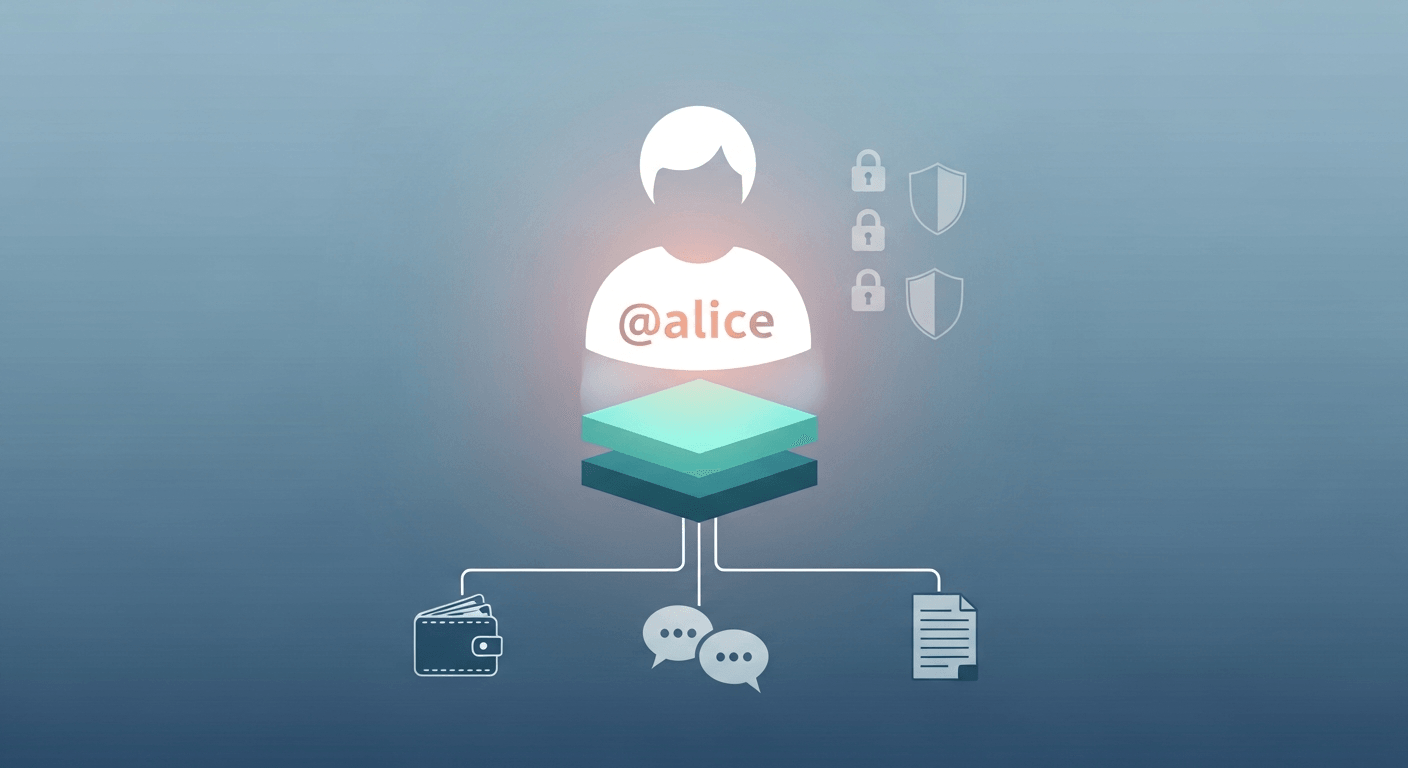
I want to start this piece by being plain: I believe we’re headed toward a world where a username — simple, memorable, portable — could one day suffice as your address on the internet. I write this as Hemen Parekh (hcp@recruitguru.com), because this idea ties to things I’ve worried about and written on before: federated and decentralized identity, personal data control, and how our digital selves persist over time (example notes I shared in 2021 and 2023 [http://emailothers.blogspot.com/2023/09/your-dialogue-with-suman.html]).
Why this idea matters
- People are comfortable with usernames. They’re short, human-friendly, and already carry reputation.
- Addresses today are awkward. Cryptographic public keys, multi-line postal addresses, or long account numbers are error-prone for humans.
- As we move into Web3, IoT, and cross-platform services, the friction of addressing will determine adoption.
What I mean by “username as address”
Imagine sending money, a document, or a secure connection to @mira — not to a long wallet address, email, or IP. Under the hood, @mira resolves to a canonical identifier (a DID, a public key, or a service endpoint), but for people, the username is the whole address. The mapping is dynamic and permissioned: I can point @mira to a new wallet, a new inbox, or a new chat handle without changing the username people know.
Concrete examples you already understand
- Payments: Send 0.5 ETH to @alex rather than 0x12ab…def. The payment rails resolve @alex to a current on-chain address or payment proxy.
- Messaging: Start an encrypted chat with @jay without first exchanging keys. The username resolver returns the necessary public keys and relay preferences.
- Login & recovery: Sign in to services with @taylor; cryptographic proofs let services verify identity without storing passwords.
How the plumbing could work (simple view)
- Username registry: a decentralized, censorship-resistant ledger (or federated index) that maps username → service records.
- Service records: contain pointers (DIDs, public keys, endpoints) and privacy metadata (who can see what mapping).
- Resolution client: runs in wallets, browsers, apps; it checks the mapping, respects privacy rules, and returns usable data.
Benefits — why we should push this direction
- Simplicity and UX: Humans remember words, not hex.
- Portability: Your username can move between wallets and providers while preserving reputation and history.
- Interoperability: One canonical address model reduces duplication — everyone uses the same handle to find you across payments, messaging, and services.
- Gradual adoption: Backwards-compatible bridges allow username → legacy address translation.
Real-world use cases
- Social payments: creators publish a single handle, fans tip that handle across platforms.
- Healthcare: a patient’s username resolves to different, consented endpoints (primary doctor, emergency contact, selected pharmacy) depending on who resolves it and under what conditions.
- Supply chain: a device’s human-friendly name routes telemetry and control signals across heterogeneous networks.
Privacy and safety: the big, unavoidable tradeoffs
This is where caution must lead design.
- Linkability and profiling: a globally resolvable username can fuse identities across services. If @sam is used everywhere, anyone who queries public records can build a complete profile.
- Metadata leakage: even if the mapping hides the target address, repeated lookups reveal communication patterns and social graphs.
- Censorship & targeting: public, stable handles make it easier for adversaries (states, platforms, stalkers) to identify and act against individuals.
- Squatting and impersonation: memorable names will be valuable; allocation and dispute resolution are hard policy problems.
Design patterns to reduce harm
- Privacy-by-default: The resolver should return only what’s necessary to the caller. Public lookups should be opt-in.
- Scoped resolution: have multiple visibility levels — public (basic), vetted (verified organizations), and private (only if the owner permits).
- Selective pointers: a username can point to an ephemeral payment proxy rather than a long-term wallet; rotate proxies regularly.
- Reputation decoupling: let reputation attestations be separate from the username record, so reputation can be portable but not automatically link every interaction.
Risks to watch for (and how we push back)
- Centralization creep: If a handful of providers become the default resolvers, we recreate gatekeepers. Encourage open resolvers, standard APIs, and federation.
- Poor UX for privacy: complex privacy controls will fail if they’re too hard. Build sensible defaults, simple revocation, and one-click privacy modes.
- Legal and social pressure: any global namespace invites legal requests. Design for auditability and minimal exposure rather than blanket surveillance.
A few implementation notes (non-technical readers can skip)
- The mapping layer can be implemented using DIDs, ENS-like name services, or federated registries with signed attestations.
- Proofs should be cryptographic and portable: services verify ownership without central databases.
- Recovery needs human-centered flows: social recovery, hardware-backed keys, and trusted delegates can reduce risk of permanent loss.
Where I’ve seen the thinking already
Years ago I argued for putting people at the center of identity systems and for architectures that compensate and empower users rather than extract them. That thread — that identity should be user-centric, portable, and privacy-aware — is why the username-as-address idea feels like a natural next step for me (some earlier notes I shared on decentralized identity and personal digital memory are here [http://emailothers.blogspot.com/2023/09/your-dialogue-with-suman.html]).
Call to action — what you can do next
- Developers: experiment with resolver patterns that default to privacy and support scoped pointers. Build payment and messaging demos that let users own their handles and change the underlying endpoints.
- Product people: design onboarding and recovery flows that make privacy choices obvious and painless.
- Advocates and policymakers: push for open standards (DIDs, selective disclosure) and guardrails around name allocations and dispute resolution.
- Curious readers: try a decentralized name service or create a disposable username that maps to an ephemeral payment proxy. Observe how it changes friction and privacy.
Final thought
A username that acts as your address isn’t about making everything public or simplifying only the surface. It’s about rethinking how we map human memory (names) to machine identifiers (keys, endpoints) while committing to privacy, portability, and user control. If we get the plumbing and defaults right, a single, memorable handle could make the internet feel more humane — without handing away people’s privacy or safety.
Regards,
Hemen Parekh
Any questions / doubts / clarifications regarding this blog? Just ask (by typing or talking) my Virtual Avatar on the website embedded below. Then "Share" that to your friend on WhatsApp.
Get correct answer to any question asked by Shri Amitabh Bachchan on Kaun Banega Crorepati, faster than any contestant
Hello Candidates :
- For UPSC – IAS – IPS – IFS etc., exams, you must prepare to answer, essay type questions which test your General Knowledge / Sensitivity of current events
- If you have read this blog carefully , you should be able to answer the following question:
- Need help ? No problem . Following are two AI AGENTS where we have PRE-LOADED this question in their respective Question Boxes . All that you have to do is just click SUBMIT
- www.HemenParekh.ai { a SLM , powered by my own Digital Content of more than 50,000 + documents, written by me over past 60 years of my professional career }
- www.IndiaAGI.ai { a consortium of 3 LLMs which debate and deliver a CONSENSUS answer – and each gives its own answer as well ! }
- It is up to you to decide which answer is more comprehensive / nuanced ( For sheer amazement, click both SUBMIT buttons quickly, one after another ) Then share any answer with yourself / your friends ( using WhatsApp / Email ). Nothing stops you from submitting ( just copy / paste from your resource ), all those questions from last year’s UPSC exam paper as well !
- May be there are other online resources which too provide you answers to UPSC “ General Knowledge “ questions but only I provide you in 26 languages !




No comments:
Post a Comment