
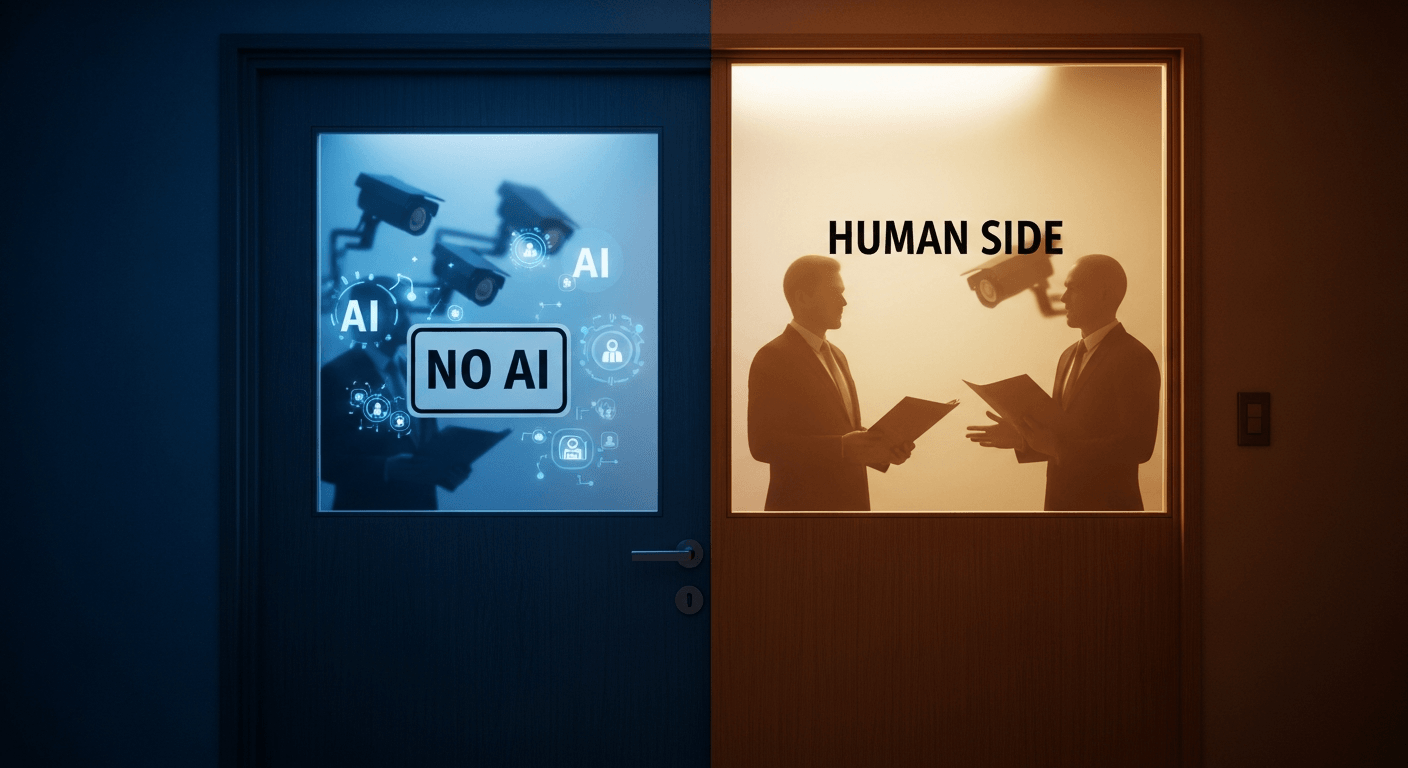
Why Corporate India is pulling back from AI interviews
Lately I’ve been watching a curious reversal: after an enthusiastic sprint toward AI-first hiring, parts of Corporate India are quietly closing interview doors to what I call "prying AIs." This feels familiar — not because the technology has failed, but because organisations are waking up to the social, ethical and human consequences of letting opaque models grade, record, and decide human futures.
I have been writing about AI in recruitment for years and even built recruitment software long before generative models became fashionable. In a post earlier this year I noted the drive toward AI-driven screening and assessment and the mixed reactions it provoked (Firms turn to AI-first hiring). What we are seeing now is the other side of that coin: a precautionary retreat.
What's changing — and why
Efficiency vs. trust. Companies have adopted AI to scale resume parsing, matching and even interviews because it speeds things up. But speed without trust and transparent consent erodes candidate confidence.
Privacy alarm. Automated video interviews, emotion-analysis tools and automated scoring capture biometric and behavioral signals. Candidates — and some employers — are rightly worried about where that data goes, how long it’s stored, and who can re-use it.
Fairness and explainability. When an AI gives a low score, candidates ask: why? Lack of clear, explainable reasoning makes these tools fragile in the court of public opinion.
Reputational risk. A hiring decision that feels machine-driven can damage employer brand. For many firms, protecting their reputation has become more valuable than a marginal increase in screening throughput.
The Economic Times summarized this tension well: AI is being used across sourcing, screening and even interviews, but companies are split — some embrace it for efficiency while others remain cautious because of bias, privacy and soft-skill evaluation problems (The rise of AI in recruitment process).
My view: this pullback is healthy — if done right
I don’t mourn the technology. I’ve advocated using intelligent tools to remove repetitive friction in hiring. But we must insist that adoption be responsible. A retreat is healthy when it is a pause for governance, not a permanent rejection of useful automation.
Here are practical guardrails HR teams should adopt before re-opening the doors to interview-AI:
Transparency and consent: Tell candidates exactly what data you collect, how it will be used, who will see it and how long it will be retained. Consent must be explicit and revocable.
Human-in-the-loop decisions: Use AI for augmentation (shortlisting, summarising) but keep humans responsible for judgements that affect livelihoods.
Auditability and bias testing: Regularly audit models for disparate impact, and publish (internally at least) metrics that show fairness across demographic groups.
Data minimisation: Collect only what is necessary. Avoid storing raw video/biometrics unless there is a clear, justified need and a retention policy.
Candidate experience design: Let candidates opt out of video-analysis processes and offer alternative assessment paths. Preserve dignity and choice.
Explainability: When a tool affects a decision, provide interpretable feedback to candidates (e.g., which competencies were assessed and how).
For leaders: rethink value, not only velocity
If your goal is to hire faster, AI is an obvious lever. If your goal is to hire sustainably — building trust, protecting brand and ensuring fairness — then governance and candidate-first design must lead.
I have seen similar waves before: a promising tech is rushed into operations, unintended harms appear, and organisations either silently stop or build better controls. I prefer the latter. Use this pause to build policies, involve legal and ethics teams, and pilot with full transparency.
A modest call to action
If you run talent acquisition, start small and public: publish your AI hiring policy, run an explainability pilot on one role, and invite third-party audit. If you are a jobseeker, ask recruiters whether AI played a role in screening or interviewing you — and insist on a human review when outcomes matter.
We cannot pretend technology is neutral. But we also cannot abandon tools that can reduce bias and increase access when designed and governed responsibly. Closing doors to prying AIs should be a temporary, thoughtful measure — an opportunity to redesign hiring systems so that speed, fairness and human dignity move forward together.
References & continuity
- I revisited many of these themes in my earlier analyses of AI-first hiring (Firms turn to AI-first hiring) and in long-standing notes on recruitment automation.
- Recent reporting summarising the current corporate ambivalence: The rise of AI in recruitment process (Economic Times).
Regards,
Hemen Parekh
Any questions / doubts / clarifications regarding this blog? Just ask (by typing or talking) my Virtual Avatar on the website embedded below. Then "Share" that to your friend on WhatsApp.
Get correct answer to any question asked by Shri Amitabh Bachchan on Kaun Banega Crorepati, faster than any contestant
Hello Candidates :
- For UPSC – IAS – IPS – IFS etc., exams, you must prepare to answer, essay type questions which test your General Knowledge / Sensitivity of current events
- If you have read this blog carefully , you should be able to answer the following question:
- Need help ? No problem . Following are two AI AGENTS where we have PRE-LOADED this question in their respective Question Boxes . All that you have to do is just click SUBMIT
- www.HemenParekh.ai { a SLM , powered by my own Digital Content of more than 50,000 + documents, written by me over past 60 years of my professional career }
- www.IndiaAGI.ai { a consortium of 3 LLMs which debate and deliver a CONSENSUS answer – and each gives its own answer as well ! }
- It is up to you to decide which answer is more comprehensive / nuanced ( For sheer amazement, click both SUBMIT buttons quickly, one after another ) Then share any answer with yourself / your friends ( using WhatsApp / Email ). Nothing stops you from submitting ( just copy / paste from your resource ), all those questions from last year’s UPSC exam paper as well !
- May be there are other online resources which too provide you answers to UPSC “ General Knowledge “ questions but only I provide you in 26 languages !



No comments:
Post a Comment