
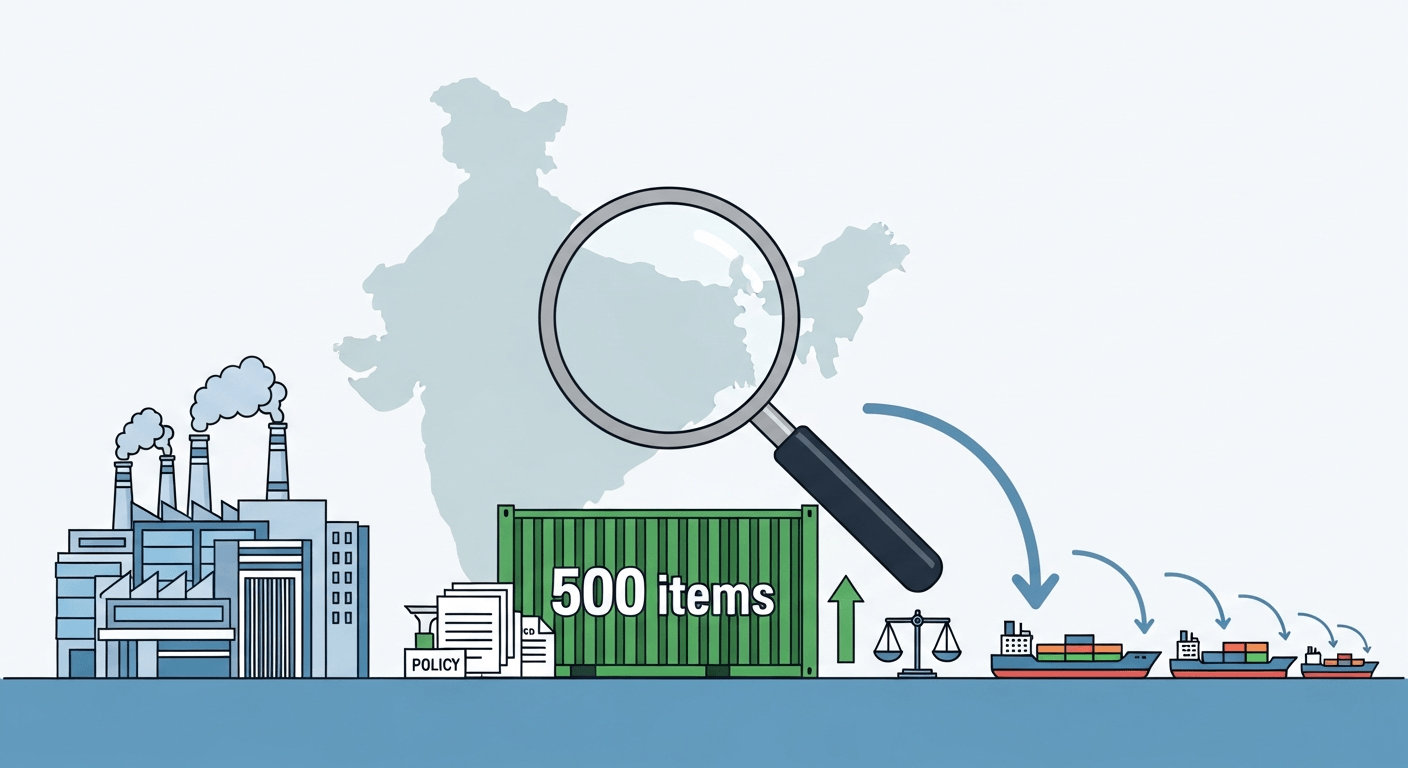
Localisation lens on DPIIT's 500-item review
I want to walk readers through the Department for Promotion of Industry and Internal Trade (DPIIT) initiative to analyse the country's 500 most‑imported items and frame localisation responses that could reduce India’s import bill. The initiative is explicitly pragmatic: identify high‑value, high‑dependency import lines, assess where domestic production can realistically replace imports, and design policy levers to make that transition efficient and sustainable.
This is not protectionism for its own sake. From my vantage point, a disciplined, data‑driven localisation strategy can be an instrument to create jobs, improve supply‑chain resilience, and reduce balance‑of‑payments vulnerability — provided it is calibrated to economic realities and trade commitments.
Why DPIIT’s exercise matters
Large import lines matter not only because of headline import figures but because a relatively small number of tariff lines often account for a disproportionate share of value. By focusing on the ‘‘top 500’’ items, DPIIT aims to prioritise interventions where the payoff — in rupees saved, jobs created, and strategic independence gained — can be largest.
A successful outcome will depend on rigorous diagnosis and careful policy sequencing. Below I outline the methodology DPIIT might use, the economic rationale for localisation, practical risks and trade‑offs, policy instruments that can help, and some illustrative examples of how localisation has worked elsewhere.
Methodology and data: how the 500 items can be identified
A credible list requires transparent, repeatable data work. DPIIT's analysis would typically rely on the following:
- Customs and import data (customs declarations and bill of entry records) aggregated by Harmonized System (HS) codes to identify the highest‑value import lines.
- Import value and quantity over a multi‑year window to smooth cyclical spikes and one‑off shocks.
- Import dependency metrics: domestic production share, domestic supply shortfalls, and criticality (e.g., inputs for defence, energy, pharmaceuticals).
- Trade concentration and provenance: the share of imports sourced from specific countries to gauge supply‑chain risk.
- Elasticity and substitution assessment: how easily can domestic supply substitute imports given current technology and cost structures?
- Value‑chain mapping: identify whether the import line is raw material, intermediate input, or finished good; localisation of intermediates can have multiplier effects.
- Employment and capacity metrics: potential domestic manufacturing jobs per crore of output and available domestic capacity that can be scaled.
Transparent publication of selection criteria, HS codes, and data ranges will be important to secure buy‑in from industry and trade partners.
Economic rationale for localisation
There are several justifications for targeted localisation, when done smartly:
- Jobs and industrialisation: manufacturing or assembly activity tends to generate more local employment than pure trade. Policy can steer value addition to domestic firms and MSMEs.
- Balance of payments: reducing import demand for high‑value goods easas pressure on the current account and foreign exchange reserves.
- Supply‑chain security: domestic production reduces vulnerability to geopolitical disruptions and single‑country dependencies.
- Technology transfer and capability building: selective incentives tied to technology absorption and quality upgrading can move the economy up the value chain.
- Spillovers: local production of intermediates often stimulates ancillary industries (packaging, testing, logistics).
Practical challenges and risks
Localisation is not risk‑free. Key challenges include:
- Higher consumer prices: domestic production may be costlier initially, hurting affordability unless efficiencies or scale improve.
- Economies of scale: many products are produced globally at massive scale. Small domestic markets may not sustain competitive production.
- Environmental and social externalities: ramping up manufacturing without strong environmental safeguards can create long‑term costs.
- Retaliation and trade‑law constraints: WTO rules and existing trade agreements limit the use of discriminatory import restrictions; policy design must respect obligations.
- Misallocation risks: poorly targeted subsidies can entrench inefficient producers and divert resources from higher‑value opportunities.
A time‑bound, transparent approach with clear success metrics can limit these risks.
Policy measures and incentives to promote localisation
A mix of demand‑and supply‑side instruments will be needed. Possible measures include:
- Targeted fiscal incentives: production‑linked incentives (PLIs) for sectors where scale and technology goals are clear.
- Public procurement preference: use government purchasing power to create guaranteed demand for qualifying domestic products.
- Standards, certification, and testing infrastructure: fund labs and quality assurance that lower market entry barriers and build trust.
- MSME support and clustering: capital access, common facilities, and industrial clusters reduce unit costs and accelerate scale.
- Facilitate responsible FDI and technology partnerships: allow foreign players to set up local plants with technology transfer conditions.
- Phased import restrictions or safeguards: time‑bound measures with sunset clauses, tied to clear localisation milestones.
- Tradeable tariff‑rate quotas or import monitoring: more surgical than blanket bans and less likely to violate trade rules.
- Skills and R&D support: grant support for workforce training and local R&D grants targeted at import‑substitution technologies.
The emphasis should be on catalysing domestic producers to achieve competitiveness, not sheltering them indefinitely.
Case studies and examples
Several examples show that localisation can work when accompanied by clear demand signals and investment incentives:
- Electronics and mobile assembly: targeted incentives and clustering policies have attracted domestic and foreign investment into handset assembly and component manufacture; these efforts grew domestic value‑addition over time.
- Solar photovoltaics: scale‑oriented industrial policy in multiple countries reduced module costs and created exportable capacity after an initial protected phase.
- Pharmaceuticals API localisation: governments have used a combination of procurement, financing, and standards support to bring critical active pharmaceutical ingredient (API) production onshore to reduce strategic risk.
These are illustrative: success depends on aligning incentives, scale, and quality assurance over a multiyear horizon.
Conclusion: impacts and trade‑offs
The DPIIT exercise to analyse the 500 most‑imported items is an important, pragmatic step. It can prioritise policy action where impact is greatest, help reallocate public resources more efficiently, and provide a roadmap for industry to invest in domestic capacity. But localisation is not a panacea: it involves trade‑offs between short‑term costs and long‑term gains, between strategic resilience and consumer prices, and between nurturing domestic capability and adhering to international trade commitments.
My recommendation is clear: adopt a time‑bound, data‑driven, and phased localisation strategy that combines demand guarantees (procurement), targeted supply incentives (PLIs, cluster support), and strong quality and environmental safeguards. Evaluate outcomes transparently against published metrics, and be prepared to pivot if domestic firms do not reach competitiveness thresholds within agreed timelines.
If implemented thoughtfully, DPIIT’s 500‑item review can be a pragmatic instrument to shrink avoidable import dependence while catalysing sustainable industrial capability.
Regards,
Hemen Parekh
Any questions / doubts / clarifications regarding this blog? Just ask (by typing or talking) my Virtual Avatar on the website embedded below. Then "Share" that to your friend on WhatsApp.
Get correct answer to any question asked by Shri Amitabh Bachchan on Kaun Banega Crorepati, faster than any contestant
Hello Candidates :
- For UPSC – IAS – IPS – IFS etc., exams, you must prepare to answer, essay type questions which test your General Knowledge / Sensitivity of current events
- If you have read this blog carefully , you should be able to answer the following question:
- Need help ? No problem . Following are two AI AGENTS where we have PRE-LOADED this question in their respective Question Boxes . All that you have to do is just click SUBMIT
- www.HemenParekh.ai { a SLM , powered by my own Digital Content of more than 50,000 + documents, written by me over past 60 years of my professional career }
- www.IndiaAGI.ai { a consortium of 3 LLMs which debate and deliver a CONSENSUS answer – and each gives its own answer as well ! }
- It is up to you to decide which answer is more comprehensive / nuanced ( For sheer amazement, click both SUBMIT buttons quickly, one after another ) Then share any answer with yourself / your friends ( using WhatsApp / Email ). Nothing stops you from submitting ( just copy / paste from your resource ), all those questions from last year’s UPSC exam paper as well !
- May be there are other online resources which too provide you answers to UPSC “ General Knowledge “ questions but only I provide you in 26 languages !


No comments:
Post a Comment