
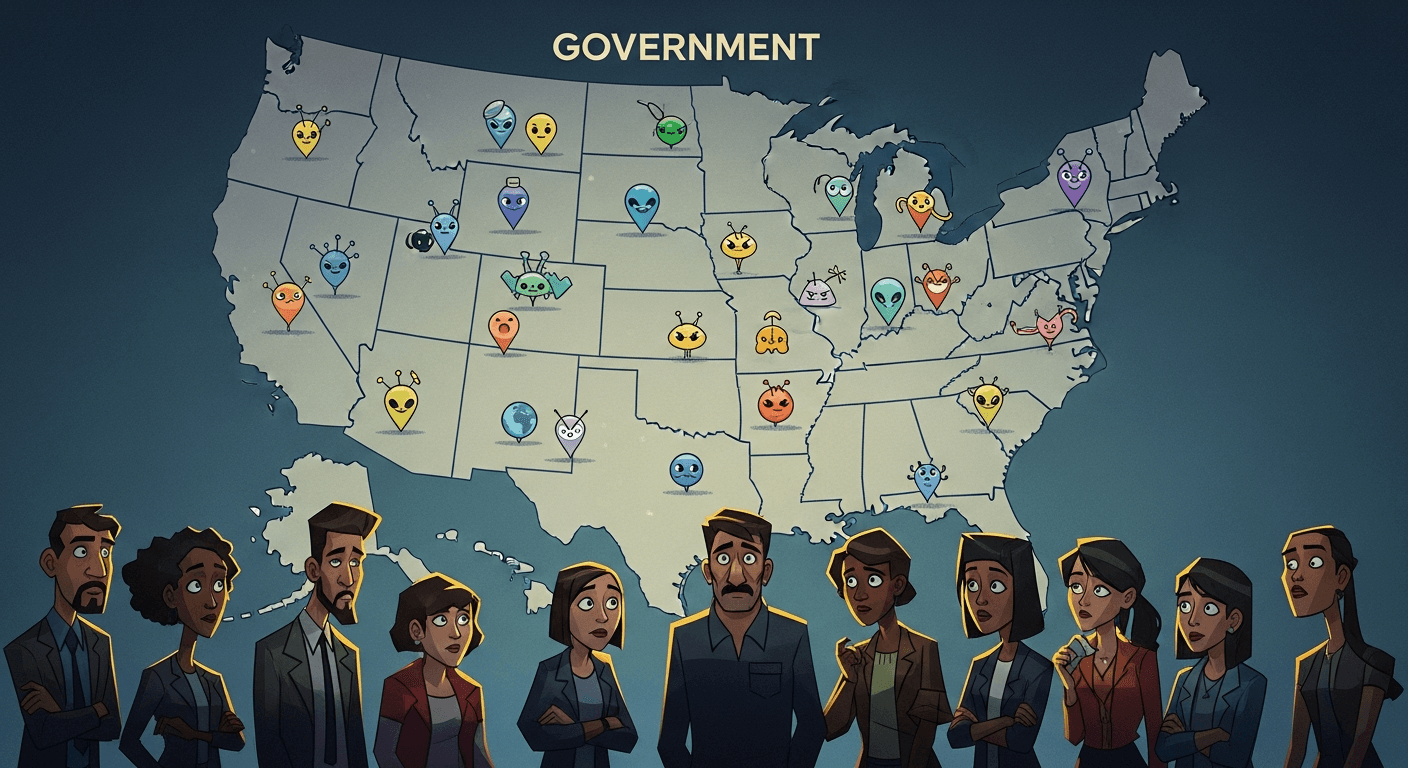
The White House's 'Alien' Arrest Map — What Happened?
I watched the rollout of the new immigration landing page with a mixture of incredulity and professional curiosity. The site — described in headlines as an "ICE arrest map" and repeatedly framed by critics as "alien-themed" — pairs a public-facing map and narrative about enforcement data with stylized visuals and messaging that many observers found cartoonish, dehumanizing, and tone-deaf.
Below I unpack what the site appears to be, public and political reactions, privacy and legal concerns, the technical and misinformation risks, some historical precedents of government-themed messaging, and what this all means for immigrant communities.
What the site is (briefly)
From the public rollout, the page combines:
- An interactive county-by-county map claimed to show recent enforcement actions or arrest locations (marketed as helping communities "see" immigration enforcement activity).
- A series of stylized graphics and headline labels using space/alien metaphors and iconography alongside plain-language explanations.
- Links and buttons that direct users to federal resources or forms related to enforcement, reporting, or public-safety updates.
Screenshot/visuals description (since images aren't provided):
- A full-width hero banner with a simplified map of the United States, points clustered by county, and small spacecraft/alien icons used as markers.
- Panels beneath the map show simplified stat-cards (e.g., "Arrests this month") with bold sans-serif text and badge-like graphics.
- A sidebar explains how the data is sourced and a FAQ that mixes legal language with conversational metaphors.
Note: I flag items above that were reported in contemporary press coverage; where something is unconfirmed I explicitly note it as such in the text.
Public and political reactions
- Civil liberties advocates and immigrant-rights groups quickly criticized the page for using extraterrestrial motifs to describe people — a rhetorical move that can dehumanize vulnerable populations and echo long-standing xenophobic tropes.
- Some conservative commentators defended the site as a modern, attention-grabbing public-information tool intended to make enforcement data more accessible to the public.
- Lawmakers were split: a handful raised immediate questions about tone and impact, while others focused on the accuracy and provenance of the data.
(Where possible, check mainstream reporting for exact quotes and statements from organizations and members of Congress.)
Privacy, ethics, and legal context
There are several overlapping concerns:
- Data provenance and scope: What exactly is being plotted? Arrest locations? Residence? Agency press releases? Ambiguity here matters — plotting an address tied to a case file can expose individuals, families, or witnesses to harm.
- DHS / ICE data-sharing rules: Immigration and Customs Enforcement (ICE) and the Department of Homeland Security (DHS) are subject to a mix of statutory limits and internal rules about personally identifiable information (PII), data redaction, and interagency sharing. Any public dashboard that displays geolocated enforcement data needs to adhere to those safeguards to avoid unlawful disclosures.
- Ethics of rhetoric: Using animalizing or othering metaphors in official communications has downstream effects — it changes how the public perceives those depicted and can increase stigma, harassment, or even targeted violence.
Technical issues and misinformation risks
An enforcement map can be useful — but it brings predictable technical pitfalls:
- False precision: Geolocation markers often imply greater accuracy than the underlying data support. A reported arrest "in X county" may be placed at a single point, which misleads users about where an event actually occurred.
- Stale or unverified data: If the map pulls from multiple feeds (local law enforcement, federal notices, press releases), inconsistent timestamps and standards will create confusing or contradictory displays.
- Gamable UX: Bad actors could mine public visualizations to identify patterns and exploit them (e.g., identifying communities with reduced watchdog coverage). Worse, the visual metaphor itself — if it frames people as "aliens" — can encourage dehumanizing misinformation and hostile social-media narratives.
Historical precedents: themed government messaging
Government communications have long used metaphors to simplify complex topics. Examples include wartime propaganda, public-health mascots, and safety-campaign mascots.
What makes this instance different is the combination of law-enforcement data and an othering metaphor. Historically, that mixing has led to controversies when tone undermined trust (for instance, when lighthearted public-safety campaigns were launched in the wake of traumatic events).
Implications for immigrant communities
- Heightened fear: Visual maps associated with enforcement can make entire neighborhoods feel surveilled — emboldening landlords, employers, or local officials to act in discriminatory ways.
- Chilling effect: People with mixed-status families may stop accessing essential services, reporting crimes, or enrolling children in school because they believe a dashboard makes them more traceable.
- Legal exposure: If the site inadvertently publishes identifiable information, it could expose people to detention risks and complicate ongoing legal proceedings.
What to watch next
- Official clarifications on data sources and redaction standards. A responsible dashboard should publish a clear methodology, update cadence, and privacy impact assessment.
- Independent audits by privacy groups or journalists. Third-party reviews can test for PII leaks, metadata exposure, or incorrect geocoding.
- Legislative or oversight responses. If the rollout raises civil-liberties concerns, expect letters from oversight committees or state attorneys general asking for fixes or pauses.
My quick take
Design and clarity matter when government agencies publish enforcement information. Putting enforcement data behind a gimmick — especially one that draws on dehumanizing metaphors — risks doing real harm while reducing public trust. If the intent was to make data more accessible, that goal can be achieved without alienating the people the policy affects.
Call to action
If this concerns you, contact your representatives and ask them to demand transparency about data sources, privacy protections, and an independent audit. In the meantime, immigrant communities and their allies should review privacy settings for commonly used apps and avoid sharing precise addresses or real-time location details on public channels.
Regards,
Hemen Parekh
Any questions / doubts / clarifications regarding this blog? Just ask (by typing or talking) my Virtual Avatar on the website embedded below. Then "Share" that to your friend on WhatsApp.
Get correct answer to any question asked by Shri Amitabh Bachchan on Kaun Banega Crorepati, faster than any contestant
Hello Candidates :
- For UPSC – IAS – IPS – IFS etc., exams, you must prepare to answer, essay type questions which test your General Knowledge / Sensitivity of current events
- If you have read this blog carefully , you should be able to answer the following question:
- Need help ? No problem . Following are two AI AGENTS where we have PRE-LOADED this question in their respective Question Boxes . All that you have to do is just click SUBMIT
- www.HemenParekh.ai { a SLM , powered by my own Digital Content of more than 50,000 + documents, written by me over past 60 years of my professional career }
- www.IndiaAGI.ai { a consortium of 3 LLMs which debate and deliver a CONSENSUS answer – and each gives its own answer as well ! }
- It is up to you to decide which answer is more comprehensive / nuanced ( For sheer amazement, click both SUBMIT buttons quickly, one after another ) Then share any answer with yourself / your friends ( using WhatsApp / Email ). Nothing stops you from submitting ( just copy / paste from your resource ), all those questions from last year’s UPSC exam paper as well !
- May be there are other online resources which too provide you answers to UPSC “ General Knowledge “ questions but only I provide you in 26 languages !


No comments:
Post a Comment