
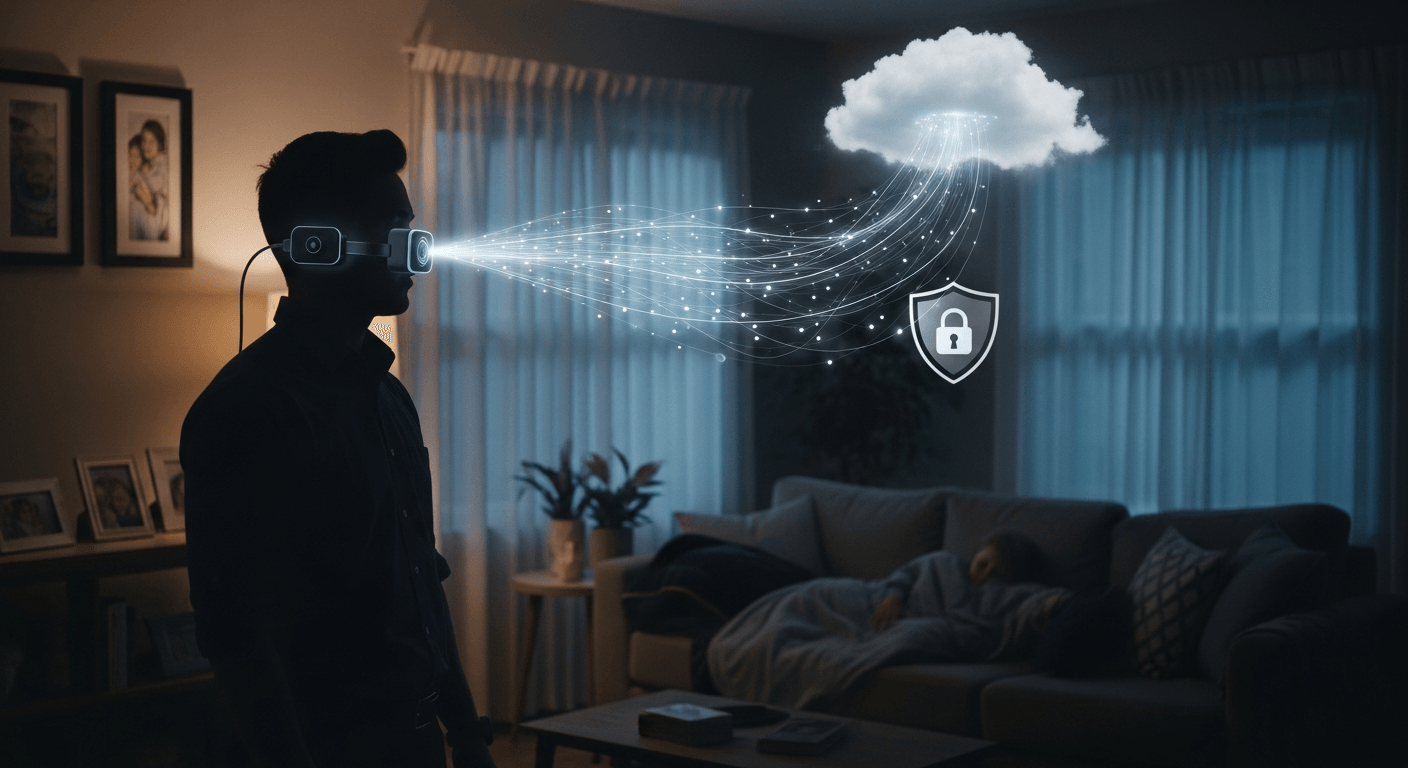
I woke up to news about Pronto — an AI-powered home-service startup equipping technicians with always-on wearable cameras — and felt that familiar chill I've written about before. The promise is straightforward: better diagnostics, faster fixes, and a layer of accountability for both customers and service providers. The danger is also familiar: a steady erosion of private spaces by sensors and cameras dressed up as convenience.
Why this matters to me
I've long argued that sensors are multiplying everywhere — in our phones, watches, even our furniture — and that this will change what privacy means in daily life. Years ago I wrote about the coming wave of devices that watch us constantly and how that would strain any data-protection law to its breaking point Close Your Eyes?. I also sketched a more general law of privacy: concern grows in direct proportion to how much a person has to hide Parekh's Law of Privacy.
Pronto sits at the intersection of two powerful trends: the rush to automate and monitor for quality, and the increasing normalization of body-worn cameras. That intersection is where practical benefits collide with ethical and legal hazards.
Concrete privacy risks from wearable cameras
- Ambient collection: Cameras in a home will inevitably record family members, neighbors (through windows), and visitors who never consented.
- Sensitive context capture: Bathrooms, bedrooms, children's play areas — places we assume are private — may be photographed or recorded during service visits.
- Biometric inferences: Video plus AI can infer faces, routines, health conditions, and relationships. This is far more than a simple snapshot.
- Data retention & reuse: Who stores the footage? For how long? Is it used only for the service visit, or for training models, for targeted ads, or sold to third parties?
- Security & breach risk: Centralized video stores are juicy targets. A compromise would expose the most intimate moments of people’s lives.
- Power asymmetry: Low-wage technicians may have little choice about using wearable cameras. Customers may feel surveilled by those entering their homes.
What responsible startups should do (and what customers should demand)
I believe startups that truly care about people must design privacy in from day one. Practical measures include:
- Minimize data collection: capture only what’s essential for the task. Prefer metadata or event logs over continuous video.
- On-device processing: analyze video locally and send only anonymized, task-relevant results to the cloud.
- Strict retention policies: auto-delete raw footage within a short, auditable window unless explicit consent is recorded for exceptions.
- Explicit, contextual consent: homeowners and any adults present must be informed (and shown) when a camera is active; visitors should be notified when possible.
- No facial-recognition by default: if identification isn’t necessary for the job, it shouldn't be enabled.
- Independent audits and transparency reports: publish how footage is used, who accessed it, and audit logs open to regulators.
- Worker protections: technicians should be able to control recording in their private moments and understand how their data is used.
- Clear breach notification and remediation plans: in the event of a leak, affected households must be informed and assisted immediately.
Regulation and civic responses
Technology often moves faster than law. That gap means civil society, consumer groups, and industry must define norms while regulators catch up. I have suggested, in previous posts, that national data-protection frameworks need to reckon with ubiquitous sensors and the fact that people cannot practically consent to every capture event Close Your Eyes?.
A few sensible regulatory guardrails:
- Classify in-home wearable recordings as sensitive personal data requiring higher safeguards.
- Require explicit purpose limitation and prohibit commercial reuse without fresh consent.
- Mandate default-on privacy-preserving defaults (e.g., blur faces, strip audio unless needed).
- Empower local consumer protection agencies to investigate and sanction misuse quickly.
For founders and investors: design for trust, not just growth
If Pronto — or any startup — wants to scale, it must earn trust. Growth at the cost of privacy is short-sighted: reputational harm, regulatory fines, and loss of customers follow quickly when sensitive home footage leaks or is misused.
Investors should ask hard questions about data minimization, encryption, retention, and compliance. Founders should consider privacy as a competitive advantage: a product that demonstrably protects users' intimate spaces will outlast one that harvests them.
A personal ask
If you're using a service that brings someone into your home with cameras, ask these simple questions:
- Is the camera recording continuously or only when needed?
- Who stores the footage, how long, and for what purposes?
- Can I see and delete footage of my home?
- Is face recognition enabled? If so, why?
Refusing to accept vague answers is not being paranoid — it's holding technology to a humane standard.
Closing thought
Convenience is seductive. Cameras can improve service quality and accountability. But convenience should not become an excuse to normalize surveillance in the spaces where we live and love.
Technology must be built around human dignity. That means defaults that protect the vulnerable, transparency for the curious, and strong limits on how data collected in our homes can be used.
I hope companies like Pronto listen, adapt, and show that an AI-enabled future can respect the private life as fiercely as it optimizes the public one.
Connect with me: Hemen Parekh — hcp@recruitguru.com
Regards,
Hemen Parekh — hcp@recruitguru.com
Any questions / doubts / clarifications regarding this blog? Just ask (by typing or talking) my Virtual Avatar on the website embedded below. Then "Share" that to your friend on WhatsApp.
Get correct answer to any question asked by Shri Amitabh Bachchan on Kaun Banega Crorepati, faster than any contestant
Hello Candidates :
- For UPSC – IAS – IPS – IFS etc., exams, you must prepare to answer, essay type questions which test your General Knowledge / Sensitivity of current events
- If you have read this blog carefully , you should be able to answer the following question:
- Need help ? No problem . Following are two AI AGENTS where we have PRE-LOADED this question in their respective Question Boxes . All that you have to do is just click SUBMIT
- www.HemenParekh.ai { a SLM , powered by my own Digital Content of more than 50,000 + documents, written by me over past 60 years of my professional career }
- www.IndiaAGI.ai { a consortium of 3 LLMs which debate and deliver a CONSENSUS answer – and each gives its own answer as well ! }
- It is up to you to decide which answer is more comprehensive / nuanced ( For sheer amazement, click both SUBMIT buttons quickly, one after another ) Then share any answer with yourself / your friends ( using WhatsApp / Email ). Nothing stops you from submitting ( just copy / paste from your resource ), all those questions from last year’s UPSC exam paper as well !
- May be there are other online resources which too provide you answers to UPSC “ General Knowledge “ questions but only I provide you in 26 languages !



No comments:
Post a Comment