
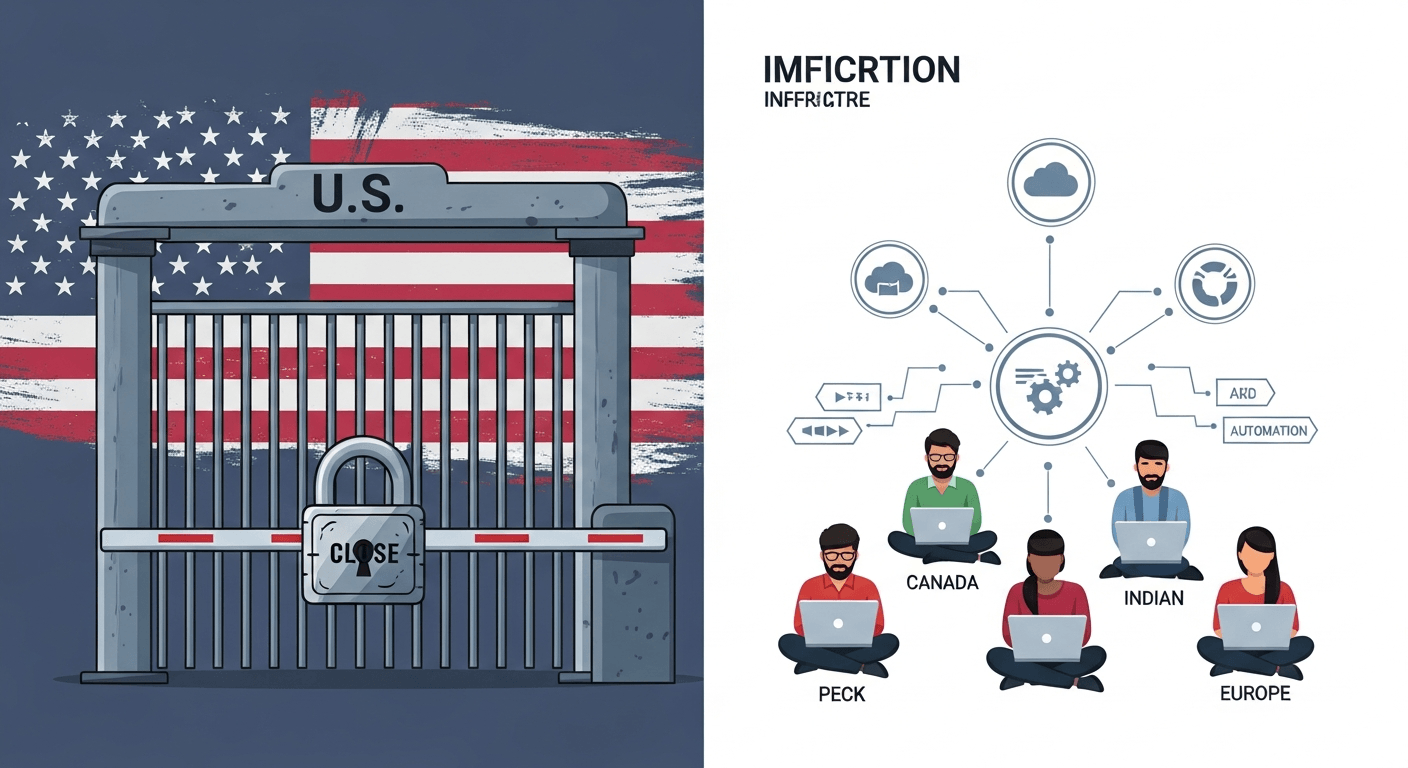
What the "America First" Visa Policy Means for Indians
I write this as someone who has followed migration, technology and policy shifts for decades. The phrase "America First" has become shorthand for a set of immigration and visa proposals that prioritize U.S. labor-market interests and national security. I avoid naming individuals here, because the term has been used by different administrations and campaigns; the policy idea, however, is consistent enough to merit a clear read for Indians who work with or hope to work in the U.S.
What the policy typically includes
At a practical level, the policy package often contains a few recurring elements:
- Merit-first framing: preference for applicants with high skills, English proficiency, or demonstrated economic contribution rather than family ties.
- Tighter scrutiny and vetting: more rigorous background checks, interview standards and documentation requirements for work and immigrant visas.
- H-1B changes: proposals to raise wage floors, prioritize petitions for the highest-paid (or highest-skilled) applicants, and restrict third-party placement models.
- Limits on family-based or lottery routes: reductions or elimination of diversity-lottery visas and steps against broad family-chain immigration.
- Enforcement emphasis: tougher employer compliance checks, site visits and an intent to reduce perceived misuse of temporary work visas.
These are policy levers, not a single law. Their concrete form varies—through executive orders, regulatory changes at agencies, and new Department of Labor or USCIS guidance.
Immediate implications for Indians
Many Indians are directly affected because of the scale of Indian professionals in U.S. tech, services and research roles. The most important on-the-ground implications I see are:
- Slower mobility, higher uncertainty: H-1B petition denials, longer adjudication times and stricter documentation can delay moves and projects.
- Wage-driven selection: proposals to raise minimum H-1B wages would advantage highly paid roles and hurt long-tail, lower-paid placements.
- Green-card backlog impact: any reduction in legal immigration throughput or reprioritization can extend wait times for employment-based green cards—this particularly affects Indians in EB-2/EB-3 queues.
- H-4 and dependent effects: changes to spouse work authorization rules multiply personal and household career disruption for Indian families.
- Shift in business models: demand for onsite short-term placements may fall; clients and vendors may accelerate automation, remote delivery and productized services.
What this means strategically (practical advice)
If you are an individual professional, team leader, or company exposed to U.S. hires or clients, consider a three-pronged approach:
- Protect income and career optionality
- Prioritize high-value credentials, patents, leadership roles, or demonstrable product ownership to strengthen visa cases.
- Explore alternative legal pathways: intra-company transfers, extraordinary-ability tracks, or routes through countries with faster residency pipelines.
- Re-orient delivery and markets
- Build remote-first delivery models and emphasize IP and outcomes rather than headcount and hours.
- Diversify clients geographically (Europe, Southeast Asia, Middle East, Canada, Australia) to reduce single-market dependency.
- Future-proof the business
- Invest in automation, platformization and productized services so revenue is less dependent on cross-border labor movement.
- Move up the value chain—offer engineering-led services, IP, and domain-specialized solutions rather than commodity staff augmentation.
I have written before about how policy shocks can accelerate transformation in the IT industry—turning a restriction into an impetus to re-invent delivery models and invest in automation and remote-enabled services. See my earlier pieces where I argued that these shocks can be a blessing in disguise for long-term competitiveness (Will Holograms beat H1B Visa Ban?) and why the industry must accelerate reinvention (Can Indian IT re-invent itself?).
Longer-term choices for India and Indians
- Talent strategy: India should continue to grow higher-value capabilities—AI, cloud-native engineering, product management and IP creation.
- Policy engagement: Indian industry and policy makers must engage diplomatically and commercially to preserve balanced talent flows and mutual economic benefits.
- Embrace global mobility alternatives: Canada, Australia, the U.K. and EU nations are viable sinks for talent and may offer clearer immigration pathways for some professionals.
A personal note
I am not alarmist. Policy shifts create winners and losers; the tide rarely affects everyone equally. Those who adapt—by moving up the value chain, productizing services, and diversifying markets—will find new opportunities. I have seen this story before: shocks force clarity, and clarity forces innovation. That is where I place my hope for India’s professionals and companies.
Regards,
Hemen Parekh
Any questions / doubts / clarifications regarding this blog? Just ask (by typing or talking) my Virtual Avatar on the website embedded below. Then "Share" that to your friend on WhatsApp.
Get correct answer to any question asked by Shri Amitabh Bachchan on Kaun Banega Crorepati, faster than any contestant
Hello Candidates :
- For UPSC – IAS – IPS – IFS etc., exams, you must prepare to answer, essay type questions which test your General Knowledge / Sensitivity of current events
- If you have read this blog carefully , you should be able to answer the following question:
- Need help ? No problem . Following are two AI AGENTS where we have PRE-LOADED this question in their respective Question Boxes . All that you have to do is just click SUBMIT
- www.HemenParekh.ai { a SLM , powered by my own Digital Content of more than 50,000 + documents, written by me over past 60 years of my professional career }
- www.IndiaAGI.ai { a consortium of 3 LLMs which debate and deliver a CONSENSUS answer – and each gives its own answer as well ! }
- It is up to you to decide which answer is more comprehensive / nuanced ( For sheer amazement, click both SUBMIT buttons quickly, one after another ) Then share any answer with yourself / your friends ( using WhatsApp / Email ). Nothing stops you from submitting ( just copy / paste from your resource ), all those questions from last year’s UPSC exam paper as well !
- May be there are other online resources which too provide you answers to UPSC “ General Knowledge “ questions but only I provide you in 26 languages !




No comments:
Post a Comment