
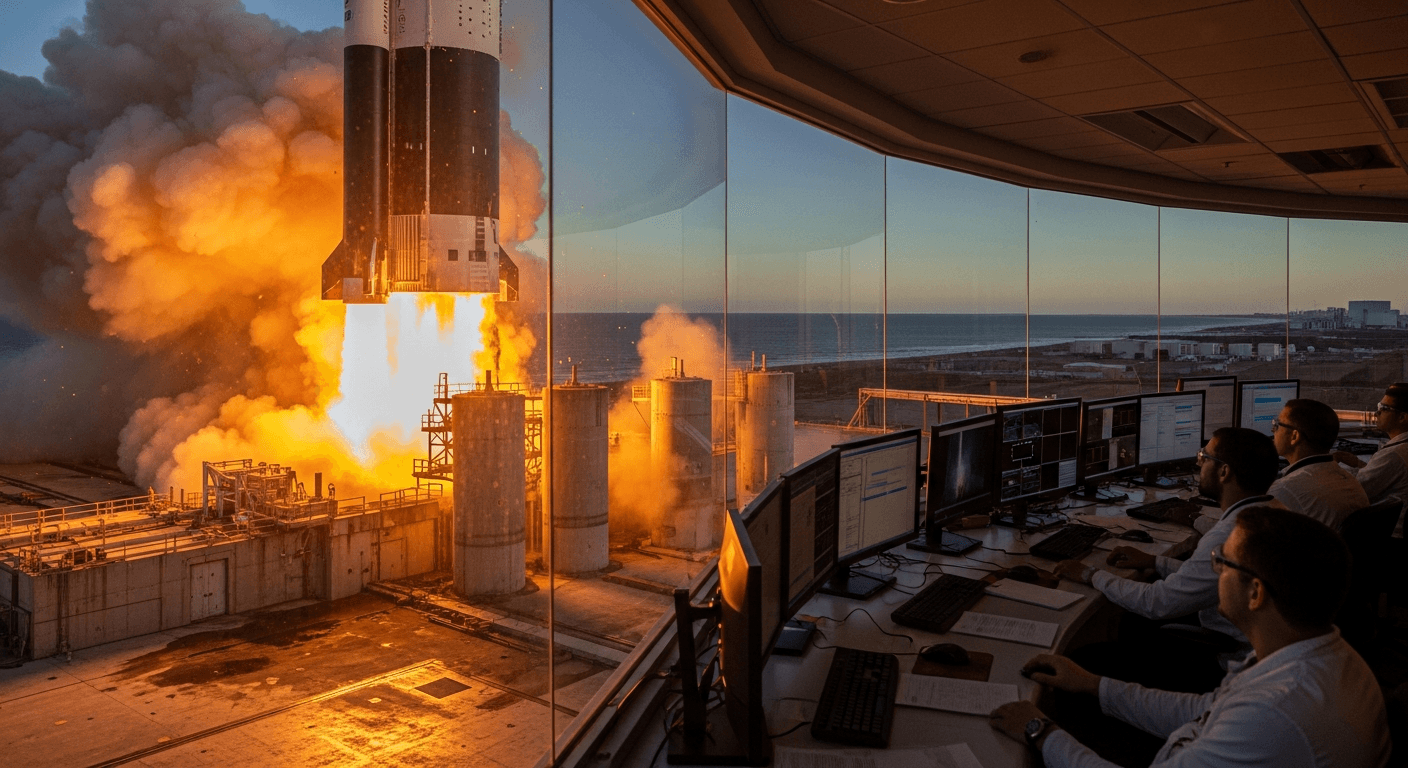
New Glenn Test Fireball
I watched the footage and read what I could about the incident: Blue Origin’s New Glenn rocket erupted into a massive fireball while undergoing a ground test. As someone who follows the commercial space sector closely, I want to put this event into context, explain what we know and what typically follows, and outline why this matters beyond a dramatic video clip.
A quick background: Blue Origin and New Glenn
Blue Origin is one of the private companies that helped expand the commercial space era alongside others such as SpaceX and Rocket Lab. New Glenn is Blue Origin’s heavy-lift orbital launch vehicle designed to compete in both commercial satellite launches and crewed or cargo missions in the longer term. The program has been watched closely because New Glenn represents Blue Origin’s step into large orbital rockets and because engine and vehicle development at this scale is inherently complex.
What happened
According to on-screen footage circulating online, a test of the New Glenn vehicle — described as a ground or integrated systems test — ended with a sudden flame and a large fireball. Tests like this are meant to exercise engines, propellant systems, and ground support operations before a flight. At this stage, the immediate priority is always personnel safety and securing the test site.
Plausible causes (no speculation beyond what’s reasonable)
While investigators will need telemetry and forensic data to conclude cause, plausible technical issues that can produce explosions during ground tests include:
- engine or turbopump failure leading to a rapid overpressure event
- propellant leak and subsequent ignition (fuel, oxidizer, or pressurant)
- failure of valves, piping, or seals during fueling or ignition
- ground-support equipment malfunction (e.g., umbilicals, test-stand systems)
- structural failure under test loads
Each of these pathways is technically plausible; identifying which one (or combination) occurred requires access to telemetry, high-speed video, and physical inspection by engineers and regulators.
Typical company and authority responses
In incidents like this, standard actions usually include:
- immediate site evacuation and securing the area for safety
- suspension of further tests until an initial hazard assessment is complete
- collection of telemetry and video for forensic analysis
- cooperation with relevant regulators (often the FAA in the U.S.) and local emergency services
- internal stand-downs and safety reviews prior to resuming any testing
Companies also generally issue formal statements when they have verified facts they can share. Investigations can take days to months depending on complexity.
Safety and environmental concerns
Ground test explosions raise several concerns:
- risk to personnel on-site (which is why strict safety zones and protocols exist)
- potential contamination from unburned propellants or combustion byproducts
- local air quality impacts and debris hazards
- damage to test infrastructure, which can delay recovery and future tests
Regulatory oversight and environmental assessments are part of the post-incident process to ensure public and worker safety.
Precedents from the industry
The commercial space sector has experienced test and launch failures before, and the pattern has been instructive:
- SpaceX had high-profile prototype test explosions during Starship development and lost a satellite during a pre-launch static fire (Amos-6) in 2016; each event led to procedural or design changes.
- Orbital Sciences’ Antares rocket suffered a catastrophic failure shortly after liftoff in 2014; that incident prompted design review and engine changes.
- NASA’s history (e.g., the Challenger and Columbia disasters) and other agency-level failures have driven major improvements in organizational processes, safety culture, and engineering redundancy.
Those precedents show that failures, while costly, often lead to stronger safety margins and better hardware — provided the lessons are properly learned and applied.
What this means for the commercial space industry
A high-profile test failure of a flagship vehicle can have several near-term effects:
- schedule delays for New Glenn and customers who planned to use its capacity
- increased scrutiny from regulators and insurers
- additional testing, redesign, or certification work that raises program cost and time
- but also, potentially, improved designs and procedures that reduce long-term risk
The commercial space sector has matured in part because firms have institutionalized post-failure learning: the development cadence — test, fail, analyze, fix — is integral to progress.
Looking forward — cautious optimism
We should expect a careful investigation rather than instant conclusions. If the event occurred during a ground test, it is often easier (though still complex) to analyze and correct causes than if it had happened in flight. That does not remove the cost or delay, but it does increase the likelihood that engineers can identify root causes and implement fixes.
I have written before about the importance of building systems and processes that prioritize safety and iterative learning in advanced technology programs (Parekh’s Law of Chatbots). The same principle applies here: transparency, disciplined investigation, and rigorous testing help the industry move forward after setbacks.
Follow updates
I’ll be watching official statements from Blue Origin and regulators closely. For accurate information, rely on official updates rather than social-media clips. I’ll share validated developments as they emerge.
Regards,
Hemen Parekh
Any questions / doubts / clarifications regarding this blog? Just ask (by typing or talking) my Virtual Avatar on the website embedded below. Then "Share" that to your friend on WhatsApp.
Get correct answer to any question asked by Shri Amitabh Bachchan on Kaun Banega Crorepati, faster than any contestant
Hello Candidates :
- For UPSC – IAS – IPS – IFS etc., exams, you must prepare to answer, essay type questions which test your General Knowledge / Sensitivity of current events
- If you have read this blog carefully , you should be able to answer the following question:
- Need help ? No problem . Following are two AI AGENTS where we have PRE-LOADED this question in their respective Question Boxes . All that you have to do is just click SUBMIT
- www.HemenParekh.ai { a SLM , powered by my own Digital Content of more than 50,000 + documents, written by me over past 60 years of my professional career }
- www.IndiaAGI.ai { a consortium of 3 LLMs which debate and deliver a CONSENSUS answer – and each gives its own answer as well ! }
- It is up to you to decide which answer is more comprehensive / nuanced ( For sheer amazement, click both SUBMIT buttons quickly, one after another ) Then share any answer with yourself / your friends ( using WhatsApp / Email ). Nothing stops you from submitting ( just copy / paste from your resource ), all those questions from last year’s UPSC exam paper as well !
- May be there are other online resources which too provide you answers to UPSC “ General Knowledge “ questions but only I provide you in 26 languages !


No comments:
Post a Comment