
Why this matters — legal context
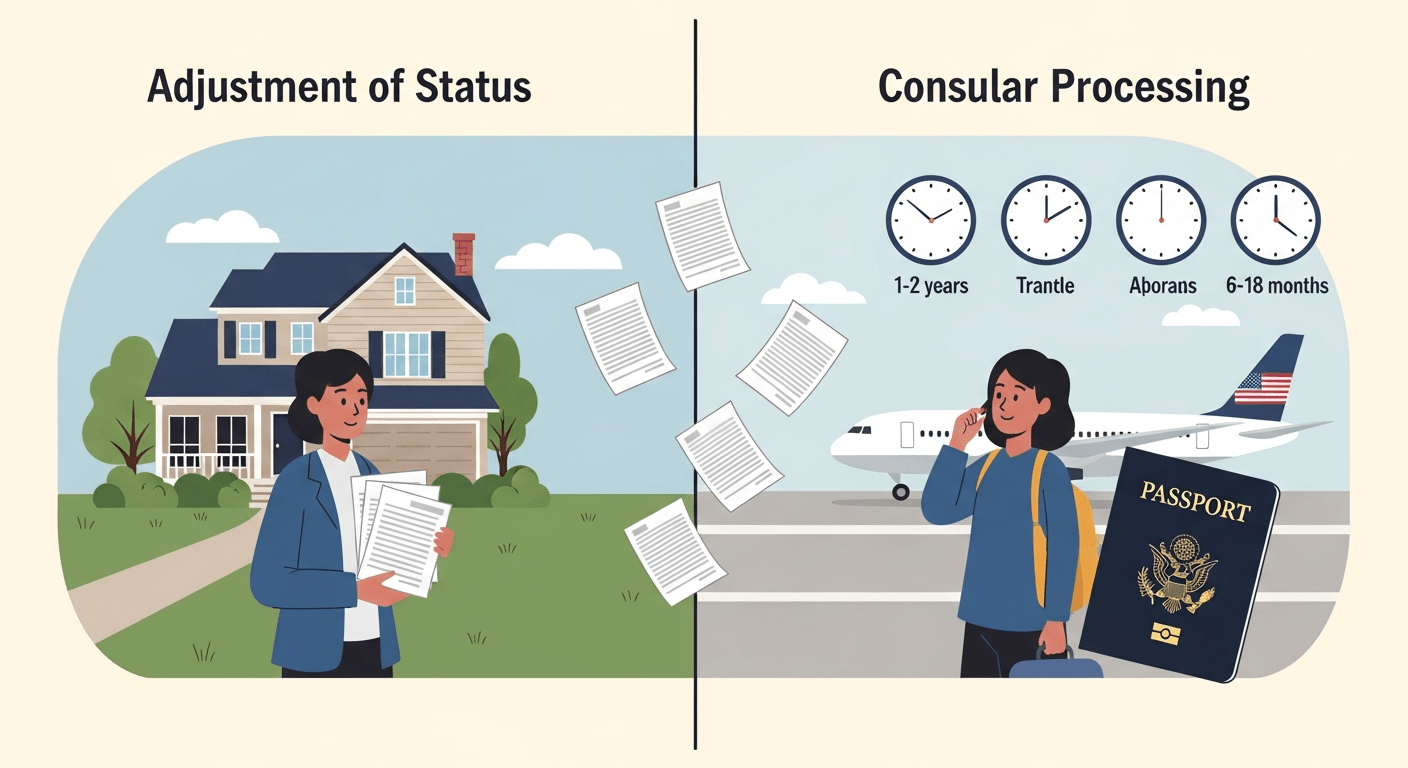
I write this as someone who follows immigration policy closely and cares about the people affected. In U.S. immigration law there are two main routes to a green card (lawful permanent residence): adjustment of status (AOS), where an eligible person already inside the United States files Form I-485, and consular processing, where the applicant completes immigrant visa processing at a U.S. consulate abroad. The statute and regulations (notably INA §245 and related provisions) and long-standing agency practice determine which path an individual may use.
A recent memo from U.S. immigration authorities has drawn attention because it signals a stronger presumption that certain applicants will need to pursue consular processing — in other words, “go home first” — rather than finishing their case inside the U.S. This can change timelines, eligibility choices, and family planning for many applicants.
What the memo says (plain language summary)
The memo emphasizes that, in specific circumstances, USCIS (and related agencies) will require applicants to depart the United States and obtain their immigrant visa through a consular post rather than being granted adjustment of status on U.S. soil. The guidance focuses on cases where statutory or regulatory bars, prior immigration violations, or eligibility concerns make in-country approval inappropriate. The memo also clarifies that some applicants may still pursue waivers or other remedies that would allow consular processing to succeed.
Note: this blog summarizes the memo’s implications; applicants should read the official agency guidance and consult counsel for case-specific interpretation.
Who this affects
- Noncitizen workers (including those on H‑1B, L‑1, OPT, etc.) who filed or planned to file I‑485.
- Family-based applicants whose petitions were expected to convert to adjustment in the U.S.
- Employers sponsoring immigrant workers who rely on predictable timelines.
- Mixed-status families facing temporary separation.
Generally, people with prior unlawful presence, certain visa overstays or entries, or criminal-admissibility issues are most likely to be steered to consular processing.
Steps applicants should take now
- Read your file and review the memo: obtain a copy of any agency notices and the memo text.
- Talk to an experienced immigration attorney immediately — eligibility nuances and waivers matter.
- Audit your immigration history: dates of entry/exit, prior visa refusals, arrests/convictions, and prior removals or voluntary departures.
- Assess waivers: identify whether an unlawful-presence waiver (I-601 or provisional I-601A), INA §212(h) waiver, or other relief may apply.
- Prepare documents for consular processing: civil documents, medical exam, and police/background records.
- Coordinate with your employer and family: plan for potential travel, work authorization, and temporary separation.
Timeline expectations
Consular processing timelines vary. In many cases, expect several months to over a year from the moment you depart the U.S. to visa issuance, depending on:
- Whether a waiver is required and how long waiver adjudication takes (provisional waivers can add months).
- The consulate’s current backlog and required clearances (e.g., name checks).
- Additional requests for evidence or security vetting.
If you leave without advance planning, you may face longer delays if a waiver becomes necessary after departure.
Possible exceptions or waivers
Some important avenues to avoid or reduce separation:
- Advance parole (AP): if you have valid AP and are eligible to re-enter, travel may preserve in‑country status — but AP is not a guarantee and does not cure certain bars.
- Provisional unlawful presence waiver (I‑601A): for certain immediate relatives, this allows waiver adjudication while in the U.S., but the applicant must still depart for visa stamping.
- INA §212(h)/§212(a)(9) waivers: waivers of inadmissibility may be available; eligibility is case-specific.
- Humanitarian parole or deferred action: rare and fact-specific, potentially useful in narrow situations.
Impact on families and employers
- Families: Short-term or prolonged separation can disrupt childcare, schooling, and care for elder relatives. Applicants should plan support systems and legal strategies to minimize separation.
- Employers: Workforce planning becomes harder; key employees may be unavailable during processing, or employers may need to sponsor H‑1B extensions or nonimmigrant options while immigrant processing proceeds.
Employers should communicate early, consider temporary staffing plans, and consult immigration counsel regarding portability and maintenance of nonimmigrant work authorization.
Policy rationale (what agencies say they’re trying to achieve)
Authorities frame the memo as an effort to ensure statutory compliance and protect immigration system integrity: consular processing allows the Department of State to assess admissibility overseas and execute removability determinations differently than an in‑country adjudication. Requiring consular processing in borderline cases reduces the risk of internal approvals that might later be reversed.
Practical advice — my bottom line
- Don’t panic, but don’t delay. Immediate review and counsel are essential.
- Gather records now (passports, travel history, police clearances, birth/marriage certificates, tax and employment records).
- If eligible, pursue provisional waivers promptly to reduce post‑departure uncertainty.
- Coordinate with family and employer before any travel; ensure you understand the risks of departing without proper authorization.
- Stay informed: policy guidance can change; monitor official agency sites and consult counsel for updates.
Short example/case study Priya (on H‑1B) had an I‑140 approved and an I‑485 pending when the memo arrived. Her file showed a prior overstay more than a decade ago. After consulting counsel she: (1) compiled documentation, (2) filed a provisional unlawful‑presence waiver, (3) coordinated with her employer to maintain H‑1B extensions, and (4) scheduled consular processing only after the waiver was favorably adjudicated — shortening the separation and avoiding unnecessary travel.
If you or someone you advise is facing the same situation, start with a careful audit of the immigration history and talk to counsel about waivers and timing.
Regards,
Hemen Parekh
Any questions / doubts / clarifications regarding this blog? Just ask (by typing or talking) my Virtual Avatar on the website embedded below. Then "Share" that to your friend on WhatsApp.
Get correct answer to any question asked by Shri Amitabh Bachchan on Kaun Banega Crorepati, faster than any contestant
Hello Candidates :
- For UPSC – IAS – IPS – IFS etc., exams, you must prepare to answer, essay type questions which test your General Knowledge / Sensitivity of current events
- If you have read this blog carefully , you should be able to answer the following question:
- Need help ? No problem . Following are two AI AGENTS where we have PRE-LOADED this question in their respective Question Boxes . All that you have to do is just click SUBMIT
- www.HemenParekh.ai { a SLM , powered by my own Digital Content of more than 50,000 + documents, written by me over past 60 years of my professional career }
- www.IndiaAGI.ai { a consortium of 3 LLMs which debate and deliver a CONSENSUS answer – and each gives its own answer as well ! }
- It is up to you to decide which answer is more comprehensive / nuanced ( For sheer amazement, click both SUBMIT buttons quickly, one after another ) Then share any answer with yourself / your friends ( using WhatsApp / Email ). Nothing stops you from submitting ( just copy / paste from your resource ), all those questions from last year’s UPSC exam paper as well !
- May be there are other online resources which too provide you answers to UPSC “ General Knowledge “ questions but only I provide you in 26 languages !



No comments:
Post a Comment