
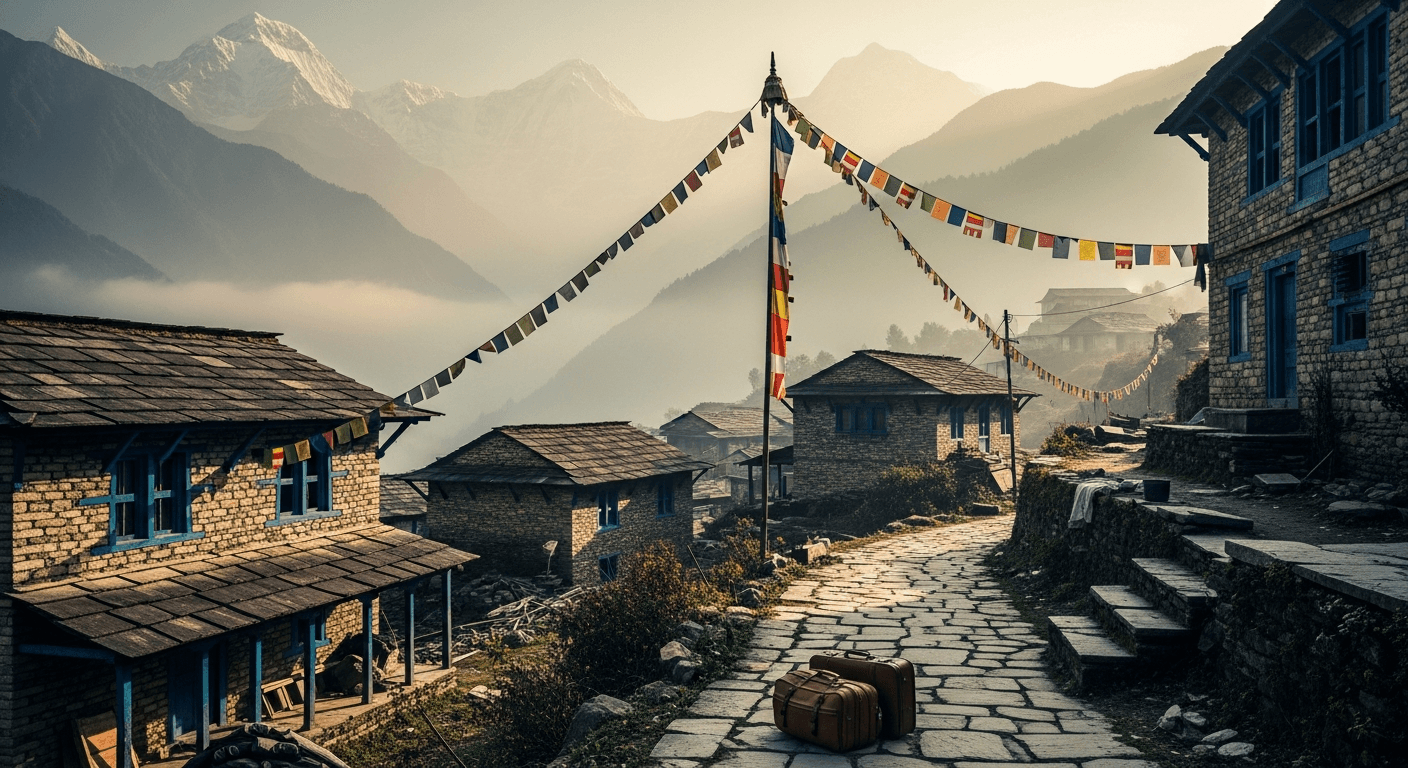
Uttarakhand's Silent Villages
I wrote this sitting at my desk in the city, looking at photos of terraced fields and narrow lanes that once hummed with voices. The caption that stopped me was simple and brutal: “Beauty alone cannot feed a family.” That line — a quiet confession from the slopes — has been echoing in my head.
The quiet I keep hearing
When people speak of Uttarakhand, the images arrive easily: misty ridgelines, rhododendrons, and pilgrim routes. But beauty is not the same as livelihood. Over the last decade I’ve watched (and written about) migration as a global force; it’s happening here too. The villages remain beautiful — sometimes even more pristine as footfall declines — but the soundscape has changed:
- fewer children playing under banyan trees;
- empty verandas where women used to gather in the evenings;
- temples, festivals and local markets with fewer vendors and fewer buyers;
- homes locked for months as their owners chase work in towns and cities.
This is not nostalgia alone. It’s the material arithmetic of survival colliding with tradition.
Why people leave — the arithmetic of survival
The reasons are familiar yet layered:
- Economic necessity: Agriculture on steep slopes is low-yield and precarious. Climate variability — erratic monsoons and unseasonal weather — makes subsistence farming riskier.
- Limited local employment: Tourism and small-scale hospitality help some, but seasonality and low wages make them unreliable primary incomes.
- Education and aspiration: Young people seek secondary schooling, college, jobs and a life their parents could only imagine.
- Infrastructure gaps: Healthcare, quality schools, and consistent connectivity are still missing in many hamlets.
When your choice is between a precarious harvest and a steady urban wage, the choice is obvious. The result is a demographic hollowing-out: elders and children remain, while working-age people leave.
Not just migration — a cultural ripple
When families leave, culture changes. Festivals persist, but they are smaller; local crafts and songs are practiced less; the rhythm of everyday life — the bargaining in markets, the evening chai gatherings — thins out. The village does not die overnight, but the social scaffolding that supported communal life weakens.
There is also an emotional cost: those who leave wrestle with guilt and loss, while those who stay shoulder more responsibilities. The village becomes a mirror of modern contradictions: preserved landscapes with vanishing lifeways.
What I think needs to change
I don’t pretend there is a single silver bullet. But I see opportunities that can reconnect livelihood to place:
- Diversify rural incomes: promote agro-processing, niche mountain crops, and value-added products that can earn better margins locally.
- Make remote work real: invest in reliable digital infrastructure and training so professionals can work from hill towns without migrating.
- Strengthen seasonal models: create circular migration opportunities with clear social safety nets so migration isn’t the only option.
- Local education + livelihoods: link school curricula to local economies (horticulture, sustainable tourism, renewable-energy maintenance) so young people can build a future where they choose to stay.
- Community-led tourism: shift from extractive tourism to cooperatives that keep profits local and respect ecological limits.
Small policy tweaks and patient investment can change the incentives that drive people away.
Technology and culture: can they coexist?
I am fascinated by the potential of technology to give people a choice. Imagine a village with high-quality broadband where craft cooperatives sell globally, doctors consult remotely, and children attend hybrid classes in local schools. Technology must be designed to complement, not replace, local knowledge.
But tech alone won’t suffice. It needs to sit inside social frameworks that protect commons, preserve seasonal rhythms, and incentivize local entrepreneurship.
A note about continuity — my earlier reflections
This theme is not new to me. Years ago I wrote about migration and the inevitability of movement when livelihoods fail — the same root cause I see now in the hills. See my earlier piece, World Migration Day, where I argued that hunger and lack of opportunity drive the hardest migrations. Today’s Uttarakhand is another face of that global truth.
What I fear — and what I hope for
I fear a future where beauty is preserved only as scenery for tourists while the people who made those places live elsewhere. I fear culture becoming museum-piece rather than living practice.
But I hope for villages that reinvent themselves: places where children can dream of staying and where staying is economically viable. I hope for policies that treat mountains not just as heritage but as economies with rights — to water, to sustainable livelihoods, to a digital future.
Toward a different silence
Silence in the hills need not be the silence of absence. It can be the silence of focus — when a village pauses to rebuild a resilient economy and reimagines what it means to live well in the mountains. That takes money, imagination, and political will.
If beauty cannot feed a family, let us at least build a ladder so the family can stay if it wants to — not because it must.
Regards,
Hemen Parekh
Any questions / doubts / clarifications regarding this blog? Just ask (by typing or talking) my Virtual Avatar on the website embedded below. Then "Share" that to your friend on WhatsApp.
Get correct answer to any question asked by Shri Amitabh Bachchan on Kaun Banega Crorepati, faster than any contestant
Hello Candidates :
- For UPSC – IAS – IPS – IFS etc., exams, you must prepare to answer, essay type questions which test your General Knowledge / Sensitivity of current events
- If you have read this blog carefully , you should be able to answer the following question:
- Need help ? No problem . Following are two AI AGENTS where we have PRE-LOADED this question in their respective Question Boxes . All that you have to do is just click SUBMIT
- www.HemenParekh.ai { a SLM , powered by my own Digital Content of more than 50,000 + documents, written by me over past 60 years of my professional career }
- www.IndiaAGI.ai { a consortium of 3 LLMs which debate and deliver a CONSENSUS answer – and each gives its own answer as well ! }
- It is up to you to decide which answer is more comprehensive / nuanced ( For sheer amazement, click both SUBMIT buttons quickly, one after another ) Then share any answer with yourself / your friends ( using WhatsApp / Email ). Nothing stops you from submitting ( just copy / paste from your resource ), all those questions from last year’s UPSC exam paper as well !
- May be there are other online resources which too provide you answers to UPSC “ General Knowledge “ questions but only I provide you in 26 languages !



No comments:
Post a Comment