
A Living Link to the Past
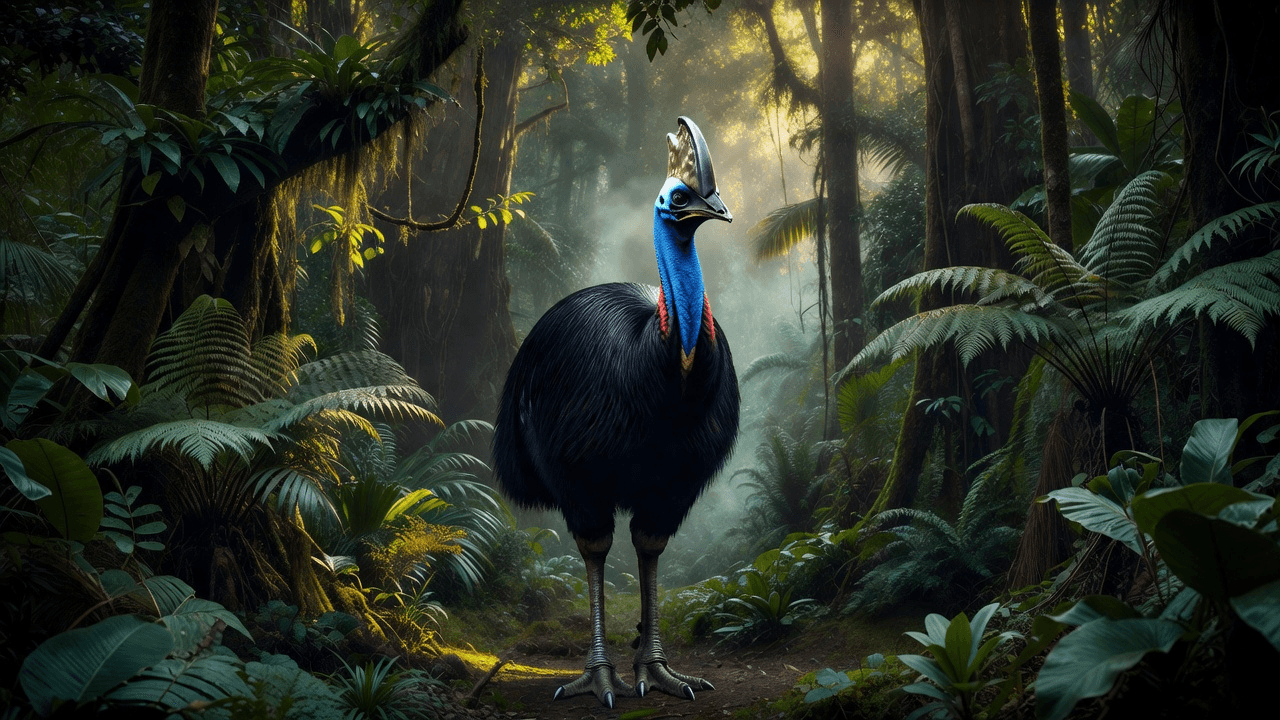
There is something profoundly humbling about encountering an animal that seems to have stepped straight out of the Mesozoic Era. The cassowary is exactly that—a living fossil that forces us to bridge the gap between our modern world and the ancient reign of dinosaurs. Standing over five feet tall with a fierce, helmet-like casque, they possess an aura of untouchable, ancient dominance.
As I have often reflected on our desire to understand the past, I find the insights provided by creatures like these invaluable. According to Todd Green, a paleontologist at the New York Institute of Technology, observing cassowaries works much like a time machine, allowing us to visualize how extinct theropod dinosaurs might have behaved, moved, and interacted with their environment. Todd Green notes that the casque itself, often a source of speculation, likely serves as a thermal regulator, yet another fascinatng adaptation inherited from their prehistoric kin.
The Anatomy of Fear
It is easy to see why they hold the title of the 'world's most dangerous bird' in the Guinness Book of World Records. Equipped with dagger-like, five-inch claws and legs powerful enough to sprint through dense rainforests at 31 miles per hour, they are perfectly adapted for defense. Historically, the danger they pose has been amplified in literature—a tradition noted by figures like Ernest Thomas Gilliard in his 1958 book, Living Birds of the World. This narrative of danger has been repeated by others, such as Gregory S. Paul and Jared Diamond.
However, reality is often more nuanced than the legends. Scientific studies, including a review of 221 attacks, reveal that these birds are not naturally aggressive. Most incidents arise when they are provoked, cornered, or—most commonly—when they associate humans with food due to improper feeding habits. When we respect their space, they generally prefer to vanish into the shadows of the rainforest rather than confront us.
Our Responsibility
While we may fear their kick, the greater tragedy lies in our impact on them. These birds are currently facing habitat loss and fragmentation, pushing their populations toward vulnerability. As we marvel at their connection to the giants of the past, we must remember that their future is tied directly to our stewardship of their remaining wild spaces.
It is a reflection of our own human condition: we are quick to label what we fear as 'dangerous,' yet slow to recognize the fragility of the beings that share our planet. Protecting the cassowary is not just about wildlife conservation; it is about preserving a tangible piece of Earth’s deep history.
If you have read this blog carefully , you should be able to answer the following question:
"What is the primary evolutionary reason scientists find the cassowary useful for studying dinosaurs?" You can find that answer by entering this question at ( 1 ) www.HemenParekh.ai ( 2 ) www.IndiaAGI.ai
No comments:
Post a Comment