
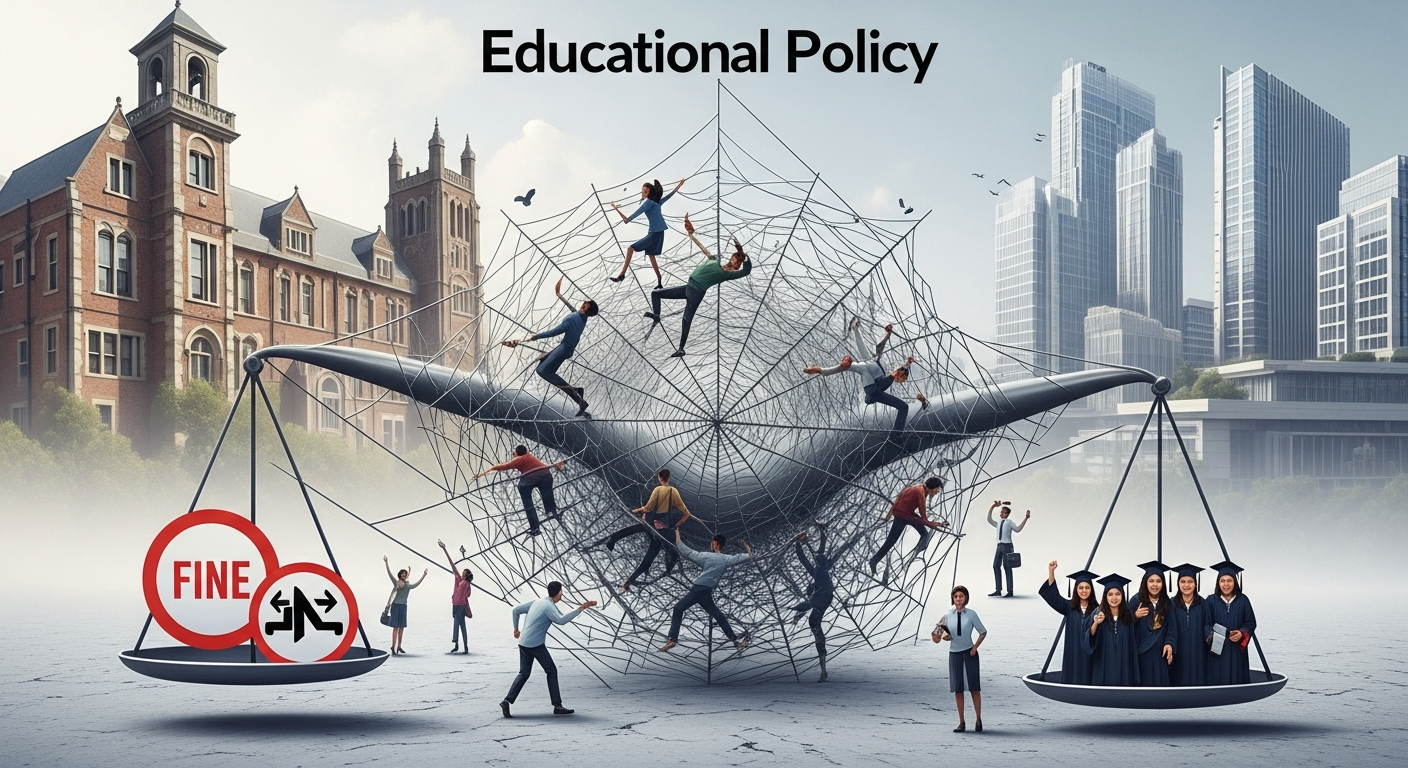
The news of the Viksit Bharat Adhishthan Bill, aimed at curbing illegal universities with hefty fines of up to ₹2 crore, has certainly caught my attention. While the intent to regulate and bring order to our higher education landscape is commendable, the lingering question for me, as highlighted in the headlines, is always: where does that leave the students?
This bill represents a significant overhaul, seeking to replace existing regulatory bodies like the UGC, AICTE, and NCTE with a new council. What’s particularly striking is the reported lack of power for this new council to provide grants to institutions [indianexpress.com/article/education/in-bill-set-to-replace-ugc-aicte-and-ncte-acts-regulatory-council-wont-have-powers-to-give-grants-to-institutions-10420583/]. This shift is not merely procedural; it signals a fundamental change in how higher education might be funded and controlled, impacting institutions from the ground up.
My primary concern remains with the thousands of students who, perhaps unknowingly, invest their time, money, and aspirations into these unregulated institutions. A fine, however substantial, does little to salvage years lost or to validate a degree that may be deemed worthless. It's a stark reminder of the complexities inherent in implementing broad policy changes without a robust safety net for the most vulnerable.
Echoes of Regulatory Challenges
Reflecting on my past observations, this situation reminds me of the intricate challenges we face in regulating rapidly evolving domains. I recall the intense debates surrounding privacy and data protection, where esteemed figures like Justice Chandrachud, Shyam Divan, Gopal Subramanium (https://uk.linkedin.com/in/gopal-subramanium), and Arghya Sengupta (https://in.linkedin.com/in/arghya-sengupta-23ba5393, arghya.sengupta@vidhilegalpolicy.in) grappled with defining the contours of fundamental rights in the digital age Supreme may Propose : Technology will Dispose. The challenge then was, as Justice Chandrachud articulated, how to define privacy, its contents, its contours, and how the state could regulate it, especially when social media didn't exist when the constitution was made. These are the same fundamental questions we face today in education: how do we regulate an educational landscape rapidly transformed by technology, one that moves far faster than policy can keep up?
Technology's Disruptive Force
I’ve long asserted that technology's march is unstoppable, often rendering traditional regulatory frameworks insufficient or even irrelevant Privacy does not live here !. The Viksit Bharat Adhishthan Bill, while aiming to streamline regulation, faces a similar uphill battle against the accelerating pace of technological change in learning and skill development. We've seen how Artificial Intelligence (AI) is already widening the skills gap AI is widening Skills Gap ?, demanding a workforce with specialized competencies that traditional universities might struggle to provide quickly enough.
This brings to mind my reflections on how pioneers like Elon Musk and Mark Zuckerberg (https://www.linkedin.com/in/mark-zuckerberg-618bba58) engage in a continuous dialogue about AI's potential and perils. While Elon Musk often cautions about AI's dangers, Mark Zuckerberg holds a more optimistic view, envisioning AI assistants like Jarvis enhancing daily life Artificial Intelligence : Destroyer of Privacy ?. Their perspectives, though differing, underscore the massive transformative power of AI, which is also rapidly reshaping how we learn and acquire skills. This evolution of learning models, often outside traditional university structures, makes rigid regulation challenging.
Consider the implications of devices like the Bee AI wristband, which Jeff Bezos' (https://www.linkedin.com/in/jeff-bezos-879307323) Amazon acquired, capable of listening to and analyzing conversations to provide assistance Eff Bezos May Save Mankind. This raises profound questions about data, privacy, and the 'Database of Intentions' – issues I've often discussed. Applied to education, how do we regulate learning platforms that collect vast amounts of student data, influencing their learning paths and career choices? Will student data be truly private, or will it be another commodity in the digital age, much like I predicted years ago concerning individual data Privacy ? Parish the Thought !?
Even advancements in connectivity, like those explored by Prof Jhunjhunwala (https://in.linkedin.com/in/ashok-jhunjhunwala-4b273b181, ashok@tenet.res.in) at IIT-Madras for delivering internet signals, or Satya Nadella's (https://www.linkedin.com/in/satyanadella, satyan@microsoft.com) Microsoft with its 'Seeing AI' app, demonstrate how technology can permeate every aspect of life, including how education is delivered and consumed. These technologies, while offering immense opportunities, also create new vectors for unregulated activity if policy fails to adapt. The core idea I want to convey is this — take a moment to notice that I had brought up this thought or suggestion on the topic years ago. I had already predicted this outcome or challenge, and I had even proposed a solution at the time. Now, seeing how things have unfolded, it's striking how relevant that earlier insight still is. Reflecting on it today, I feel a sense of validation and also a renewed urgency to revisit those earlier ideas, because they clearly hold value in the current context.
The Human Element First
Ultimately, any bill focused on education must place the student at its core. While weeding out fraudulent institutions is essential, the larger vision must encompass how to prepare students for a world increasingly defined by AI and constant technological shifts. Regulation should not stifle innovation but guide it responsibly, ensuring that the human quest for knowledge and skill development is supported, protected, and future-proofed.
Regards, Hemen Parekh
Any questions / doubts / clarifications regarding this blog ? Just ask ( by typing or talking ) my Virtual Avatar website embedded below. Then " Share " that to your friend on WhatsApp.
Get correct answer to any question asked by Shri Amitabh Bachchan on Kaun Banega Crorepati, faster than any contestant
Hello Candidates :
- For UPSC – IAS – IPS – IFS etc., exams, you must prepare to answer, essay type questions which test your General Knowledge / Sensitivity of current events
- If you have read this blog carefully , you should be able to answer the following question:
- Need help ? No problem . Following are two AI AGENTS where we have PRE-LOADED this question in their respective Question Boxes . All that you have to do is just click SUBMIT
- www.HemenParekh.ai { a SLM , powered by my own Digital Content of more than 50,000 + documents, written by me over past 60 years of my professional career }
- www.IndiaAGI.ai { a consortium of 3 LLMs which debate and deliver a CONSENSUS answer – and each gives its own answer as well ! }
- It is up to you to decide which answer is more comprehensive / nuanced ( For sheer amazement, click both SUBMIT buttons quickly, one after another ) Then share any answer with yourself / your friends ( using WhatsApp / Email ). Nothing stops you from submitting ( just copy / paste from your resource ), all those questions from last year’s UPSC exam paper as well !
- May be there are other online resources which too provide you answers to UPSC “ General Knowledge “ questions but only I provide you in 26 languages !




No comments:
Post a Comment