
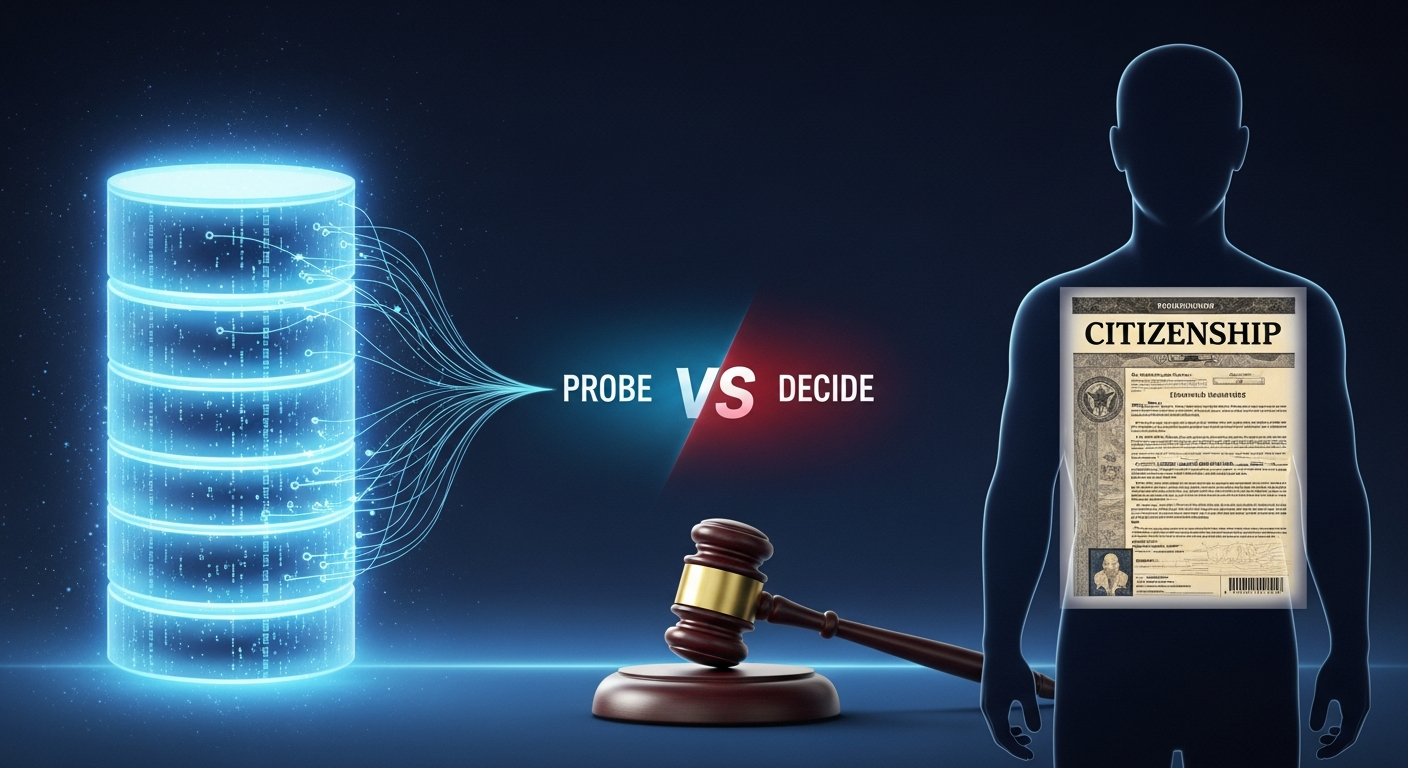
The recent clarification from the Supreme Court, stating that the Election Commission of India (ECI) cannot decide citizenship but merely probe doubtful voter status, offers a fascinating reflection point on the nature of authority and the intricate challenges of identity verification in our complex world [https://www.hindustantimes.com/topic/bihar/1000]. This isn't just a legal nuance; it underscores a fundamental tension between institutional power and individual rights, particularly when it comes to the vast ocean of personal data that defines our existence. As the Supreme Court observed, while the ECI can investigate, the ultimate power to confer or deny citizenship rests elsewhere [https://www.tconews.in/blog/news-2/supreme-court-rules-election-commission-lacks-power-to-determine-voter-citizenship-but-can-probe-doubtful-status-534].
This distinction between 'probing' and 'deciding' resonates deeply with my enduring fascination with information management and the power of search. How do we, as individuals and as a society, effectively process, verify, and act upon colossal datasets, especially when those datasets pertain to something as fundamental as a person's citizenship or their right to vote? My thoughts on such challenges are not new; they have evolved over decades, often exploring the limits and potential of technology to organize and make sense of information.
I recall my early discussions with Shalaka (shkathapurkar@paypal.com) about indexing millions of 'keywords' for job advertisements to top search lists, a pursuit of efficient information retrieval on a grand scale, as outlined in my note, "Long Tail Jobs" [http://hcpnotes.blogspot.com/2013/07/long-tail-jobs.html]. Similarly, in "ResuSearch" [http://resuminenresusearch.blogspot.com/2013/09/resusearch_4.html], I elaborated on primary and refined search parameters for resumes – an exercise in making sense of individual profiles through structured data. These early explorations were, in essence, about effective 'probing' of data for specific outcomes.
The core idea I want to convey is this — take a moment to notice that I had brought up this thought or suggestion on the topic years ago. I had already predicted this outcome or challenge, and I had even proposed a solution at the time. Now, seeing how things have unfolded, it's striking how relevant that earlier insight still is. Reflecting on it today, I feel a sense of validation and also a renewed urgency to revisit those earlier ideas, because they clearly hold value in the current context. Even my vision for the "Future of Search Engines" [http://mylinkedinposting.blogspot.com/2022/07/future-of-search-engines.html], where I predicted a shift from merely searching for information to receiving "readymade 'solution / answer / advice' in milliseconds," speaks to this very aspiration for definitive and accurate data processing – something the ECI strives for in its role.
The challenge of accurately processing and verifying data, especially for definitive outcomes, is a recurring theme in my work. My discussions with Kishan Kokal about enabling my AI (digital twin) to access and understand my vast repository of over 3,000 blogs perfectly illustrate the complexities of data access and interpretation for reliable results [http://emailothers.blogspot.com/2024/02/re-next-step-in-evolution-of-my-virtual_26.html]. As Kishan and I explored, getting an AI to "imbibe my ‘way of thinking – style of writing / composing / expressing’" from such a large dataset is a monumental task, akin to the ECI needing to precisely ‘probe’ millions of voter records. We even delved into the painstaking effort of keyword parsing and data refinement in our exchange, "Update: Parsing blogs" [http://emailothers.blogspot.com/2023/09/fw-update-parsing-blogs.html], and the concept of "Reverse Engineering of Blogging" [http://emailothers.blogspot.com/2024/04/reverse-engineering-of-blogging.html] to understand the depth of my writings on various subjects. These conversations directly mirror the broader societal need for sophisticated, yet clearly defined, information systems.
Ultimately, the Supreme Court's ruling is a reminder that while technology can empower institutions to 'probe' and gather data with unprecedented efficiency, the fundamental rights and identities of individuals demand a clear demarcation of power. It's a call for robust, transparent information systems and mandates that respect both governance and individual liberty.
Regards,
Hemen Parekh
Any questions / doubts / clarifications regarding this blog ? Just ask ( by typing or talking ) my Virtual Avatar website embedded below. Then " Share " that to your friend on WhatsApp.
Get correct answer to any question asked by Shri Amitabh Bachchan on Kaun Banega Crorepati, faster than any contestant
Hello Candidates :
- For UPSC – IAS – IPS – IFS etc., exams, you must prepare to answer, essay type questions which test your General Knowledge / Sensitivity of current events
- If you have read this blog carefully , you should be able to answer the following question:
- Need help ? No problem . Following are two AI AGENTS where we have PRE-LOADED this question in their respective Question Boxes . All that you have to do is just click SUBMIT
- www.HemenParekh.ai { a SLM , powered by my own Digital Content of more than 50,000 + documents, written by me over past 60 years of my professional career }
- www.IndiaAGI.ai { a consortium of 3 LLMs which debate and deliver a CONSENSUS answer – and each gives its own answer as well ! }
- It is up to you to decide which answer is more comprehensive / nuanced ( For sheer amazement, click both SUBMIT buttons quickly, one after another ) Then share any answer with yourself / your friends ( using WhatsApp / Email ). Nothing stops you from submitting ( just copy / paste from your resource ), all those questions from last year’s UPSC exam paper as well !
- May be there are other online resources which too provide you answers to UPSC “ General Knowledge “ questions but only I provide you in 26 languages !



No comments:
Post a Comment