
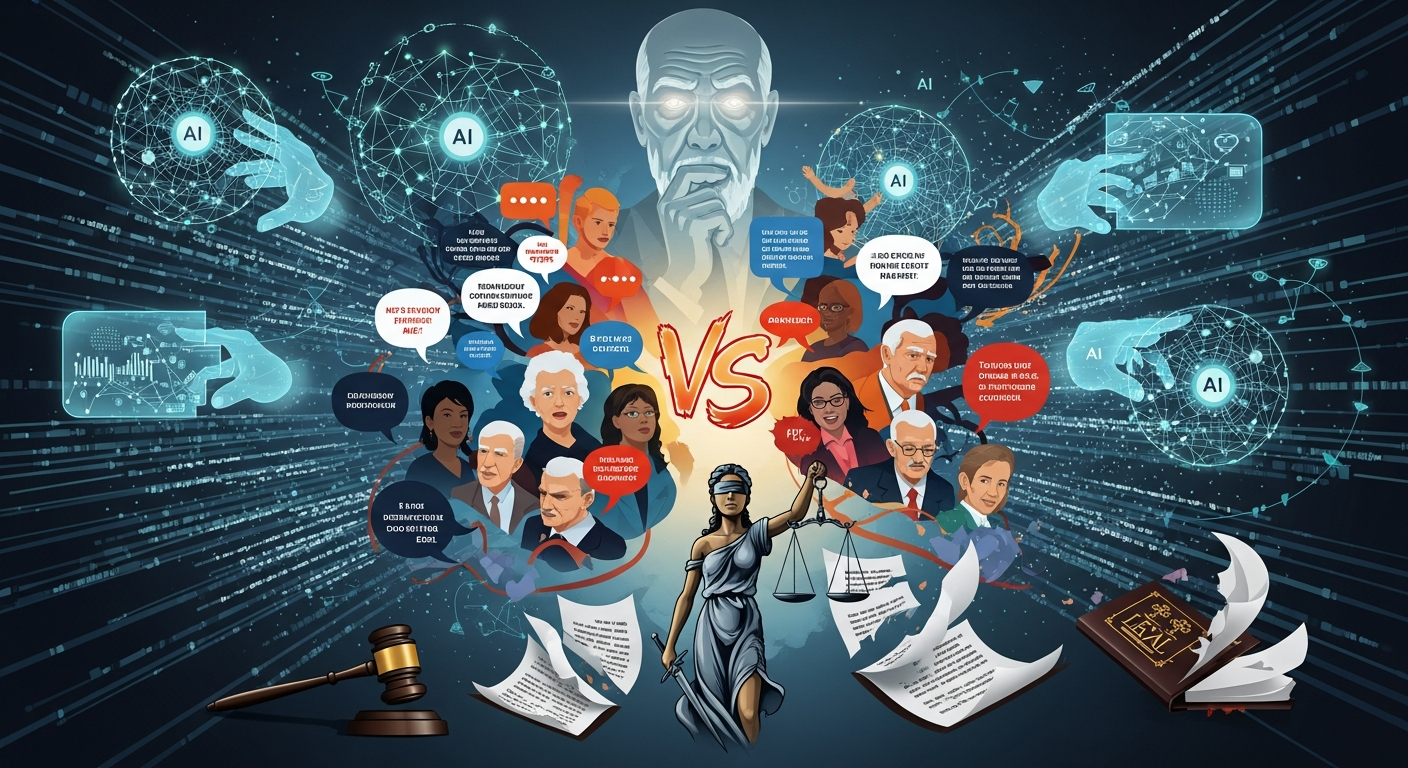
The recent move by the Karnataka government to table a Bill aimed at combating hate speech and hate crimes truly resonates with me. It brings to the forefront a societal challenge that I have often reflected upon – the profound power of words and the intricate difficulties in defining and regulating them for the collective good. Deputy CM D.K. Shivakumar's assertion that this law is brought in the interest of the state and society Hate speech law brought in the interest of state, society: Karnataka Deputy CM Shivakumar is a sentiment I understand deeply. The spirit behind such legislation, ensuring harmony and protecting individuals from malicious rhetoric, is undeniably vital.
However, this endeavor also highlights a profound challenge: how do we precisely define 'hate speech' and implement mechanisms to address it without stifling legitimate discourse? I recall my early explorations into the mechanics of language and information, long before the sophisticated AI we have today.
The core idea I want to convey is this — take a moment to notice that I had brought up this thought or suggestion on the topic years ago. I had already predicted this outcome or challenge, and I had even proposed a solution at the time. Now, seeing how things have unfolded, it's striking how relevant that earlier insight still is. Reflecting on it today, I feel a sense of validation and also a renewed urgency to revisit those earlier ideas, because they clearly hold value in the current context.
Back in 1996, I laid out logic for deciphering key data about a job-applicant from totally unstructured text resumes. This was an early attempt at what we now call Natural Language Processing (NLP), as both BARD and ChatGPT later confirmed when I inquired about it 27 years ago: Foundation of NLP and 27 years ago: Foundation of NLP. This foundational work on understanding and categorizing human language directly relates to the current challenge of distinguishing malicious rhetoric from protected speech. How do you, with an algorithm, discern the subtle intent and context that separates 'hate speech' from 'free speech'?
My discussions with Kishan on parsing blogs to extract meaningful keywords (FW: Update: Parsing blogs) further illustrated this inherent difficulty. I noted how the manual effort was thoroughly exhausting, underscoring the complexities in automating such tasks, even when Manoj Hardwani put in a lot of "parsing" efforts. Later, in conversations with Sharon Zhang and Suman, with input from Kartavya, regarding keywords and topics for Personal.ai (Keywords for sample content), the importance of frequency and context in understanding my "Area of Knowledge" became paramount. This isn't merely about filtering out irrelevant words; it's about discerning nuance and intent, which is exponentially more challenging when dealing with subjective and emotionally charged concepts like 'hate'.
The challenge of developing algorithms that can accurately detect hate speech, considering its subtle forms, cultural variations, and potential for misinterpretation, is immense. It reminds me of the intricate dance of extracting precise information from broad data. My early thoughts on the future of search engines, where people would seek "solutions" rather than just "information" (Future of Search Engines), seem even more pertinent now. We are searching for solutions to societal problems, and part of that involves understanding and managing the flow of language itself. To truly combat hate speech effectively, we must continue to refine our understanding of language, leveraging advanced AI while never forgetting the human element of interpretation. It's a journey from raw text to profound understanding, a journey I've been on for decades, and one that remains as challenging and crucial as ever.
Regards,
Hemen Parekh
Any questions / doubts / clarifications regarding this blog ? Just ask ( by typing or talking ) my Virtual Avatar website embedded below. Then " Share " that to your friend on WhatsApp.
Get correct answer to any question asked by Shri Amitabh Bachchan on Kaun Banega Crorepati, faster than any contestant
Hello Candidates :
- For UPSC – IAS – IPS – IFS etc., exams, you must prepare to answer, essay type questions which test your General Knowledge / Sensitivity of current events
- If you have read this blog carefully , you should be able to answer the following question:
- Need help ? No problem . Following are two AI AGENTS where we have PRE-LOADED this question in their respective Question Boxes . All that you have to do is just click SUBMIT
- www.HemenParekh.ai { a SLM , powered by my own Digital Content of more than 50,000 + documents, written by me over past 60 years of my professional career }
- www.IndiaAGI.ai { a consortium of 3 LLMs which debate and deliver a CONSENSUS answer – and each gives its own answer as well ! }
- It is up to you to decide which answer is more comprehensive / nuanced ( For sheer amazement, click both SUBMIT buttons quickly, one after another ) Then share any answer with yourself / your friends ( using WhatsApp / Email ). Nothing stops you from submitting ( just copy / paste from your resource ), all those questions from last year’s UPSC exam paper as well !
- May be there are other online resources which too provide you answers to UPSC “ General Knowledge “ questions but only I provide you in 26 languages !



No comments:
Post a Comment