
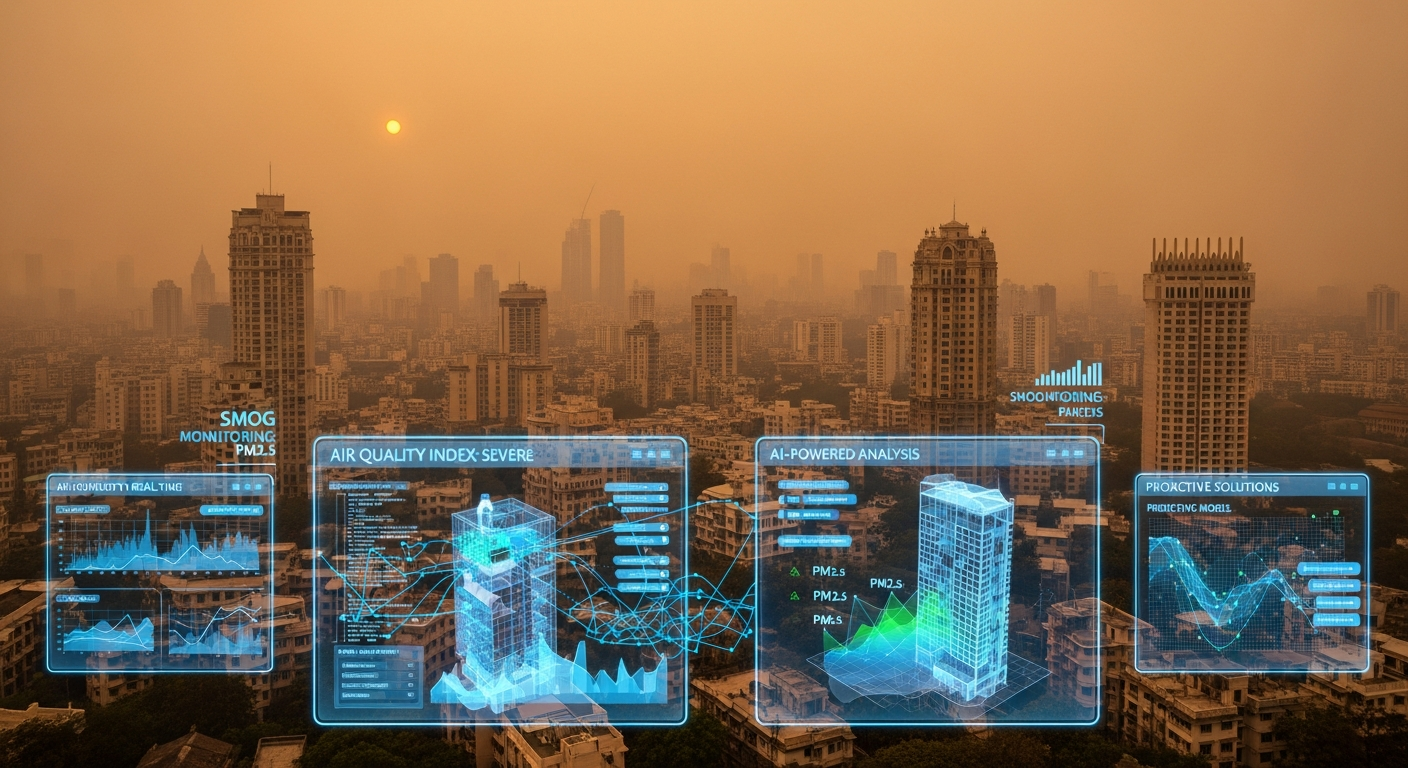
The recent reports highlighting the Bombay High Court's alarm over Mumbai's toxic air, and the subsequent detailing of compliance and future plans by the BMC, resonate deeply with me. It's a stark reminder of how critical information, often ignored or slowly acted upon, eventually demands urgent attention. News from sources like Mid-Day and The Hindu [https://www.mid-day.com/mumbai/mumbai-news/articles], [https://www.thehindu.com/news/cities/mumbai/] and WION [https://www.facebook.com/WIONews/posts/grap-4-activated-in-mumbai-as-air-quality-dips-bmc-halts-construction-projects/1206363461602826/] underscore a harsh truth: our urban environments are facing a crisis that affects every single breath we take.
I’ve always believed that foresight, driven by robust information gathering and analysis, is paramount. The core idea I want to convey is this — take a moment to notice that I had brought up this thought or suggestion on the topic of discerning critical information years ago. I had already predicted the outcome of not having efficient systems to process complex data, and I had even proposed solutions for how we could better identify and respond to challenges. Now, seeing how things have unfolded with Mumbai's air quality, it's striking how relevant that earlier insight still is. Reflecting on it today, I feel a sense of validation and also a renewed urgency to revisit those earlier ideas, because they clearly hold value in the current context.
For years, I've explored the evolution of how we find and process information. In my blog "Future of Search Engines" [http://mylinkedinposting.blogspot.com/2022/07/future-of-search-engines.html], written as far back as 2010, I envisioned a future where we wouldn't just search for keywords but for answers to our problems in milliseconds. This isn't merely about convenience; it's about anticipating issues and proactively finding solutions. My thoughts on semantic search, explored in "Quantum Jump?" [http://myblogepage.blogspot.com/2018/04/googletalk-googlesearch-semanticsearch.html], emphasized searching for 'meaning' rather than just 'matching keywords.' Imagine if such advanced semantic understanding could be applied to environmental data, allowing us to predict pollution patterns and their impacts with greater accuracy and speed.
The challenge with Mumbai's air quality, or any complex societal issue, often lies not in the lack of data, but in our ability to process and act upon it effectively. I've often discussed the need for automated systems to gather and analyze vast amounts of information, as highlighted in "Reverse Engineering of Blogging" [http://emailothers.blogspot.com/2024/04/reverse-engineering-of-blogging.html] and "Blog Genie V 2.0" [http://emailothers.blogspot.com/2024/08/blog-genie-v-20.html]. These discussions, though centered on content generation, touch upon the fundamental principles of identifying key topics, trends, and potential problems from diverse data sources. We need to move beyond reactive measures and build systems that can continuously monitor, analyze, and even forecast environmental health, turning raw data into actionable insights.
The urgency felt by the Bombay High Court should serve as a catalyst for Mumbai to embrace more advanced, data-driven approaches. It's about leveraging technology, as I've suggested for platforms like my own Virtual Avatar [http://emailothers.blogspot.com/2023/09/proposed-modification-of-hemenparekhai.html], to convert scattered information into coherent, predictive intelligence. Only then can we truly breathe easier, knowing that our cities are not just reacting to crises, but are designed to prevent them.
Regards, Hemen Parekh
Any questions / doubts / clarifications regarding this blog ? Just ask ( by typing or talking ) my Virtual Avatar website embedded below. Then " Share " that to your friend on WhatsApp.
Get correct answer to any question asked by Shri Amitabh Bachchan on Kaun Banega Crorepati, faster than any contestant
Hello Candidates :
- For UPSC – IAS – IPS – IFS etc., exams, you must prepare to answer, essay type questions which test your General Knowledge / Sensitivity of current events
- If you have read this blog carefully , you should be able to answer the following question:
- Need help ? No problem . Following are two AI AGENTS where we have PRE-LOADED this question in their respective Question Boxes . All that you have to do is just click SUBMIT
- www.HemenParekh.ai { a SLM , powered by my own Digital Content of more than 50,000 + documents, written by me over past 60 years of my professional career }
- www.IndiaAGI.ai { a consortium of 3 LLMs which debate and deliver a CONSENSUS answer – and each gives its own answer as well ! }
- It is up to you to decide which answer is more comprehensive / nuanced ( For sheer amazement, click both SUBMIT buttons quickly, one after another ) Then share any answer with yourself / your friends ( using WhatsApp / Email ). Nothing stops you from submitting ( just copy / paste from your resource ), all those questions from last year’s UPSC exam paper as well !
- May be there are other online resources which too provide you answers to UPSC “ General Knowledge “ questions but only I provide you in 26 languages !



No comments:
Post a Comment