
About the author: Hemen Parekh (hcp@recruitguru.com)
Why this matters — in plain terms
I want to walk you through what people are calling the “H-1B wage reset,” why it’s being discussed now, and what it practically means for Indian students and early-career professionals who plan to work in the U.S.
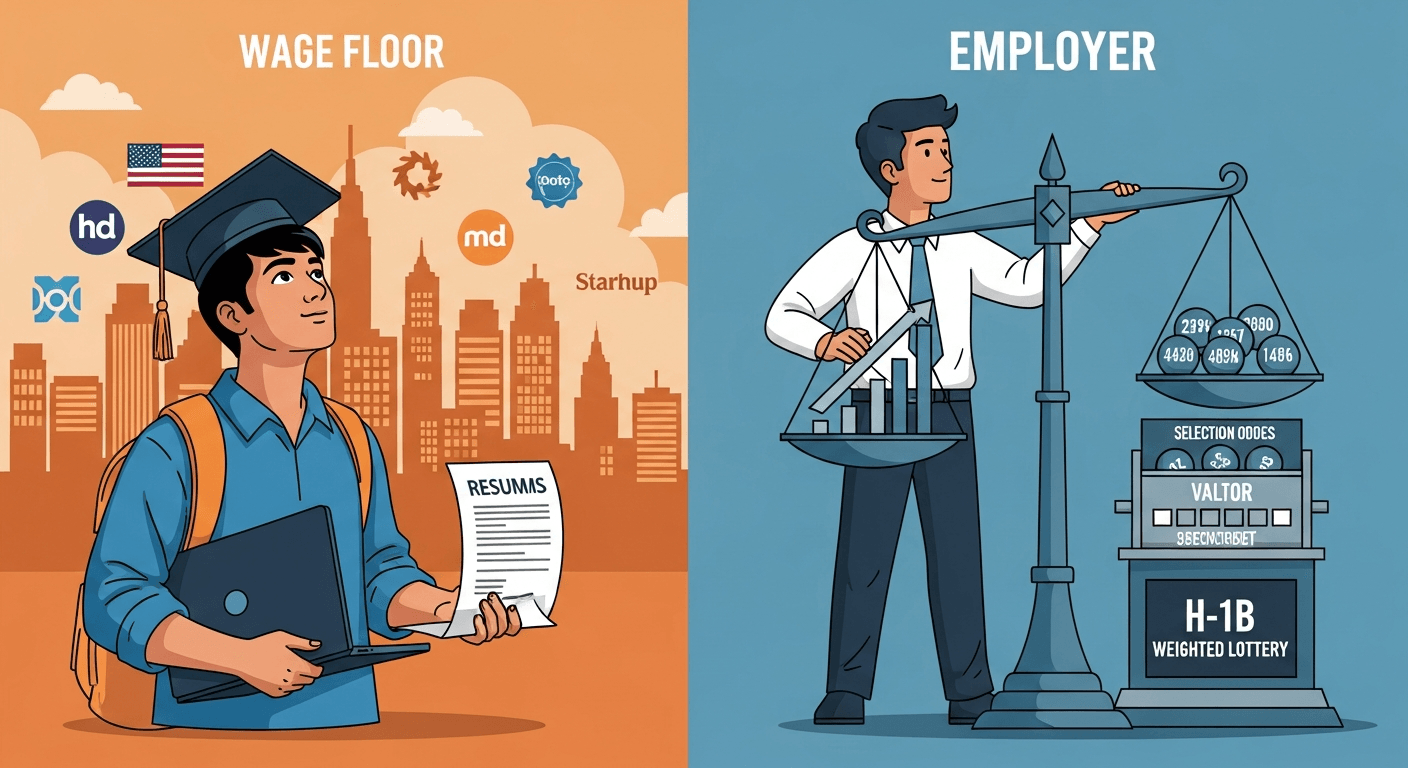
At its core, the U.S. Department of Labor (DOL) is proposing to raise the wage floors used when employers certify H-1B roles (and related PERM cases). Separately, U.S. agencies have changed the H-1B lottery to favor higher-paid roles. Together, these moves are designed to make H-1B hiring more expensive for lower-wage positions and to give higher-paid applicants better odds in the cap lottery. See the DOL proposal and DHS/USCIS lottery changes for more detail DOL proposed rule and USCIS weighted selection.
I’ve written about the future of talent flows before (see my earlier thoughts on visa policy and technology) — the shape of opportunity keeps changing, and our response must be practical.
What the wage reset could look like (simple example)
- Today’s prevailing-wage tiers for H-1B LCAs are calculated from Occupational Employment and Wage Statistics (OEWS) percentiles. The DOL proposal would shift those percentiles upward — for example, entry-level (Level I) could move from roughly the 17th percentile to the 34th percentile, and the top tier to near the 88th percentile. That’s a big upward shift in wage floors in many metro areas.
- DOL’s own analysis found an average gap of roughly $19,000 between wages reported in LCAs and the mean wages for similarly employed U.S. workers in some occupations — which is the shortfall this rule aims to fix.
Scenario: If an entry-level software role in a mid-cost U.S. city has a current prevailing wage of $75,000, a DOL increase could push the required minimum for that level to $85–95K (numbers vary widely by SOC code and city). Employers hiring for those entry-level slots would need to pay more to meet the new LCA requirement.
Immediate implications for Indian students and early-career professionals
- Lower odds for low-paid registrations: With the H-1B lottery now weighted toward higher-paid roles, entry-level wage registrations will still be allowed but will have fewer “entries” in the weighted lottery. That reduces selection probability for lower-paid offers. See USCIS weighted selection details.
- Employers may raise offered salaries (good if you’re negotiating) or simply sponsor fewer junior hires (risk for those seeking employer sponsorship).
- Smaller companies and startups may become more selective about sponsorship or focus on cap-exempt hires (universities, research labs, some nonprofits).
- Some roles may shift to remote-first hiring (offshore) or to alternative visa pathways.
Practical steps you can take — a playbook
I recommend a mix of short-term and medium-term actions. Think of this as lowering risk and increasing optionality.
Short-term (next 6–12 months)
- Strengthen negotiations: If you receive an offer, be explicit about LCA wage level. Ask for a salary that lands you at a higher OEWS wage level — that both improves lottery odds and reduces the employer’s incentive to reclassify the role later. (Example: moving from $75K to $90K could change wage-level classification in many metros.)
- Time your H-1B filing: Employers and attorneys will be accounting for the new rules — discuss the timing of registration and whether they will file cap-subject petitions or use cap-exempt routes.
- Build alternatives: Apply to cap-exempt employers (universities, research institutions) and to employers who have strong track records of sponsoring early-career hires.
Medium-term (12–36 months)
- Consider alternative visas: OPT->STEM OPT remains valuable; other categories like O-1 (for exceptional talent), L-1 (internal transfers after time abroad), or even work through a foreign affiliate with remote work arrangements may help bridge gaps.
- Prepare to be mobile: If U.S. options narrow, plan for a high-quality return to India (startups, MNC roles, remote positions paying U.S.-competitive wages). India’s tech market and remote-work pays are improving.
- Upskill to a higher wage bracket: Certifications, impactful project experience, and language skills can justify higher salary offers and increase lottery weighting.
Negotiation tips specific to this environment
- Ask recruiters how they plan to classify the role’s SOC and wage level on the H-1B registration.
- If an employer is unable/unwilling to meet a higher wage, ask about cap-exempt possibilities or contracting models that allow you to start while sponsorship is being planned.
- Document your contributions (metrics, impact) so you can justify a higher offer.
Actionable checklist (copy this)
- [ ] Ask employer which OEWS wage level your offer maps to
- [ ] Request written confirmation of offer and salary for LCA purposes
- [ ] Apply to at least one cap-exempt employer or university role
- [ ] Expand job search to remote roles paying U.S. wages
- [ ] Save an emergency fund (3–6 months) in case visa timelines shift
- [ ] Pursue one skill/certification that moves you into a higher wage band
Key takeaways — quick bullets
- The wage reset aims to raise minimum required wages for H-1B/PERM and to favor higher-paid registrations in the H-1B cap.
- Entry-level applicants are not barred, but their cap odds are reduced and employers may adjust hiring budgets.
- You can respond by negotiating higher starting salaries, targeting cap-exempt employers, using alternative visa strategies, or choosing remote/work-from-India options.
- There’s still uncertainty: DOL rulemaking needs public comment and finalization; implementation timelines vary. Watch for official publications and attorney guidance.
Timelines & uncertainties
- DOL published a proposed rule and invited comments; rulemaking typically takes months: there will be a comment period, possible revision, and a final-rule stage. Expect several months to a year before full implementation in many cases. DOL proposal coverage.
- DHS/USCIS changes to the lottery (weighted selection) have been finalized and have earlier effective dates for upcoming lotteries; check USCIS announcements for exact registration windows.
- Courts or policy shifts could modify or slow implementation. Because policy is in flux, maintain multiple options rather than relying on a single pathway.
Final thought
I know this is stressful if you’re a student planning to stay in the U.S. or an early-career professional relying on employer sponsorship. My practical advice is to prepare: negotiate, diversify options, and build both technical and career capital so you’re attractive at higher wage bands. Policy shifts like this change the shape of opportunity — but they rarely remove it entirely. They reward planning, clarity, and adaptability.
Regards,
Hemen Parekh (hcp@recruitguru.com)
Any questions / doubts / clarifications regarding this blog? Just ask (by typing or talking) my Virtual Avatar on the website embedded below. Then "Share" that to your friend on WhatsApp.
References:
- DOL proposed wage rule overview: Ogletree — DOL Proposed Rule
- DHS/USCIS weighted selection explanation: Ogletree — DHS Weighted Selection
- My earlier reflection on visa-policy and tech-era shifts: Will Holograms beat H1B Visa Ban?
Get correct answer to any question asked by Shri Amitabh Bachchan on Kaun Banega Crorepati, faster than any contestant
Hello Candidates :
- For UPSC – IAS – IPS – IFS etc., exams, you must prepare to answer, essay type questions which test your General Knowledge / Sensitivity of current events
- If you have read this blog carefully , you should be able to answer the following question:
- Need help ? No problem . Following are two AI AGENTS where we have PRE-LOADED this question in their respective Question Boxes . All that you have to do is just click SUBMIT
- www.HemenParekh.ai { a SLM , powered by my own Digital Content of more than 50,000 + documents, written by me over past 60 years of my professional career }
- www.IndiaAGI.ai { a consortium of 3 LLMs which debate and deliver a CONSENSUS answer – and each gives its own answer as well ! }
- It is up to you to decide which answer is more comprehensive / nuanced ( For sheer amazement, click both SUBMIT buttons quickly, one after another ) Then share any answer with yourself / your friends ( using WhatsApp / Email ). Nothing stops you from submitting ( just copy / paste from your resource ), all those questions from last year’s UPSC exam paper as well !
- May be there are other online resources which too provide you answers to UPSC “ General Knowledge “ questions but only I provide you in 26 languages !


No comments:
Post a Comment