
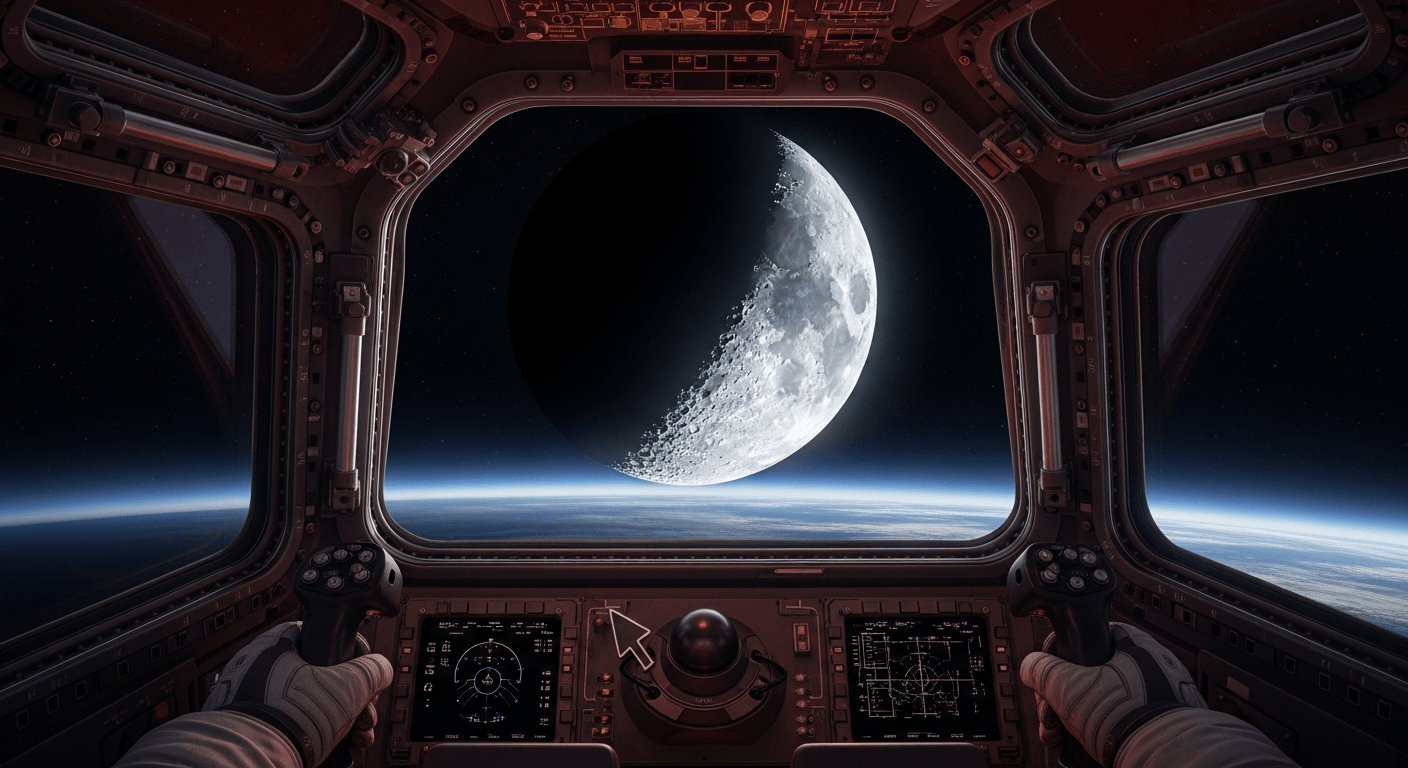
One-sentence summary: NASA released video showing Artemis II astronauts take manual control of Orion during proximity operations, a live demonstration of human backup skills as the spacecraft begins its journey toward the Moon.
Suggested social captions:
- "Watch humans take the stick: Artemis II astronauts manually pilot Orion as it heads to the Moon. #Artemis #Orion #MoonMission"
- "Manual mode engaged: Orion’s crew proves hands-on control matters — a key step for future lunar docking."
- "Historic handover: Automation leads, humans are ready. Orion’s manual piloting test is underway."
- "From autopilot to joystick — Artemis II shows why crewed control still matters in deep space."
Artemis II: Crew Takes the Controls
I watched the short NASA video with the kind of attention you give to a live experiment you know matters for decades. The clip shows Orion separated from the upper stage and the Artemis II crew conducting what NASA calls proximity operations — and, crucially, manually piloting the spacecraft in ways that mirror the motions needed for docking. That simple fact matters more than it looks: it demonstrates the crew’s ability to take the controls when automation can’t or shouldn’t.
Background: what Artemis II is testing
Artemis II is NASA’s first crewed flight in the Artemis series, a roughly 10-day mission that will take a four-person crew beyond low Earth orbit, around the Moon, and back. The trip is a systems shakedown in the real environment of deep space: the Space Launch System (SLS) heavy-lift rocket, the Orion crew capsule and its European-built service module will be tested with humans aboard to validate life support, guidance, communications and reentry systems. The mission also rehearses maneuvers future missions will use to rendezvous with lunar landers or the planned Gateway outpost. Live mission coverage and onboard views are being streamed as the flight unfolds NASA Live Views.
What the NASA video showed — and why it’s significant
The video captures Orion after separation from the interim cryogenic propulsion stage (the upper stage). During the subsequent proximity operations test the crew shifted Orion from automated control into manual modes and used hand controllers to perform station-keeping and translation maneuvers relative to the upper stage.
Why this matters:
- It proves the crew can physically control attitude (where the capsule points) and translation (small position moves) in deep space — essential for docking with a lander or another vehicle.
- It validates the human-in-the-loop backup to the automated flight software. Automation is primary, but the crew must be able to step in when margins are tight or unexpected failures occur.
- It builds crew confidence and refines procedures that will be used on later Artemis missions when a lunar lander or Gateway docking is required.
One of the astronauts leading the piloting tests, Reid Wiseman (reid.wiseman@nasa.gov), described the moment as a deliberate rehearsal: he paraphrased that the tests were about ‘‘assessing handling qualities and the crew’s ability to command precise relative motion — the kinds of skills we’ll need for future rendezvous and docking.’’
How Orion’s control systems and crew interfaces work (high level)
Orion is designed to fly itself using onboard guidance, navigation and control software, but the human crew has several layers of interaction:
- Flight software and guidance stack: software computes desired trajectories and translates them into thruster firings.
- Navigation: star trackers onboard and tracking from Earth (Deep Space Network and ground radar) tell Orion where it is; inertial sensors fill gaps.
- Crew interfaces: dual hand controllers (rotational and translational) let astronauts nudge attitude and position; a cursor control device (CCD) and touchscreen/displays let the crew interact with software menus and diagnostics.
- Redundant manual backups: physical switches and panels (switch interface panels) provide low-level control if higher-level interfaces fail.
- Service module propulsion: the European-built service module provides the main translational delta-v for large burns; reaction control thrusters handle fine pointing and translation during proximity operations.
In plain terms: software flies the long highway, humans steer when they need to thread the needle.
Mission timeline and next steps
In the hours and days ahead the mission will follow the planned sequence: apogee-raising and checkout burns in high Earth orbit, the trans-lunar injection burn that sends Orion toward the Moon, a multi-day outbound transit, a far-side pass and a free-return trajectory that brings the spacecraft back to Earth for Pacific splashdown roughly ten days after launch. Along the way the crew will continue system checks, science observations and communications tests. The manual piloting demonstrations are an early and visible milestone in that sequence.
Program context: why crewed lunar flights matter
Artemis is not just nostalgia for Apollo. These crewed missions are stepping stones to sustainable operations: testing hardware, command-and-control concepts, and international partnerships that will support surface science and, ultimately, a longer-term lunar presence. Proving humans can take manual control of Orion in deep space keeps exploration resilient — it’s the difference between depending solely on software and having a human capacity to adapt when things deviate from script.
Public reaction and what to watch next
Reaction online has mixed wonder and practical questions: people celebrate the return of humans to lunar space while others ask how this mission advances science, safety and long-term presence. The next things to watch are the trans-lunar injection burn, any additional proximity tests, and the crew’s reporting on Orion’s handling qualities as they continue toward the Moon. If those manuals-and-joysticks scenes repeat successfully, it will be a quiet but important victory for crewed exploration.
I’ve followed Artemis closely because it frames how we blend automation and human judgment at the edges of what’s possible. Seeing the crew take the stick — even briefly — felt like a reminder that in exploration we build machines to extend us, and then we teach ourselves to use those machines when the moment requires.
Regards,
Hemen Parekh
Any questions / doubts / clarifications regarding this blog? Just ask (by typing or talking) my Virtual Avatar on the website embedded below. Then "Share" that to your friend on WhatsApp.
Get correct answer to any question asked by Shri Amitabh Bachchan on Kaun Banega Crorepati, faster than any contestant
Hello Candidates :
- For UPSC – IAS – IPS – IFS etc., exams, you must prepare to answer, essay type questions which test your General Knowledge / Sensitivity of current events
- If you have read this blog carefully , you should be able to answer the following question:
- Need help ? No problem . Following are two AI AGENTS where we have PRE-LOADED this question in their respective Question Boxes . All that you have to do is just click SUBMIT
- www.HemenParekh.ai { a SLM , powered by my own Digital Content of more than 50,000 + documents, written by me over past 60 years of my professional career }
- www.IndiaAGI.ai { a consortium of 3 LLMs which debate and deliver a CONSENSUS answer – and each gives its own answer as well ! }
- It is up to you to decide which answer is more comprehensive / nuanced ( For sheer amazement, click both SUBMIT buttons quickly, one after another ) Then share any answer with yourself / your friends ( using WhatsApp / Email ). Nothing stops you from submitting ( just copy / paste from your resource ), all those questions from last year’s UPSC exam paper as well !
- May be there are other online resources which too provide you answers to UPSC “ General Knowledge “ questions but only I provide you in 26 languages !




No comments:
Post a Comment